Knowledge is Power

Sitewide Search

Search Bare Metal Cyber

Search exact control and technique identifiers, Cyber Wiki articles, framework records, playbooks, books, podcasts, Academy courses, individual lessons, and BMC Cyber Challenge activities.

CompTIA · Free, ad-free audio course

CompTIA Linux+

A structured, audio-first learning route for CompTIA Linux+, designed for focused review and practical understanding.

Every Bare Metal Cyber audio course is free and 100% ad-free.

PUT IT INTO PRACTICE

Practice CompTIA Linux+ concepts

Try 50 original BMC questions, review every explanation, and return to the lessons behind the answer. No login is required. Earn Challenge achievements and share your progress as you go.

50 original questionsExplanation after every answerAchievements and sharing

Independent BMC learning practice—not official exam items, a full mock exam, or an exam-readiness score.

Certification practice in the BMC Cyber Challenge

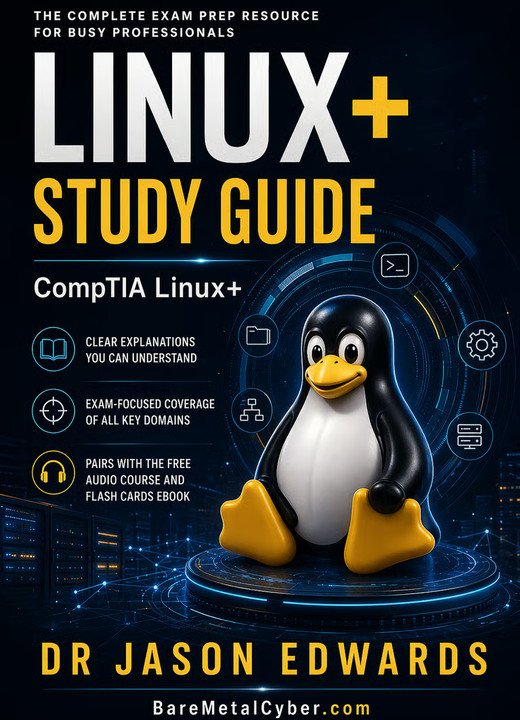
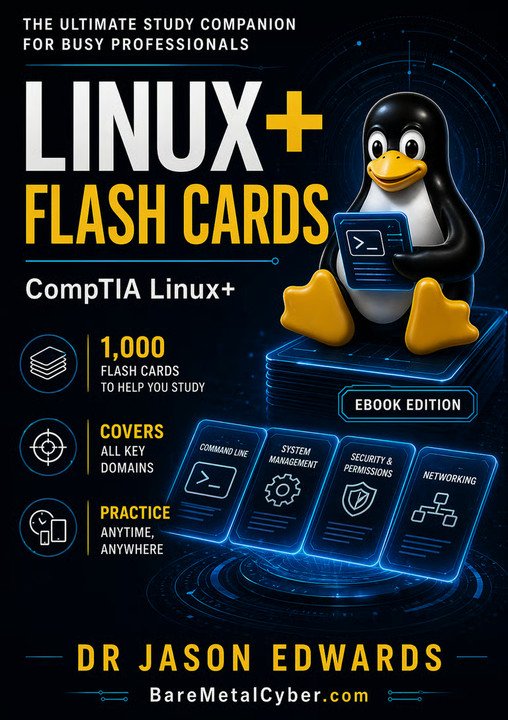
Companion Books

Study with the audio course, then reinforce it in print.

The study guide helps you organize and revisit the material. The flashcards book adds active recall and rapid review across the course objectives.

Complete Lesson Directory

Choose the exact subject you want to study.

Search by topic or narrow the directory by exam domain. Courses with multiple editions are organized below so every season remains easy to find. Each lesson includes its own audio player, full description, transcript when available, and previous-or-next navigation.

105 lessons available

S01E04Transcript

Domain 1 · System Management

Boot configs and kernel parameters: what they change and why it breaks

Kernel parameters and boot configuration are exam-relevant because they sit at the boundary between “system won’t start” and “system starts but behaves wrong.” This episode explains what boot configs control: which kernel boots, which initramfs is paired with it, which root filesystem is expected, and which runtime flags alter kernel behavior at the earliest moments.…

Transcript availableFebruary 7, 2026
→
S01E06Transcript

Domain 1 · System Management

FHS tour: why where things live matters on exam questions

The Filesystem Hierarchy Standard (FHS) shows up on Linux+ because “where” is often the clue to “what,” especially when questions compress a scenario into a few paths and log snippets.…

Transcript availableFebruary 7, 2026
→
S01E07Transcript

Domain 1 · System Management

Distros and packages: RPM-based vs dpkg-based thinking

Linux+ tests distribution awareness because real environments are mixed, and exam questions may describe commands, file locations, or package behaviors without naming the distro explicitly.…

Transcript availableFebruary 7, 2026
→
S01E15Transcript

Domain 1 · System Management

LVM part 1: PV, VG, LV concepts and why LVM exists

Logical Volume Manager (LVM) is a recurring Linux+ topic because it represents modern storage management: flexible allocation, online growth, and abstraction that makes systems easier to evolve safely.…

Transcript availableFebruary 7, 2026
→
S01E28Transcript

Domain 1 · System Management

Text processing decision drill: grep, awk, sed, sort, uniq, cut, xargs in context

Linux+ expects you to choose the right text tool quickly, because administration is often “read a file, extract signals, transform output, feed a command.” This episode frames common text utilities by intent: grep finds patterns, cut extracts fields, sort orders data, uniq summarizes duplicates, awk interprets structured text, sed applies stream edits, and xargs turns output into arguments for another command.…

Transcript availableFebruary 7, 2026
→
S01E39Transcript

Domain 1 · System Management

Reading process reality: ps/top/htop/proc and what to look for first

Processes are central to Linux+ because nearly every troubleshooting scenario eventually becomes “what is running, under what identity, consuming what resources, and why.” This episode teaches you to read process reality using multiple viewpoints: ps for snapshot listings, top/htop for live behavior, and /proc as the authoritative source of per-process details like command line, open files, and runtime stats.…

Transcript availableFebruary 7, 2026
→
S01E48Transcript

Domain 1 · System Management

Container fundamentals: runtimes and the image/container boundary

Containers are on Linux+ because they represent a mainstream way to package and run workloads, and they require you to think clearly about what is immutable versus what changes at runtime.…

Transcript availableFebruary 7, 2026
→
S01E53Transcript

Domain 2 · Security

Linux auth story: PAM, polkit, and what controls what

Linux+ includes authentication and authorization because access control in Linux is a layered system, and questions often test whether you can identify which layer is responsible for a decision.…

Transcript availableFebruary 7, 2026
→
S01E55

Domain 2 · Security

Directory-backed auth: LDAP vs Kerberos vs Samba, in exam language

Linux+ tests directory-backed authentication because understanding the roles of LDAP, Kerberos, and Samba prevents you from confusing “where identities are stored” with “how authentication happens.” This episode explains LDAP as a directory protocol used to query and store identity attributes, Kerberos as a ticket-based authentication system that proves identity without repeatedly sending passwords, and Samba as the suite that enables SMB-based file and identity integration, often bridging Linux systems into Windows-centric environments.…

February 7, 2026
→
S01E71Transcript

Domain 3 · Scripting, Containers and Automation

IaC overview: what problems it solves and how exams describe it

Linux+ includes Infrastructure as Code (IaC) because modern operations depends on repeatability, traceability, and the ability to rebuild systems reliably under change pressure.…

Transcript availableFebruary 7, 2026
→
S01E75Transcript

Domain 3 · Scripting, Containers and Automation

CI/CD and GitOps: pipelines, shift-left testing, DevSecOps vocabulary

Linux+ tests CI/CD and GitOps vocabulary because modern Linux administration often happens through pipelines, not through manual terminal changes, and the exam expects you to understand the operational implications.…

Transcript availableFebruary 7, 2026
→
S01E79Transcript

Domain 3 · Scripting, Containers and Automation

Conditionals: if, case, string vs numeric comparisons, common test flags

Linux+ tests conditionals because automation depends on making correct decisions with correct comparisons, and the exam often uses subtle differences to see if you understand what is being evaluated.…

Transcript availableFebruary 7, 2026
→
S01E80Transcript

Domain 3 · Scripting, Containers and Automation

Loops: for, while, until with real admin-style use cases

Loops are a Linux+ staple because they represent scalable administration: you apply a consistent operation to many files, users, hosts, or checks without manual repetition.…

Transcript availableFebruary 7, 2026
→
S01E85Transcript

Domain 3 · Scripting, Containers and Automation

Branching and merging: merge vs rebase, squash, conflict mindset

Branching and merging are tested on Linux+ because teams depend on controlled integration, and administrators must understand how history is shaped and how conflicts are resolved safely.…

Transcript availableFebruary 7, 2026
→
S01E86Transcript

Domain 3 · Scripting, Containers and Automation

Recovery skills: reset vs stash, tags, safe undo thinking

Linux+ includes Git recovery skills because real operations involves mistakes, urgent reversals, and the need to return to a known-good state without making the situation worse.…

Transcript availableFebruary 7, 2026
→
S01E88Transcript

Domain 3 · Scripting, Containers and Automation

Monitoring language: SLA vs SLI vs SLO and what healthy means

Linux+ includes monitoring concepts because administrators must describe and measure health in a way that supports decisions, not just collects metrics.…

Transcript availableFebruary 7, 2026
→
S01E89Transcript

Domain 3 · Scripting, Containers and Automation

Data collection concepts: SNMP, traps, MIBs, agent vs agentless

Linux+ includes monitoring data collection because the value of monitoring depends on how metrics and events are gathered and how reliable that gathering is.…

Transcript availableFebruary 7, 2026
→
S01E95Transcript

Domain 4 · Troubleshooting

Package and dependency breakage: what fails, what to check first

Linux+ includes package and dependency breakage because software management is a common source of outages, and administrators must troubleshoot quickly without turning a partial break into a full one.…

Transcript availableFebruary 7, 2026
→
S01E97Transcript

Domain 4 · Troubleshooting

DNS vs routing vs firewall: fast isolation with minimal commands

Linux+ often tests network failures by making multiple causes plausible, then rewarding the candidate who isolates the layer quickly. This episode teaches fast isolation between DNS, routing, and firewall causes using minimal commands and a strict workflow.…

Transcript availableFebruary 7, 2026
→
S01E105Transcript

Domain 4 · Troubleshooting

Memory pressure: swapping, OOM, killed processes, memory leaks

Linux+ includes memory pressure because it produces symptoms that mimic application bugs, random crashes, and performance degradation, and administrators must recognize the pattern quickly.…

Transcript availableFebruary 7, 2026
→

A Practical Study Routine

Listen, read, and review in the order that works for you.

01

Listen

Use the free audio course during a commute, walk, workout, or focused study session.

02

Read

Use the study guide to organize the material, annotate key ideas, and build a reference you can return to.

03

Review

Use the flashcards book to practice active recall and quickly revisit weak areas.