The listing is only a few lines long: region, industry, annual revenue band, “VPN + domain admin,” and a starting price that would not cover a single day of your red team. No company name, no splashy threat actor branding – just a quiet promise on an underground forum that someone, somewhere, can walk straight into a live corporate environment tonight. For the buyer, it is inventory. For you, it is your production network, your customer data, and your business continuity, reduced to an auction lot number.
This is the world of initial access brokers, the intermediaries who specialize in turning footholds into tradable assets. They do not run full campaigns or build custom malware. Their job is to collect working access, clean it up just enough to be reliable, and sell it on to whatever ransomware crew, data theft outfit, or state-aligned operator is willing to pay. In effect, they have created a market where your identity sprawl, segmentation gaps, and brittle remote access setups translate directly into a price per compromised company.
In this Wednesday “Headline” feature in Bare Metal Cyber Magazine, we treat that market as a lens on modern enterprise design. The question is not only “how do we keep them out,” but also “what about our architecture makes it so easy for others to package and resell us?” Over the next few years, leadership decisions about identity lifecycles, segmentation, third-party access, and detection will determine whether your environment is a high-value, low-risk product on those shelves – or something attackers reluctantly pass over.
For security and technology leaders, the goal is to flip the economics. You will not eliminate compromise, and you will not abolish the auction houses. But you can design networks and access patterns that depreciate fast, are hard to standardize, and make every purchased foothold more likely to burn its buyer than to pay out. That design mindset is where the rest of this article lives.
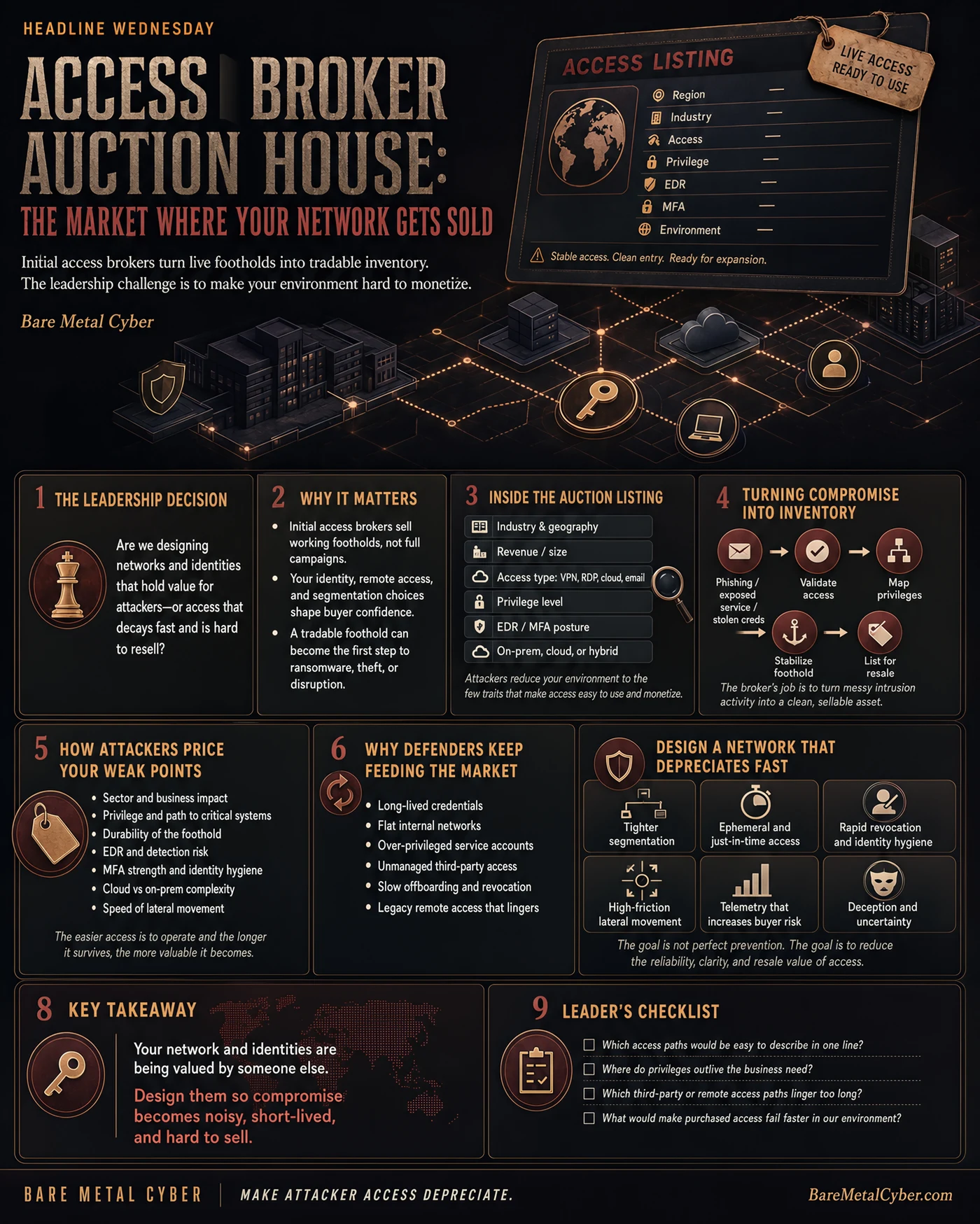
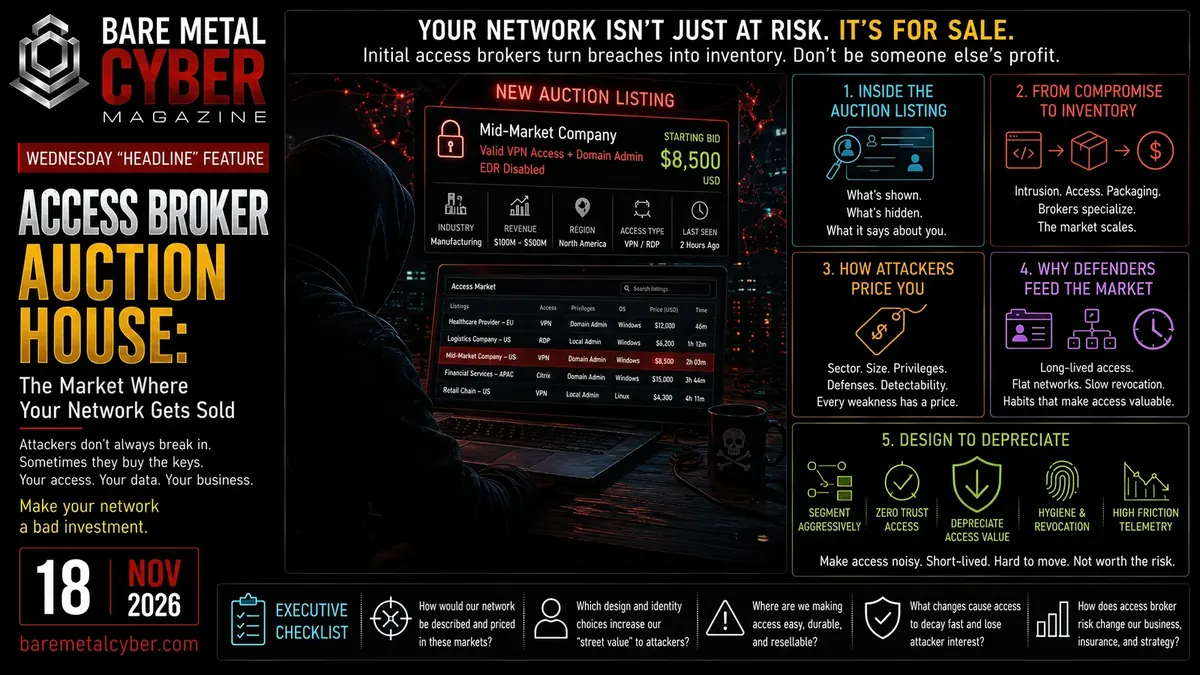
Inside the Auction Listing
If you have never read one, an initial access broker (IAB) listing is surprisingly boring. It looks like a real estate ad written by an engineer: “US manufacturing, 5–10k hosts, AD, EDR present, RDP + VPN, DA available, backups online.” A few lines of meta-data, a price range, maybe a note about cyber insurance or whether the company is public. Every detail is there to reassure a professional buyer that they are not wasting their time bidding on something that will fall apart at the first login attempt.
The structure of these listings exposes how your environment is seen from the outside. Industry and geography hint at regulatory pressure and ransom appetite. Revenue and headcount are proxies for how much disruption will cost you. Access type – domain admin versus a single cloud tenant, remote desktop versus virtual private network, on-premises versus software as a service – tells you what kind of playbook the buyer can run without doing much more work. Even small details, like “endpoint detection and response (EDR) bypassed” or “multi-factor authentication (MFA) disabled on admin accounts,” show up as selling points that raise the perceived reliability of the asset.
What is conspicuously missing is any nuance about your security program. There is no column for your zero trust ambitions, your risk register, or the heroic work your team did last quarter. The only question is whether the buyer can log in, move laterally, and monetize that position within their preferred dwell time. That harsh simplification is useful for leaders. It strips away internal narratives and reduces your design and governance choices to the handful of attributes that actually matter in the underground.
Leaders can use this lens deliberately. If an auction house were preparing a listing for your company today, what would it say? What access types are easiest to describe in one line? Which of your business decisions – mergers, third-party integrations, remote work enablement – have quietly created neat, tradable footholds? Seeing your environment as productized inventory is the first step toward making it a bad product.
Turning Compromise into Inventory
Initial access brokers do not wake up with a clean catalog of companies to sell. They start with noise: phishing hits that land on random endpoints, exposed remote desktop services with weak passwords, web apps with one-liner exploits, unpatched VPN appliances, and misconfigured cloud identities. Most of this is low-grade compromise material that would never justify a full campaign on its own. The broker’s value lies in filtering, stabilizing, and packaging those messy footholds into something a buyer can trust and operationalize quickly.
The supply chain usually begins with commodity intruders or automated tooling. Scripts crawl the internet for known-vulnerable services, password-spraying against remote access portals and scanning for forgotten web apps. Phishing kits harvest credentials at scale. When something lands, the initial operator proves they can authenticate, maybe drops a basic implant or uses off-the-shelf remote management utilities, and then passes the opportunity up the chain. The broker steps in to validate: confirming that access is persistent, privileges are understood, and defensive tools are mapped well enough that a buyer knows what they are walking into.
This is where your internal design choices start to matter. A flat network turns a single compromised host into easy lateral movement. Long-lived local admin accounts make persistence trivial. Shared service accounts and broad groups in directory services create simple paths to sensitive systems without much creativity. In contrast, tightly scoped roles, noisy authentication logs, and aggressive conditional access policies all increase the effort required to turn a beachhead into a sellable asset. The broker’s question is always the same: can this be turned into a repeatable, low-touch product?
For leaders, the important shift is recognizing that access is not just “stolen” once. It is curated. It moves from opportunistic compromise to inventory on a shelf. Every place where your architecture normalizes broad privileges, weak segmentation, or opaque third-party access is a place where that curation becomes easier. The more standardized and predictable your access patterns are, the simpler it is for someone else to document them in a listing and move on to price negotiation.
How Attackers Price Your Weak Points
For access brokers and their buyers, your network is not mystical, it is an asset class. They think in simple economic terms: how much effort did it take to obtain and stabilize the foothold, what is the likely payoff window, and how much risk comes with using it. Industry and revenue are baseline multipliers. A mid-sized healthcare provider, a regional insurance company, or a cloud-native software vendor each carries different assumptions about ransom appetite, data resale value, and regulatory pressure. The more likely you are to pay quickly and quietly, the higher the price per foothold.
From there, pricing becomes a reflection of your technical and governance choices. The type of access matters enormously. Domain administrator in a traditional directory service, console access to a major cloud provider, or full remote desktop into a jump host will all fetch more than a single low-privilege endpoint. The presence and configuration of endpoint detection and response (EDR) tools changes the risk profile; “EDR present, tuned but bypassed” can be a selling point rather than a deterrent. Multi-factor authentication (MFA) on high-value accounts might lower the price of a given credential set, while a working, MFA-less path into a privileged environment can command a premium.
Buyers also look at durability. Long-lived accounts with broad rights, static VPN configurations, legacy remote access solutions, and slow identity governance all signal access that will survive routine hygiene. If your offboarding is sluggish, your contractors have evergreen privileges, or your merger and acquisition systems stay in “temporary” trust relationships for years, a single credential or implant becomes a semi-permanent key to the estate. A short-lifespan token with clear rotation and good logging is worth less than a forgotten service account that has been quietly overprivileged for a decade.
Finally, attackers factor in their own operational risk. If your environment is instrumented with strong network segmentation, noisy lateral movement detection, and meaningful behavioral analytics, the odds of early discovery go up. That does not guarantee safety, but it does change the economics. Buyers will either discount or avoid access that looks likely to burn them, preferring clean, flat networks where moving from the first login to impactful action feels almost routine. In other words, the more your environment forces attackers into bespoke work, the less attractive it becomes as shelf-ready inventory.
Why Defenders Keep Feeding the Market
If the access broker market is thriving, it is not just because attackers are clever. It is because defenders keep supplying durable, attractive inventory without meaning to. Most of the patterns that make your environment easy to monetize are not dramatic failures, they are compromises made for speed, convenience, or short-term business commitments. Long-lived admin accounts exist because projects needed to go live quickly. Flat or loosely segmented networks persist because “we will clean this up after the migration.” Third-party access stays broad and permanent because no one wants to disrupt a vendor during a critical quarter. These are rational decisions in isolation, but collectively they create exactly the footholds brokers want.
Identity hygiene is a prime culprit. Dormant accounts that never quite get removed, shared admin credentials that outlive the team who created them, and service accounts whose purpose no one remembers all translate into durable, low-risk access. When identity governance is treated as a back-office chore instead of a strategic control, you get an environment where attackers can assume that a credential working today will still work months from now. That reliability is pure value in a market that prizes repeatable access. The irony is that many “mature” organizations proudly report on password policies and MFA rollout while quietly carrying a decade’s worth of toxic identity debt.
Organizational structure amplifies the problem. Ownership for remote access, vendor connectivity, and internal segmentation often spans multiple teams – infrastructure, cloud, security operations, individual business units. When everyone owns a slice, no one owns the end-to-end risk. Change processes focus on uptime, not the longevity of access created along the way. Security architecture reviews frequently center on initial deployment, with little attention paid to how privileges and connections will decay or be retired. That means initial access brokers can count on your environment aging badly: every new project, merger, or integration adds more potential listings, while very few are truly closed out.
For leaders, the uncomfortable truth is that the market is being fed more by governance drift than by zero-day exploits. As long as your operating model rewards teams for delivery speed and continuity but does not hold them accountable for the half-life of the access they create, you will keep subsidizing the auction house. Shifting that dynamic requires making identity, segmentation, and third-party access lifespan visible in the same way uptime and feature delivery are – as core success metrics, not afterthoughts.
Designing a Network That Depreciates Fast
If access brokers profit from durable, low-friction footholds, your job is to make footholds short-lived, noisy, and hard to reuse. That starts with designing identity and access around ephemerality instead of permanence. Privileged roles should be granted just in time and revoked automatically when the task ends, not left hanging around as standing entitlements. Remote access paths should lean on strong, policy-driven controls such as Zero Trust Network Access (ZTNA) instead of static virtual private network tunnels that quietly persist for years. The aim is simple: any specific credential, token, or session should have a short half-life and a limited blast radius.
Segmentation and lateral movement design are the next levers. Instead of thinking only in terms of “internal versus external,” leaders can push for meaningful separation between critical business services, identity infrastructure, and commodity workloads. Micro-segmentation, stricter east–west controls, and clear breakpoints between environments make it harder for a buyer to turn one purchased foothold into an enterprise-wide incident. At the same time, telemetry should be treated as part of the deterrent package. Authentication logs, session recordings for high-risk actions, and lateral movement detection do not just help incident response; they raise the operating risk for anyone who buys access, because every step they take leaves a visible trail.
Finally, you can deliberately inject uncertainty into the market. Deception technologies, high-fidelity honeypots, and carefully placed fake credentials change the calculus for buyers who can no longer be sure that an advertised path is genuine. Rapid revocation of suspected compromised accounts, aggressive revalidation of third-party access, and clear runbooks for shrinking or severing exposed connections all contribute to rapid depreciation. Over the next few years, the organizations that win against access brokers will not be the ones that never get listed; they will be the ones whose listings quietly fail to sell because attackers have learned that their footholds rarely stay valid long enough to matter.
At its heart, this topic is about value – specifically, the value others can extract from your environment and how easily they can treat your access as inventory. Initial access brokers have industrialized what used to be one-off intrusions, turning your identity sprawl, segmentation gaps, and governance drift into predictable products on underground shelves. The auction listing is just the final, brutal summary: a few lines that tell buyers everything they need to know about how exploitable your design and operating habits really are.
Closing the loop with that listing means changing the economics, not chasing every forum. When leaders design for ephemerality, enforce meaningful segmentation, and take identity governance as seriously as uptime, they shrink both the durability and the clarity of the footholds attackers can buy. A company that treats privileged access as temporary, third-party connections as narrow and revocable, and lateral movement as inherently suspicious will still experience compromise, but its access will be far harder to standardize and resell. Over time, that pushes your organization out of the “easy, reliable stock” category and into the pile that brokers quietly avoid.
The practical shift is in how you frame conversations. Instead of only asking “how do we stop ransomware,” you ask “how would our environment appear on a broker’s listing, and what would make that listing unattractive or unreliable?” That question changes architecture reviews, merger integrations, and remote access decisions in a way that outlives any specific threat campaign. As you come out of this article, consider bringing two prompts to your team: If an attacker wrote a sales ad for our network tomorrow, what would it say today? And over the next year, which two or three design and governance changes would most rapidly drive down our auction price?