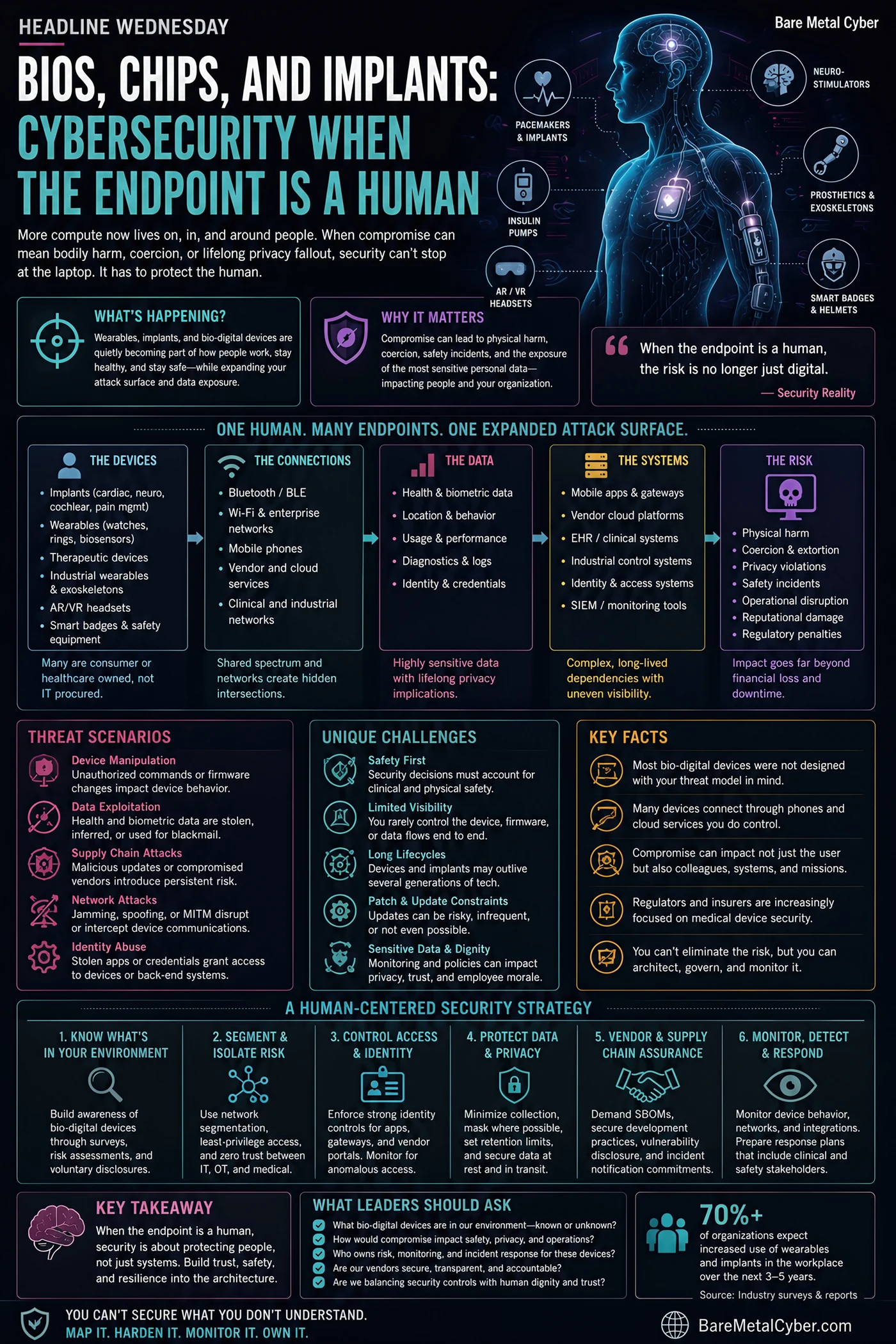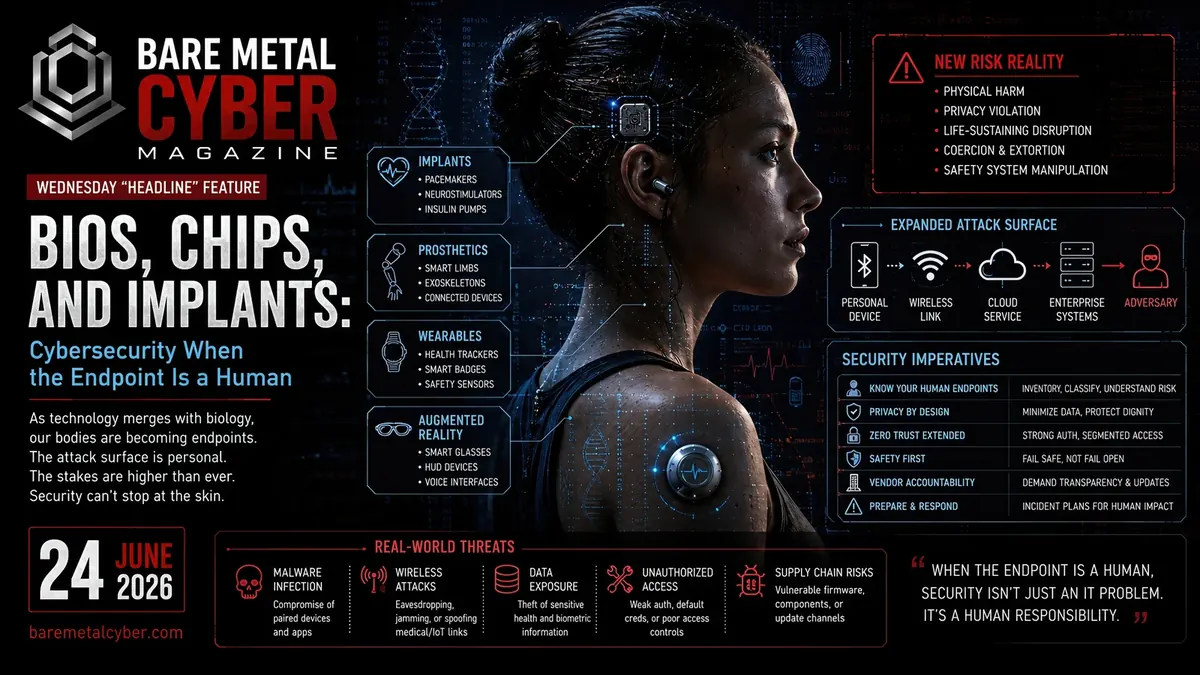
The first time it comes up, it is usually not in a security steering committee. It is a plant engineer whose exoskeleton needs a firmware update, an executive with a cardiac implant asking about airport scanners, or a line manager wondering whether smart safety helmets are allowed on the factory floor Wi-Fi. In that moment, your carefully drawn diagrams of laptops, phones, and cloud workloads collide with a harder question: what happens when the “endpoint” is literally part of someone’s body? This Wednesday “Headline” feature in Bare Metal Cyber Magazine lives in that uncomfortable intersection.
Over the next few years, more of the compute that matters to your organization will sit on skin, under it, or one Bluetooth hop away. Pacemakers, insulin pumps, neurostimulators, prosthetics, augmented reality headsets, smart badges, and industrial wearables already show up quietly in your buildings. They ride your networks, influence high-stakes decisions, and generate data about the most intimate aspects of your workforce. You cannot wish them away, and you probably do not fully control them. That combination makes them both a safety dependency and a blind spot in your current security model.
For leaders, this is not a curiosity on the edge of the roadmap; it is a new class of risk decisions. When compromise can mean bodily harm, coercion, or lifelong privacy fallout, policies written for laptops and mobile phones are no longer enough. You have to decide how far your architecture extends into people’s lives, how much monitoring is acceptable when health and employment are intertwined, and how to challenge vendors whose devices may outlive several generations of your tech stack. This article is about giving you a language and a structure to handle those decisions deliberately instead of improvising the first time someone’s implant shows up in your incident bridge.
When “Endpoints” Live on Skin and Under It
If you walk through a modern organization with your “endpoint” filter turned on, the picture looks very different from five years ago. The obvious devices are still there: laptops, mobiles, tablets, thin clients. But underneath the surface you see insulin pumps talking to phones, pacemakers with wireless telemetry, neurostimulators controlled via paired tablets, smart watches recording cardiac rhythms, and factory staff in exoskeletons whose actuators depend on cloud analytics. Add in augmented reality headsets on field technicians, smart badges and wearables for safety monitoring, and early brain–computer interface pilots in research labs, and the line between personal health tech and corporate endpoint blurs fast. Most of these devices were never procured by IT, yet they influence critical work and live one hop away from your infrastructure.
The control boundaries are equally messy. Some devices fall squarely under healthcare providers or insurance programs; others are consumer-grade wearables purchased by individuals; a smaller subset are enterprise-issued safety or productivity tools. In practice, they all show up in the same physical spaces and often traverse the same wireless spectrum. A plant worker’s medically necessary implant may use the same frequency bands as your industrial IoT sensors. A contractor’s smart glasses may rely on your corporate Wi-Fi. A senior leader’s cardiac device may sync through their work phone, which is under your mobile device management. On any given day, security teams are already making implicit policy decisions about these arrangements without a coherent model.
For security and technology leaders, the first step is to acknowledge that “bio-digital endpoints” are present today, regardless of whether they appear in asset inventories or policy documents. They are part of the dependency graph for safety, operations, and talent retention, even if they are out of formal scope. Treating them as a fringe exception is no longer realistic. The strategic question is not whether to allow them, but how to recognize the ways they intersect with your identity, network, and monitoring choices, and which of those intersections you are willing to own. The rest of the article builds on this more honest map of where your architecture already touches human bodies.
Threat Models When Compromise Equals Harm
Once you accept that some of your “endpoints” sit on or inside people, the threat model changes shape. The classic frame of “confidentiality, integrity, availability” still applies, but the consequences move from financial loss and downtime into bodily harm, coercion, and psychological impact. An attacker who manipulates sensor data from an exoskeleton or smart helmet is not just gaming a dashboard; they may influence how a worker moves in a hazardous environment. A compromise of a cardiac implant programmer, or of a paired phone app, raises the uncomfortable possibility that extortion could include threats to a person’s health. Even when devices themselves are not directly reachable, the data they stream can be weaponized to track individuals, infer medical conditions, or build pressure campaigns against key staff.
This shift also changes attacker incentives and timelines. In highly targeted scenarios, adversaries may be willing to invest more time to understand specific device ecosystems, operating environments, and human routines. A senior executive wearing a high-end medical device or experimental wearable is now a composite target: their email, calendar, collaboration tools, and bio-digital devices all contribute to leverage. In more opportunistic campaigns, attackers may not care about the medical nuance at all; they only need enough understanding to credibly threaten disruption of therapy, exposure of intimate health data, or interference with safety systems. Ransom notes start to sound different when the stakes are not just “pay or lose access” but “pay or this treatment stops working as expected.”
For leaders, the practical implication is that bio-digital endpoints pull safety, privacy, and cyber operations into the same conversation. Threat modeling exercises that ignore human bodies and medical dependencies are now incomplete. You need to ask not only “what systems could an attacker reach?” but “what human functions could they influence, and how might that change extortion power or regulatory exposure?” That perspective pushes you toward new mitigations: tighter identity flows around device management apps, more deliberate segmentation where health-related traffic crosses your networks, and crisis playbooks that account for both technical containment and human reassurance when something goes wrong.
Designing Bio-Digital Boundaries, Not Just Networks
If you keep thinking only in terms of networks, you will miss the real control points in the human endpoint era. The architecture you need is less about micromanaging every packet and more about drawing boundaries around where human safety, health, and autonomy intersect with your systems. That starts with recognizing that most implants and critical medical devices are not yours to manage. You cannot simply enroll a pacemaker into endpoint protection or push patches to a neurostimulator. What you can do is define and enforce the interfaces between those devices, their companion apps, your corporate identities, and your connectivity. In other words, you design the corridors, not the organs.
At a whiteboard level, this means carving out “bio-digital zones” in your architecture where traffic related to implants or medical wearables is treated with special guardrails. Companion apps on corporate phones may get extra scrutiny and constrained entitlements, even if the device itself is off-limits. Wireless networks used for safety wearables and exoskeletons might sit in dedicated segments with tightly controlled north–south paths, monitored for anomalies without deep inspection of personal health content. Identity flows for staff who depend on these devices can incorporate additional checks, such as ensuring the right person is using a shared programming console or that access to management portals is time-bounded and well logged. You are effectively applying principles like least privilege, but the privilege in question is the ability to influence a person’s body.
Leaders also need to decide what they will not do. There is a strong temptation to capture and analyze every signal these devices emit in the name of optimization and safety. That road leads quickly into surveillance creep and regulatory exposure. A more sustainable posture defines explicit no-go areas: data you will not store, controls you will not attempt to enforce on implants, and operational actions you will never take without medical oversight. Those decisions should be documented in policy, reflected in architecture, and rehearsed in incident simulations. The outcome is an organization that can say, with a straight face, where its responsibility stops and how it will behave when someone’s body is on the dependency graph.
Consent, Employment, and the BYO-Body Problem
The hardest questions in this space are not technical; they are about power and consent. Many workers arrive already dependent on connected medical devices: an insulin pump that keeps them stable, a cardiac implant that keeps their rhythm, a neurostimulator that manages chronic pain. Others are nudged toward wearables, smart badges, or exoskeletons that the organization frames as productivity or safety tools. On paper, participation is voluntary. In practice, when someone’s job or promotion prospects feel tied to “opting in,” the boundary between accommodation and coercion blurs. Security policies written for bring-your-own-device scenarios do not cleanly translate when the “device” is implanted under someone’s skin or worn due to a medical condition.
For security and technology leaders, this creates a different kind of risk register. You are not just worried about breaches and outages; you are also accountable for how your controls interact with employment law, disability accommodations, and privacy expectations. If you require continuous biometric telemetry for access to high-risk zones, you need to be clear what happens to staff who cannot or will not wear those devices. If you analyze health-adjacent data streams to infer fatigue or impairment, you must decide whether that data can feed performance management or discipline, and how those choices will look to regulators, unions, and courts. The same telemetry that enables proactive safety interventions can also become a tool for micromanagement or discrimination if left unchecked.
A credible strategy starts by spelling out the rules of engagement in language people can understand. That means plain statements about what bio-digital data you collect, for what purpose, who can see it, how long it is kept, and what rights employees have to say no without retaliation. It means giving workers with implants predictable paths to request accommodations and documenting that security controls will never be used to override medical advice. And it means involving HR, legal, and safety leadership early, so you are not writing policy in a vacuum. When people trust that their bodies and livelihoods are not bargaining chips in your risk management plan, they are far more likely to tell you about the devices they rely on and the edge cases you need to account for before the next incident.
Vendor Truths Behind Medical and Implant Tech
When you turn from internal policy to the vendor ecosystem, the ground gets even more uneven. Many implantable or life-sustaining devices operate on timelines that make standard IT asset cycles look frantic. A pacemaker or neurostimulator may remain in use for a decade or more, while the phones, operating systems, and networks around it churn every few years. Firmware can be difficult or risky to update. Regulatory approvals may lock in certain software versions or communication protocols for long periods. In some cases, the only realistic remediation for a major vulnerability is a full device replacement, which is neither trivial nor entirely within your control. These realities put hard boundaries around how much you can “fix” through conventional patch and configuration expectations.
Transparency is another challenge. Many medical device vendors rely on proprietary stacks, closed protocols, and tight control over diagnostics and management tools. Their vulnerability disclosure practices may not match what you expect from mainstream software suppliers, and their service models may place critical programming consoles or cloud-relay services in awkward positions in your architecture. Third-party assurance reports are often written with healthcare providers in mind, not industrial, financial, or tech enterprises that happen to employ people with implants or dependent on wearables. You may find that basic questions about encryption, access control, or incident response are answered at a level of abstraction that does not help you design defenses.
Leaders cannot wish these constraints away, but they can change the conversation. Procurement and vendor-risk teams can start asking targeted questions: not “are you secure?” but “how do you handle long-tail vulnerabilities on deployed devices?”, “what isolation assumptions do you make about companion apps?”, and “what is your process when a corporate network is part of the connectivity path?” Contract language can acknowledge the reality that devices will live across multiple employers and environments, and require clear roles in joint incident response. Over time, as more organizations treat bio-digital risk as part of their third-party risk management, vendors will feel sustained pressure to improve. In the meantime, your goal is to understand where their guarantees stop, so you can design your own guardrails around those gaps.
Leading into the Human Endpoint Era
Treating humans as part of the endpoint landscape is not a branding exercise; it is a shift in how you think about architecture, governance, and leadership. The organizations that will handle this well are not the ones that spin up a new committee and produce a glossy policy. They are the ones that quietly thread bio-digital thinking into things they already do: threat modeling, third-party risk reviews, safety programs, HR policies, and board reporting. Instead of treating implants and wearables as exotic one-offs, they ask, “Where does our existing practice assume that endpoints are replaceable objects, and what changes when they are not?” That question alone can reframe entire roadmaps.
In practical terms, this era calls for a few deliberate moves. Add specific scenarios involving medical devices, safety wearables, or executive biometrics into your tabletop exercises and incident playbooks, so leaders can feel the difference between a laptop ransomware event and a therapy-disruption threat. Make “bio-digital touchpoints” a standard lens in architecture reviews: when a new system ingests or influences data from body-adjacent devices, someone should be able to explain the safety and consent story as clearly as the encryption story. Build early partnerships with health and safety teams, disability coordinators, and unions or employee councils where they exist, so your security decisions land in a broader context of worker trust. You are not the only function that touches this risk, but you are one of the few that can see it end-to-end.
Finally, leaders need to bring this conversation into boardrooms and executive offsites in language that connects to strategy, not sci-fi. That means framing bio-digital endpoints as part of talent retention, duty-of-care, and operational resilience, not just as a future regulatory headache. It means acknowledging that some controls are ethically off-limits, even if technically feasible, and being explicit about where your organization draws those lines. Done well, this is not about dramatizing edge cases; it is about helping your company grow into a world where the line between infrastructure and bodies is thinner, and where trust depends on how you treat that line when no one is watching.
Where Leaders Draw the Line
At its heart, this topic is about recognizing that some of your “endpoints” are no longer replaceable objects; they are parts of people’s lives and bodies, and your security decisions now reach that far. Once you see bio-digital devices as part of your architecture, the conversation shifts from “how do we harden laptops?” to “how do we make risk decisions when compromise could mean harm, coercion, or intimate exposure?” That is a different kind of responsibility, and it will not be met with another policy template or a new dashboard. It calls for leaders who are willing to redraw boundaries around what they monitor, what they control, and what they refuse to touch.
This article began with small, practical moments: a worker’s exoskeleton, a manager’s safety wearables, an executive’s cardiac implant. Those edge cases are already here, quietly asking whether your existing security model is fit for a world where human bodies and networks share the same dependency graph. We moved through threat models where attackers seek leverage over people, architectures built around bio-digital zones and interfaces, the ethics of consent and employment in a bring-your-own-body reality, and the structural limits of today’s medical and implant vendors. We closed on the idea that leading into the human endpoint era means weaving these insights into how you plan, test, buy, and govern, not spinning up a separate “futurism” track.
For a security or technology leader, the real change comes when you start asking different questions in rooms that do not yet mention implants or exoskeletons. How would this design behave if a critical worker depended on a connected medical device? Where, exactly, do we promise not to use body-derived data, even if it might make operations more efficient? What would we say to staff and boards if a ransomware note named a person’s therapy schedule instead of a database server? Bring one of those questions to your next architecture review or incident rehearsal. The answers will tell you how ready your organization really is for cybersecurity when the endpoint is a human.