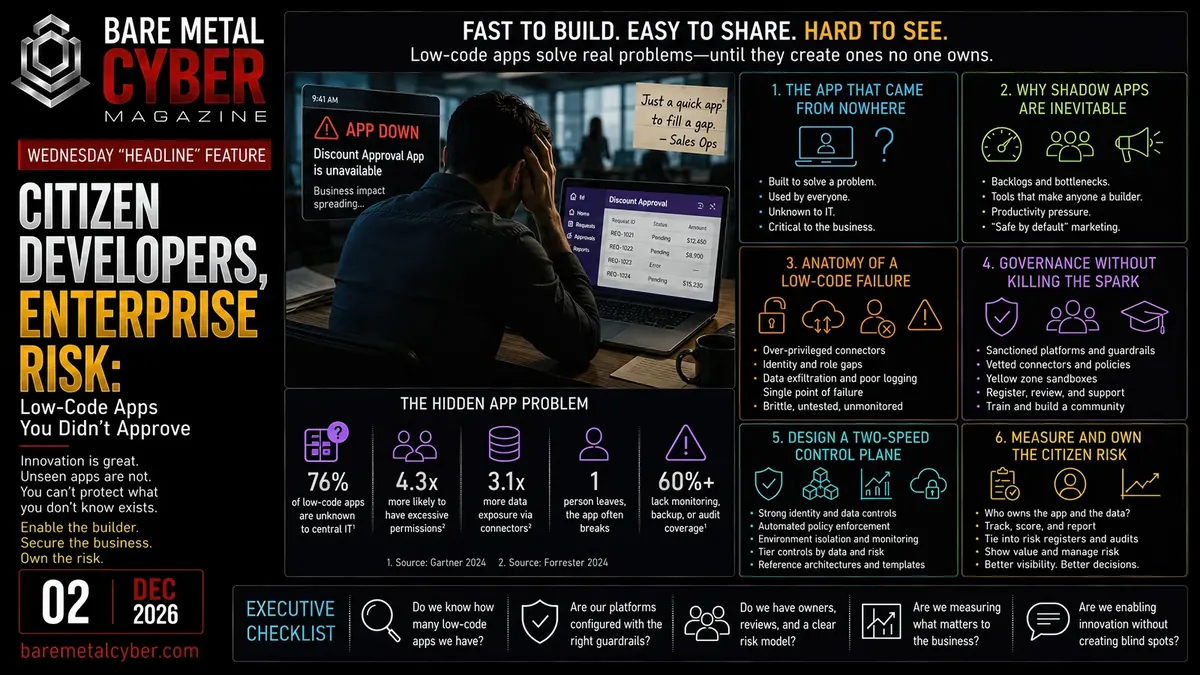
The outage starts with a shrug. A sales ops analyst clicks into the low-code app the team has been using “just for this quarter” to wrangle approvals and pricing exceptions, and it spins. Then it errors. Within an hour, regional leaders are asking why deals are stuck, finance is worried about forecast accuracy, and somewhere in security’s backlog there is exactly zero mention of this application that now holds thousands of customer records. No change ticket, no architecture review, no risk assessment. Just a business-critical workflow balanced on a tool one power user built on a quiet Friday afternoon.
This is the reality of citizen development in large enterprises today. Low-code and no-code platforms promise to unlock innovation at the edge of the business, and they do. They also create a parallel universe of “unapproved but indispensable” apps that sit outside traditional governance, monitoring, and recovery plans. Over the next few years, the risk profile here will be shaped less by any specific platform and more by how you, as a leader, choose to channel or ignore this energy. Treat these apps as shadow IT to be hunted and killed, and they will simply move further out of view. Treat them as a strategic capability without a control plane, and they will eventually hurt you.
This Wednesday “Headline” feature in Bare Metal Cyber Magazine looks at citizen developers through an enterprise risk lens. The goal is not to scare you away from low-code, but to give you a clearer mental model for where the real exposures live: identity, data, dependencies, and ownership. We will unpack why these “temporary” apps are inevitable, how they fail in recognizable patterns, and what a two-speed model of control and innovation can look like. The question is not whether low-code will show up in your environment. It already has. The question is whether you will own the risk story before an incident does it for you.
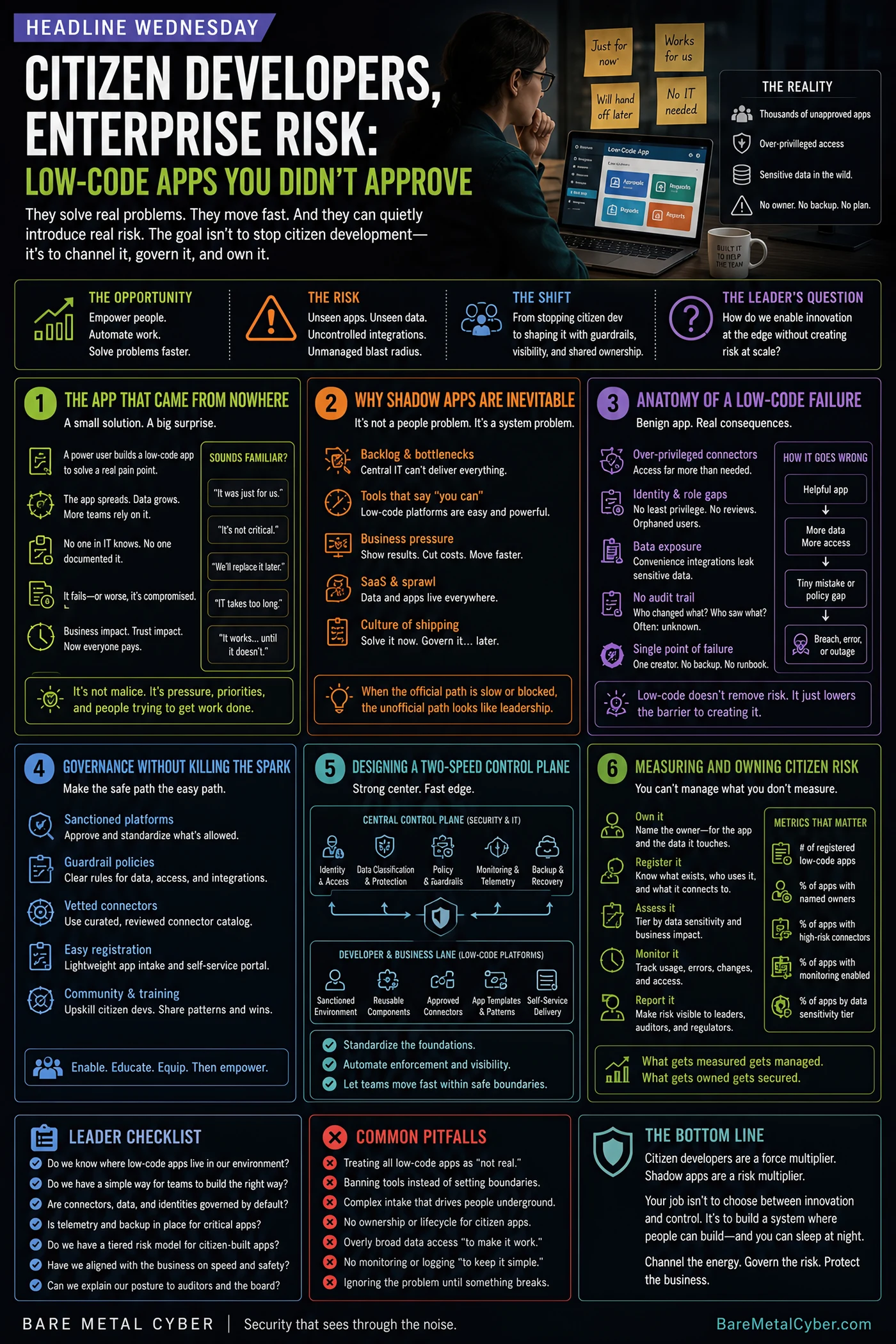
The App That Came From Nowhere
In most organizations, the story starts with a backlog and a promise. A business team has been waiting months for a small workflow change, a simple approval flow, or a more usable interface to a core system. The central product or IT team agrees it is reasonable, but it keeps losing to higher-profile initiatives. Then a power user discovers that with a low-code platform they can stitch together a form, a few connectors, and some basic logic over a weekend. They show it to their manager on Monday, it solves a real pain, and everyone quietly agrees to “try it for this quarter.” No one fills out a project intake form, and nobody thinks to ask security for an architecture review.
Fast-forward six months and that “temporary” app has become the way the organization does business in that slice of the world. New hires are onboarded into it. Regional leaders demand new features. A director in finance depends on its exported data for their weekly forecasts. The original creator is now the de facto product owner, admin, and support desk, all while doing their day job. There is still no asset record, no change history, and no clear mapping between the app’s permissions and the organization’s identity model. From the perspective of central IT and security, this app does not exist. From the perspective of the business, it is mission-critical.
Leaders usually first encounter these apps at their worst moment: during an outage, an audit, or a data discovery exercise after a near-miss. Someone asks who owns the application, who approved its access to sensitive data, or how it is backed up, and the room goes quiet. The point is not that citizen developers are reckless; on the contrary, they are often resourceful and deeply committed to solving real problems. The point is that you have allowed a parallel system of work to emerge without a matching system of control. Section by section, we will move from this familiar story to the structural reasons it keeps repeating and what it would take to bring these apps into a risk envelope without extinguishing their value.
Why Shadow Apps Are Inevitable
If you look at the incentives, shadow low-code apps are not a surprise; they are the default outcome. Most large enterprises run on a permanent tension between demand and capacity. Business teams are pushed to hit aggressive targets, streamline processes, and respond to shifting markets. Central IT, meanwhile, is juggling legacy platforms, compliance projects, and a queue of transformation initiatives that already spans quarters. When a low-code platform appears in that environment with a glossy promise of “build what you need yourself,” it is not a rogue act for a manager to say yes. It is rational behavior under pressure.
Vendors reinforce this pattern by framing low-code as inherently safe and governed. The marketing story is that every app lives inside a blessed platform, wrapped in enterprise identity, network, and data controls. In practice, the moment you allow broad self-service creation, you are encouraging thousands of micro-decisions about data sources, connectors, sharing, and automation to be made by people whose primary job is not risk management. They are optimizing for time-to-value, not for auditability, least privilege, or long-term maintainability. The platform may be secure by design, but the compositions built on top of it are only as thoughtful as the least rushed project.
Policies that try to ban or heavily restrict citizen development usually backfire. When the official stance is “no unsanctioned apps,” but the lived reality is “we cannot get your work into the roadmap this year,” people simply move to whatever tool they can reach: unsanctioned SaaS, spreadsheets, or low-code platforms tied to their corporate identity but invisible to governance. At that point, you no longer have a choice between citizen development and central delivery; you have a choice between shaped citizen development in view of your controls or unmanaged improvisation in the dark. Recognizing shadow apps as inevitable is not surrender. It is the first step toward designing an operating model that assumes their existence and builds a risk envelope around them instead of pretending they should not be there.
Anatomy of a Low-Code Failure
When a low-code app fails, the root cause is almost never a single bug; it is a stack of quiet decisions that accumulated over time. A power user chooses a connector that offers broad access “because it just works,” rather than a narrowly scoped alternative. A business owner grants sharing to “everyone in the department” to avoid access tickets. Someone wires an automation that copies data to a personal workspace “for backup.” None of these moves look catastrophic in the moment. Taken together, they create an app with more privilege than it needs, more reach than anyone intended, and more hidden dependencies than anyone remembers. When something breaks, there is no runbook, no test environment, and often no one with both the permissions and the context to fix it.
Consider a typical failure pattern. The app uses a generic service account or over-privileged connector to reach into a core SaaS platform because that was the only way to get the data flowing quickly. The citizen developer leaves the company or changes roles, and the account is disabled during an access review. Suddenly, workflows stall, and no one connects the outage to the “small” app that had quietly become the glue between systems. In a different scenario, an integration built for convenience ends up syncing sensitive data into a location that falls outside your monitoring and data loss prevention focus. An audit or incident response exercise later surfaces an unexpected cache of regulated records in a place nobody thought to check.
From a leadership perspective, these failures are not about bad people making reckless choices. They are about an architecture and operating model that pushes core risk decisions to the edge without giving people the tools to understand the blast radius. The common ingredients are over-privileged access, unclear identity mapping, informal ownership, no meaningful audit trail, and brittle error handling that surfaces as “it just stopped working.” If you only respond by blaming the last person who touched the app, you will miss the systemic lesson: your control plane did not extend to where the work was actually happening. The rest of this article argues that the answer is not to eliminate citizen development, but to redesign that control plane so these failure modes become less likely and less harmful.
Governance Without Killing the Spark
If your only response to low-code risk is to lock everything down, you will lose twice: the shadow apps will not disappear, and the people closest to the work will stop telling you what they are building. The governance challenge is to acknowledge that citizen developers are solving real problems, then design a system that makes the safe path the easiest path. That starts with a clear, positive stance: low-code and no-code are welcome in the organization, as long as they live on sanctioned platforms with guardrails and visibility. Instead of a blanket “no,” you articulate where and how this kind of building is encouraged.
Practical guardrails are more powerful than abstract policies. Sanctioned platforms with preconfigured environments give you a place to point people that is both safe and usable. Curated connector catalogs help citizen developers avoid the most dangerous patterns by limiting access to well-understood systems and data classifications. Templates and reference apps embody good design choices around identity, least privilege, logging, and error handling without requiring every business user to become a security architect. A lightweight registration flow that is integrated into the platform’s creation experience can capture basic metadata—owner, purpose, data sensitivity, expected lifespan—at the moment when people are excited to ship, not three months later.
Culture matters as much as controls. A formal citizen developer community of practice gives these builders a home, peers, and a line of sight into security and architecture teams. Training that focuses on “how to keep your app from hurting your colleagues or your customers” lands better than threat-heavy lectures. Office hours with a small enablement squad can turn potential violations into design improvements before they ship. The message is that security is part of the value proposition, not a distant gate. When you combine sanctioned platforms, sensible guardrails, and an affirmative culture, you shift the dynamic: it becomes easier for people to build in the open, and harder for dangerous patterns to survive unnoticed.
Designing a Two-Speed Control Plane
To make citizen development sustainable, you need a control plane that moves at two speeds without tearing itself apart. At one speed, central engineering and security teams define the durable foundations: identity, data classification, logging, monitoring, backup and restore, change management, and incident response. At the other speed, business teams iterate quickly on workflows, forms, and automations that sit close to the work. The mistake many organizations make is trying to run both speeds through the same process. Either everything is forced through heavyweight gates designed for core platforms, or everything is left to local improvisation. A two-speed model accepts that low-code apps will move faster, then deliberately builds shared rails they cannot fall off.
In practice, this looks like standard reference architectures and patterns for common low-code use cases. For example, apps that read from a customer data system but do not write back might have one pattern; apps that trigger financial transactions might have another, with tighter controls and review. Central teams expose these patterns through preconfigured environments and policies inside the low-code platform itself, not via separate PDFs and wikis that nobody reads. Automated enforcement—conditional access, data loss prevention policies, environment isolation, and baseline logging—is far more reliable than trying to rely on manual reviews at scale. When a business team creates a new app, the control plane quietly ensures it lands in the right box with the right default rules.
The two-speed model also clarifies escalation and evolution. Citizen-built apps that start small but show signs of becoming core can move into a higher tier with more formal lifecycle management, additional testing, and stronger recovery requirements. That transition should not be an ambush; it should be a planned pathway that recognizes success, not a punishment for popularity. Leaders set the thresholds: data sensitivity, transaction volume, regulatory impact, and dependency counts that trigger a change in status. By making those thresholds explicit and building them into your monitoring and portfolio reviews, you avoid the worst surprise: discovering, in the middle of an incident, that what you thought was a small workflow helper has quietly become one of the pillars of your business process.
Measuring and Owning Citizen Risk
You cannot manage what you only see anecdotally. For citizen-built low-code apps, ownership starts with a credible inventory and a shared understanding of who is accountable for each application’s behavior. That does not mean turning every business user into a formal product owner with a 40-page charter. It means that for every app that touches meaningful data or workflow, there is a named business sponsor, a visible primary maintainer, and a clear relationship to the central platform and security teams. The platform itself can help: registration flows, creation logs, and environment metadata can give you a living catalog of apps, their creators, their connectors, and their data classifications. Without that baseline, conversations about risk are just guesswork.
Once you have a picture of what exists, you can start defining metrics that matter. Raw counts are not enough; “we have 700 low-code apps” is more noise than signal. What helps leaders is a view into coverage and concentration. How many of those apps are in sanctioned environments with basic guardrails applied? What percentage have a named owner and a tagged data sensitivity level? How many are tied into core systems such as customer, finance, or HR platforms, and how many of those sit in higher control tiers? Over time, you can track trends: the growth rate of registered versus unregistered apps, the proportion monitored by logging and alerting, and the number that have had at least one lightweight review. These are the numbers that make sense in a risk committee or board deck.
Finally, citizen development risk has to show up in the same places as your other technology risks: the risk register, internal audit planning, and executive narratives. That means making explicit choices about where the residual risk of low-code apps sits—often with the business function that owns the process, not just with IT—and capturing those choices in the same language you use for third-party, cloud, or legacy system risk. It also means preparing supporting stories: examples where structured governance avoided an incident, and cases where a lack of ownership created unnecessary pain. When leaders see that citizen development is not a side quest but another expression of the organization’s appetite for speed versus control, they can make informed trade-offs instead of reacting only when something breaks.
Where Leaders Go From Here
At its heart, this topic is about owning the gap between where work actually happens and where your controls currently reach. Citizen developers are not a fringe group; they are the people keeping the business moving when formal roadmaps cannot. The low-code apps they build are not accidents; they are responses to real friction. When you see them that way, the story shifts from “How do we stop this?” to “How do we build a safety envelope around something that clearly delivers value?” The risk is not that people are building; the risk is that they are building in a space your governance barely touches.
Closing that gap means accepting that “unapproved” is often just shorthand for “unseen.” By bringing low-code into sanctioned platforms, curating guardrails, and designing a two-speed control plane, you replace improvisation in the dark with experimentation in the light. You stop treating every citizen app as either harmless or catastrophic and start grading them by data sensitivity, dependency, and blast radius. Ownership becomes a matter of explicit sponsorship and transparent metrics instead of folklore. When leaders internalize this model, hallways conversations change: from “Who built this thing?” to “Which tier is this in, who owns it, and what happens if it fails?”
The practical question now is where you choose to put your weight. Do you ask for a true inventory, not as a punishment but as a baseline for help? Do you give your teams a clearly endorsed platform and a path to register what they have already built? Do you ask your risk and architecture leads to design a two-speed model instead of pretending one size fits all? A useful starting point is simple: in your next leadership meeting, ask where low-code apps already sit in critical processes, who feels responsible for them, and what would happen if two of those citizen developers left tomorrow. The answers will tell you how urgent this risk really is—and where to begin.