
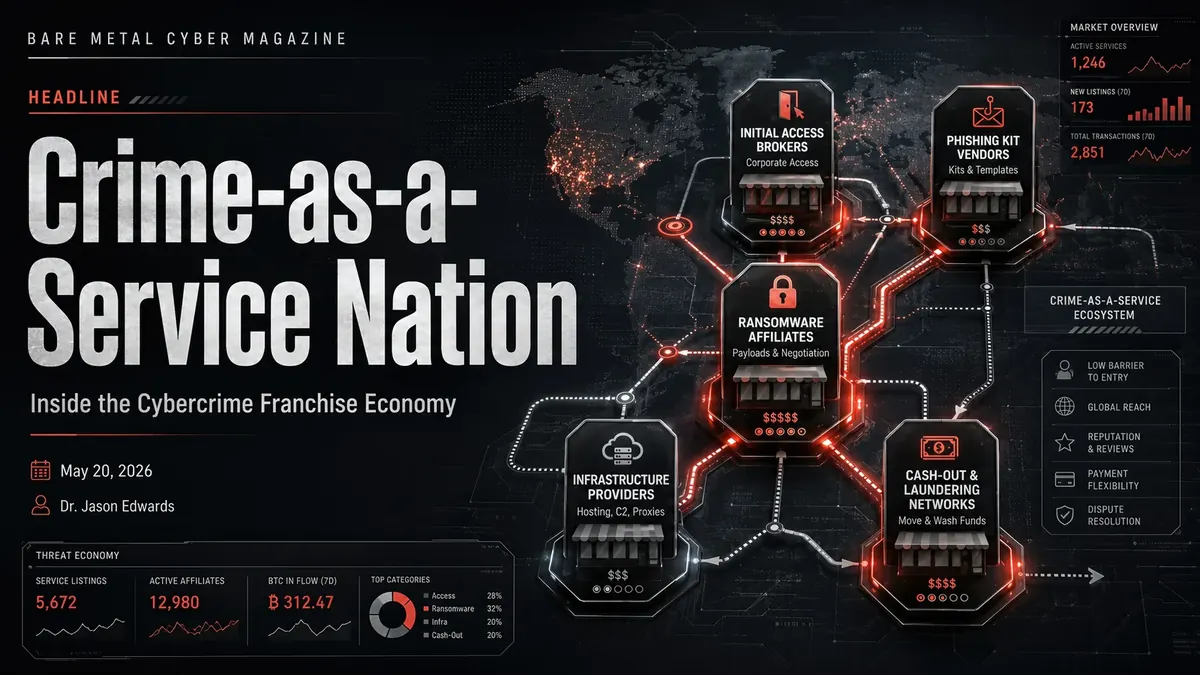
Picture a “vendor ecosystem” where you can buy initial access to a Fortune 500, rent turnkey ransomware operations, outsource money laundering, and get 24/7 customer support if your campaign stalls. In today’s environments, that is not a thought experiment, it is the lived reality of Cybercrime-as-a-Service (CaaS). What used to be a loose patchwork of individual crews has hardened into something that looks uncomfortably like a franchise economy: brands, affiliates, playbooks, and repeatable revenue streams. This Wednesday “Headline” feature in Bare Metal Cyber Magazine treats that ecosystem as what it has become—a system you can map, pressure, and disrupt, not just a stream of brand names and malware families to chase.
For security and technology leaders, the shift matters because it changes both the threat and the opportunity. A franchise economy is resilient: if one “storefront” is taken down, another pops up with the same suppliers and processes behind it. Over the next few years, you will see the same services—initial access brokers, phishing kit vendors, infrastructure providers—rebranded and reskinned, but built on familiar economic rails. Understanding Cybercrime-as-a-Service (CaaS) as a supply chain with roles, dependencies, and margin pressure points lets you move beyond whack-a-mole detection into something more strategic: quietly raising costs, increasing friction, and making reliable criminal “service delivery” harder to scale.
This article starts by mapping how we got from lone-wolf operators to a full-blown franchise model, then walks the chain end-to-end: coders, infrastructure, access, operators, cash-out. From there, we dig into the mechanics that make it work—affiliate programs, criminal “SLAs”, and underground reputation systems—before turning the lens back on defenders. Along the way, we will challenge some comfortable habits: group-centric threat reporting, IOC-heavy metrics, and an over-focus on internal hygiene that ignores the broader criminal economy. The goal is not to offer another checklist, but to give you a mental model you can use to redirect effort toward where it actually moves the economics of attack.
From Lone Wolves to Franchise Chains
For a long time, the industry’s mental model of cybercrime was the gifted lone wolf or tight-knit crew: a handful of operators writing their own malware, running their own infrastructure, and cashing out their own proceeds. Campaigns were bespoke, tools were idiosyncratic, and success depended heavily on individual skill. Law-enforcement stories and media coverage reinforced this picture, whether it was a teenager in a bedroom or a notorious “gang” with a recognizable brand. Many organizations still implicitly operate with that picture in mind, even as the underlying reality has shifted.
The last decade quietly industrialized that chaos. As monetization models like ransomware matured, it became obvious that there was money to be made at each stage of the attack lifecycle. Tool authors realized they could earn more selling or renting kits than running every campaign themselves. Infrastructure specialists discovered that “bulletproof” hosting, traffic distribution, and proxy networks were products in their own right. Out of that experimentation came today’s Cybercrime-as-a-Service economy, where entire offerings—Ransomware-as-a-Service (RaaS), phishing-as-a-service, and more—package techniques, tooling, and support into subscription-style bundles.
What makes this look like a franchise model is not just the tooling, but the division of labor and repeatability. A small number of “brand owners” focus on developing and maintaining the core platform, while an army of affiliates executes campaigns in the field. Initial access brokers (IABs) specialize in delivering footholds inside organizations at scale. Money launderers and “cash-out” specialists focus on moving and cleaning funds. Each role can be swapped out without collapsing the whole system, much like replacing one franchisee without killing the brand. That modularity is exactly what makes takedowns feel satisfying in the short term but limited in their long-term impact.
For leaders, the key shift is recognizing that this evolution was rational, not accidental. Fragmented law enforcement, uneven global regulation, and the high margins of digital crime all rewarded specialization and scale. CaaS is the natural endpoint of those incentives. If you still think primarily in terms of one-off groups and bespoke tooling, you will keep underestimating how quickly the next “brand” will appear using the same factories, the same logistics, and the same playbooks behind the scenes.
Mapping the CaaS Supply Chain
If you strip away the branding, the Cybercrime-as-a-Service (CaaS) ecosystem looks a lot like a supply chain that has been optimized for flexibility and deniability. At the start of that chain are developers and tool authors: the people who build payloads, exploit kits, phishing frameworks, and administration consoles. Many of them never run an intrusion themselves. Their core competency is shipping updates, staying ahead of defenses, and responding to “customer” feedback from the field. In a different universe, they would be running a normal software company. Here, their roadmaps are driven by evasion and monetization.
Next come the infrastructure and access layers. Bulletproof hosting providers, proxy networks, and traffic distribution services supply the equivalent of warehouses and logistics. They make it easy for operators to spin up and rotate infrastructure with minimal friction. Initial access brokers sit alongside them, specializing in harvesting footholds: compromised credentials, VPN access, vulnerable remote services, and cloud admin accounts. For a relatively modest price, an affiliate can acquire entry into a target segment—say, regional manufacturers or healthcare providers—without ever writing a single exploit. In many campaigns, the most important “exploit” is a reusable business relationship between an access broker and an operator.
Further down the chain sit the operators and monetizers. Affiliates pick up tooling and access, then execute campaigns: deploying ransomware, stealing data, or running business email compromise schemes. Once value has been extracted, money-movement specialists and money-laundering networks take over, handling cryptocurrency swaps, cash-out, and layering. At the very end, you often find real-world entities—front companies, corrupt professionals, mule networks—that turn digital loot into spendable funds. Between each of these roles, there is enough distance and compartmentalization that a single arrest or infrastructure seizure rarely collapses the system.
For a security leader, the point of this mapping is not academic. It gives you a way to ask, “Where does my organization intersect this chain, willingly or unwillingly?” Your employees, suppliers, cloud tenants, and financial providers are all potential touchpoints. Seeing CaaS as a supply chain helps you spot where you might reduce your organization’s attractiveness, shorten dwell time, and feed disruption opportunities back into the ecosystem instead of just closing tickets locally.
Franchise Playbooks and Criminal SLAs
Once you view Cybercrime-as-a-Service (CaaS) as an industry, the next thing you notice is how familiar its “go-to-market” playbooks look. Many leading CaaS brands operate with full affiliate programs: web portals, tiered revenue splits, documentation, marketing copy, and even trial offers. A prospective affiliate can compare different “providers” based on return on investment, ease of use, and historical payout reliability. Underground forums and encrypted channels function as review platforms, where performance, support quality, and toolkit stability are debated in the same way teams compare commercial security products. The language is chillingly normal: terms like “conversion rates,” “support response times,” and “feature requests” are common.
Service quality is not just a nice-to-have in this world; it is a competitive differentiator. To grow share, CaaS operators lower the skill bar and increase predictability. They provide step-by-step playbooks, pre-built phishing templates, automated configuration wizards, and dashboards that track infection and payout metrics. In effect, they are turning complex intrusion operations into guided workflows that a moderately capable affiliate can follow. The more standardized and polished these workflows become, the easier it is for new affiliates to join, execute, and switch between “brands” without starting from scratch. That is pure scale.
This is where the notion of criminal SLAs enters. While there may not be formal contracts in the legal sense, expectations are explicit: uptime guarantees for command-and-control infrastructure, response times for fixing bugs, guarantees of unique builds or customizations for high-value affiliates, and clear rules for revenue sharing. When an operator repeatedly fails to meet these expectations, word spreads and their market share erodes. Conversely, providers that honor their promises see a steady inflow of affiliates and campaigns. In practice, this means your organization is not up against a random mix of tools and personalities; you are facing an ecosystem that actively optimizes for reliability and repeatable execution. As that continues, defenses built around the idea of “amateur hour” attacks will age badly.
Why Defenders Keep Fighting the Wrong Enemy
Despite this industrialization, much of our defensive machinery still orients around group names and one-off campaigns. Board decks highlight a handful of “notorious” gangs. Threat intel reports are structured by actor brand and malware family. Metrics celebrate how many indicators of compromise were blocked, as if each were a unique victory. This framing is not wrong, but it is incomplete. It subtly encourages teams to see each campaign as discrete rather than as the visible output of a shared service economy. When the group rebrands, affiliates switch providers, or a toolkit gets a new name, the story resets even though the underlying supply chain barely changes.
Organizational structures reinforce this narrow view. SOC analysts own detection rules and incident queues. Threat intel teams own actor profiles and indicator feeds. Legal and fraud teams own relationships with banks and regulators. Abuse teams handle platform-level misuse. Each group sees a slice of the CaaS ecosystem, but few are tasked with stitching together a picture of the underlying services that keep enabling repeatable attacks. As a result, defenders are excellent at handling the fire in front of them but rarely incentivized to trace the fuel back to its source. The enemy becomes “today’s incident,” not the franchise economy that will spawn tomorrow’s.
This misalignment affects investment decisions. Budgets flow toward tools that promise more precise detection of the latest technique or family, and toward response processes that close cases faster. Those are important, but they do little to raise operating costs for the ecosystem. It is entirely possible to have a world-class incident response function that keeps your own house reasonably clean while leaving the broader CaaS marketplace intact and thriving. For leaders, the opportunity is to reframe success: not just fewer incidents and faster recovery times, but measurable contributions to disrupting repeatable criminal playbooks. That requires asking different questions and funding different capabilities than the traditional “buy tools, tune alerts” cycle.
Hitting the Margin, Not Just the Malware
If crime is running as a franchise economy, then the real leverage for defenders lies in margin, not just malware. Every role in the CaaS chain operates on a simple equation: expected payout minus cost and risk. Your existing controls already shape that equation, but usually only at the point of intrusion. When you widen the lens, you see more dials you can turn. Shorter dwell times reduce the chance that an affiliate can fully monetize access they purchased. Stronger identity proofing and anomaly detection make it harder for money-movers to cash out reliably. Consistent, high-quality incident reporting into banks, regulators, and industry groups forces the ecosystem to spend more time evading scrutiny and less time running playbooks. None of these moves eliminate attacks, but they steadily erode the business case.
This is where architecture and operations meet economics. A network that is segmented, instrumented, and designed for rapid containment is not just “more secure”; it is a bad product for access brokers to resell. If a broker’s footholds in your sector routinely result in partial access, noisy escalations, and rapid eviction, their reputation suffers and their prices adjust. Similarly, disciplined key and credential management makes stolen secrets age quickly, which directly reduces the resale value of your environment. Even basic hygiene measures—like closing orphaned accounts and revoking unused access paths—play into this: they shrink the inventory of viable footholds that can be commoditized. You are turning your organization from a reliable asset class into a volatile one.
Outside your own perimeter, margin pressure is about collaboration. Working with financial partners to improve Know Your Customer (KYC) controls, participating in sector-level fraud and abuse sharing, and backing law-enforcement efforts with high-quality, timely evidence all increase the cost of doing business for CaaS operators. When multiple organizations in a sector feed insights about recurring infrastructure, cash-out patterns, and access-broker behaviors into shared channels, you create a feedback loop the franchise cannot fully evade. The win condition is not a world without CaaS; it is a world where affiliates quietly gravitate away from your sector because the economics have become annoying, uncertain, and less profitable than other options.
Designing an Anti-Franchise Strategy
Designing an anti-franchise strategy starts with changing what you ask your teams to show you. Instead of only tracking incidents closed, vulnerabilities remediated, or dwell times, ask for a view of the recurring services behind your top threats. Which initial access broker patterns show up repeatedly in your sector? Which infrastructure providers keep appearing across unrelated incidents? Which monetization techniques and money-movement routes recur? Task your threat intelligence function with building and maintaining this ecosystem map, not as a glossy report, but as a working model that informs where you direct pressure, partnerships, and investment. When leadership asks for a threat briefing, that model should sit alongside traditional actor charts and heat maps.
Next, align internal functions so that ecosystem disruption is a shared objective, not a side effect. Incident response teams can tune their processes to capture the evidence that downstream partners and law enforcement actually need: timelines, payment flows, mule accounts, infrastructure fingerprints. Legal and compliance can pre-negotiate pathways for sharing that data with regulators, financial institutions, and sector ISACs without months of one-off approvals. Procurement and cloud governance can incorporate abuse- and resilience-aware criteria when choosing providers, recognizing that some platforms do a better job of detecting and ejecting criminal activity. The strategy is to make it easier for your organization to act as a reliable, fast signal generator about CaaS behaviors.
Finally, communicate this shift to boards and executive peers in terms they recognize: competitive positioning and systemic risk. Explain that participating in anti-franchise efforts is not altruism; it is a way to reduce long-term exposure by degrading the quality of services adversaries can buy against your industry. Highlight how ecosystem-level collaboration—joint takedown support, coordinated reporting into financial and hosting channels, shared detection playbooks—can be framed as a strategic initiative rather than an ad hoc response. Leaders who treat CaaS as an industry to be regulated, pressured, and made less profitable, rather than a fog of “bad actors” to be endured, will be better placed to bend the trajectory of cyber risk in their favor.
Where Leaders Go From Here
At its heart, this topic is about seeing cybercrime not as a blur of headlines and actor names, but as an economy with roles, incentives, and margins you can influence. Cybercrime-as-a-Service has matured into a franchise model because the conditions were right: high margins, fragmented enforcement, abundant infrastructure, and a ready pool of aspiring affiliates. Treating it as a system-first problem reconnects the dots between lone incidents, recurring playbooks, and the suppliers and money-movers that make repeatability possible. Once you see that structure, it becomes harder to be satisfied with measures that only ever touch the visible tip.
The mental shift for leaders is from “how do we stop this gang?” to “how do we make this franchise model worse business?” That changes how you value architecture decisions, incident processes, and partnerships. A segmented, observable environment is not just technically sound; it is a bad product for access brokers. Fast, well-instrumented incident handling is not just resilience; it is a drag on affiliate profitability. Thoughtful collaboration with banks, cloud providers, and law enforcement is not just compliance; it is a way to inject friction and uncertainty into the cash-out and logistics layers that CaaS depends on. You start to see each control and relationship as a small lever on someone else’s P&L.
Closing the loop means bringing this framing into the rooms where trade-offs are made. When boards ask about ransomware exposure, you can talk about the franchise economy behind it and where your organization is choosing to apply pressure. When peers debate investment in threat intelligence or sector-sharing initiatives, you can anchor the conversation in ecosystem impact, not just internal dashboards. Over the next few years, leaders who internalize this model will be better able to explain why some efforts matter more than others, and why “good enough hygiene” is not the finish line. A useful place to start is simple: ask your teams where they think your organization is unintentionally a good customer for the CaaS supply chain today, and what it would take to ruin that relationship.