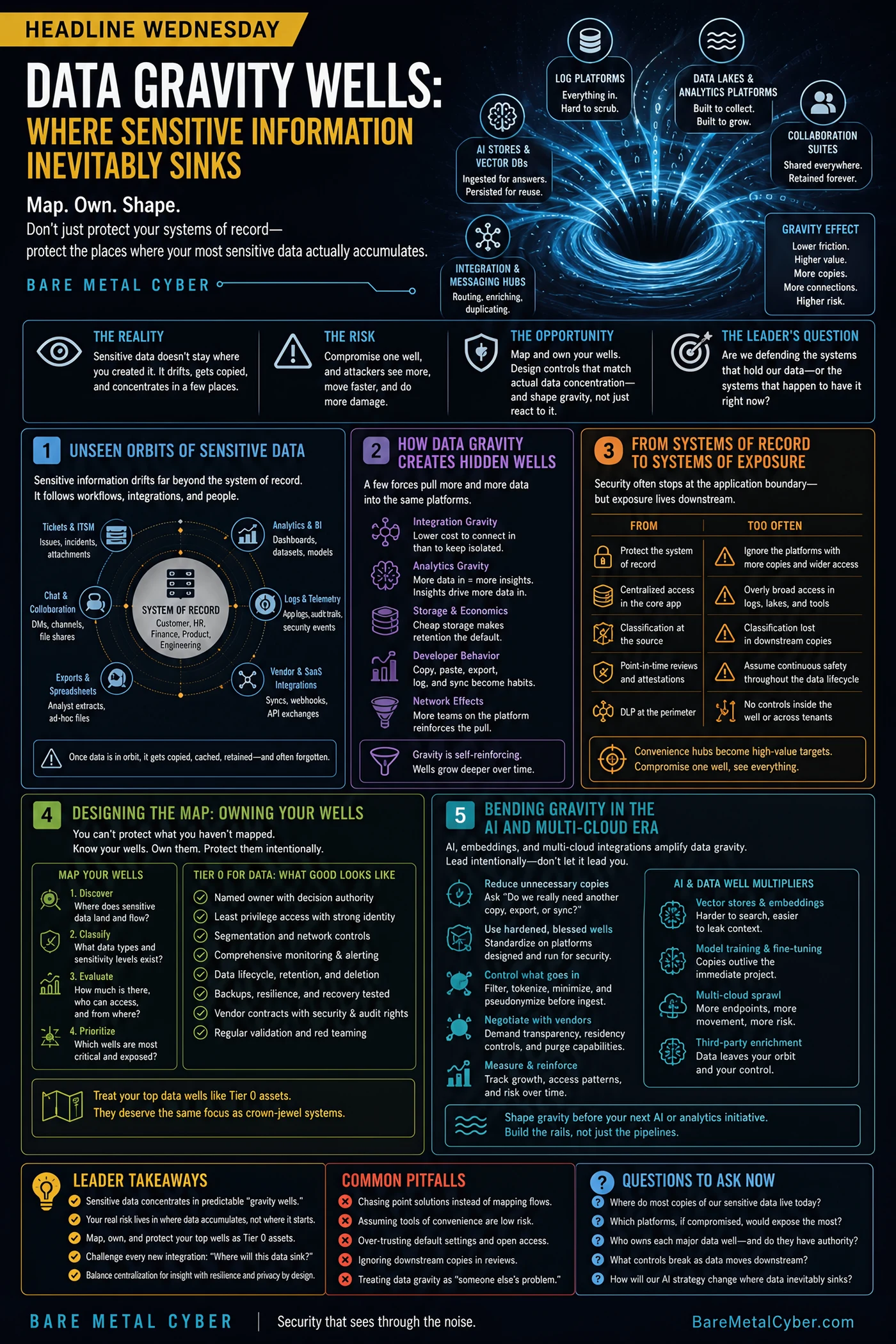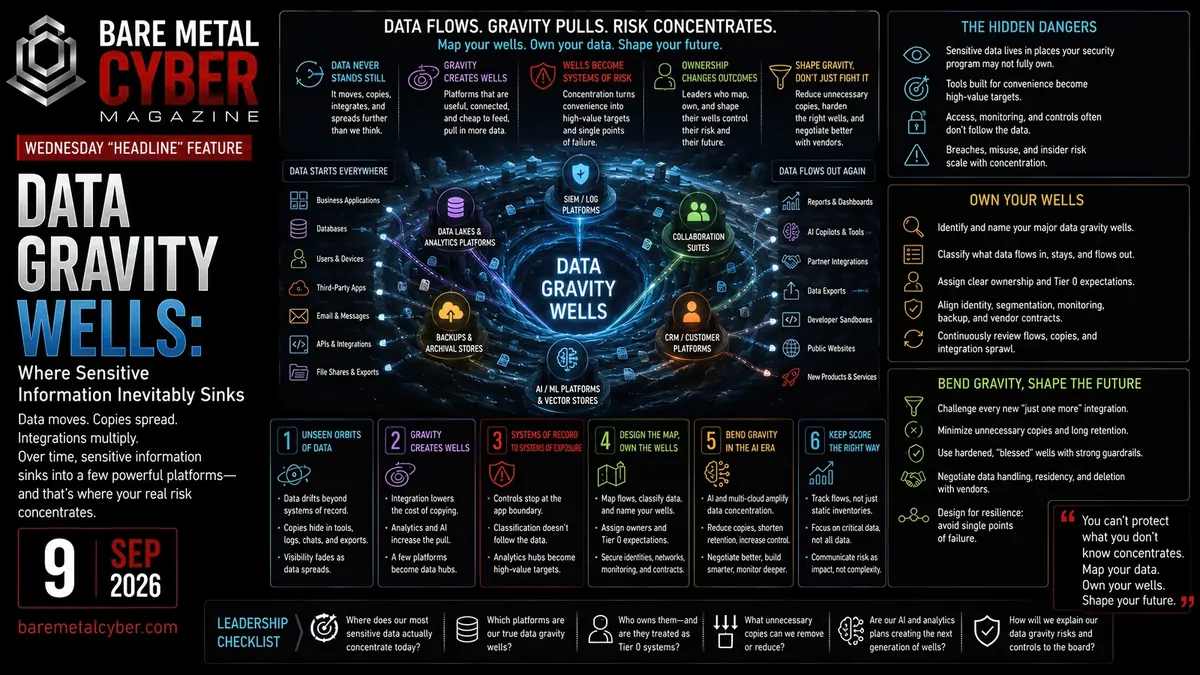
The architecture diagram on the wall looks clean: a few core systems of record in neat boxes, arrows flowing between them, and a tidy ring of controls wrapped around the “crown jewels.” But when you trace how data actually moves in a modern environment, the picture changes. Sensitive records slip into logs, land in collaboration tools, get duplicated into analytics platforms, and are quietly copied into AI knowledge stores. Over time, the real mass of your most sensitive information stops matching the boxes on the slide. It sinks into a handful of platforms that were never meant to be the center of your risk universe.
This Wednesday “Headline” feature from Bare Metal Cyber Magazine looks at those platforms as data gravity wells: places where integration costs, convenience, and analytics demand pull more and more sensitive information into the same orbit. In today’s environments, that often means log and telemetry platforms, large data lakes, collaboration suites, CRM ecosystems, and emerging AI and vector stores. Whether or not you intended it, these have become the systems your attackers care most about, and the ones your board will care most about after an incident.
For security and technology leaders, the uncomfortable truth over the next few years is that many of your formal “Tier 0” designations are out of date. The systems you fund and protect as critical are not always the ones that hold the densest, most valuable concentration of regulated data, business secrets, and long-lived identifiers. Meanwhile, the platforms that do hold that mass often sit in a gray zone of shared ownership, half-inherited controls, and optimistic vendor assumptions.
In the pages that follow, we will treat data gravity as a structural property of your architecture, not a metaphor. We will explore how wells form, how systems of record quietly become systems of exposure, and what it looks like to intentionally map and govern these centers of mass. The goal is not to scare you away from analytics and AI, but to give you a clearer mental model for where sensitive information inevitably sinks — and what that means for how you design, fund, and explain your security program.
Unseen Orbits of Sensitive Data
If you sit with an engineer or analyst and follow a single customer record through its day, it rarely stays inside the neat boundaries of the system of record. A support ticket pulls in full contact details and sometimes a screenshot that includes more than it should. A sales deck borrows a real account name and spend history “just for internal use.” A developer enables verbose logging during a tricky rollout, and suddenly error traces contain identifiers, payload fragments, and occasionally raw secrets. None of these moments look like a data architecture decision, but collectively they redraw where sensitive information actually lives.
Over time, patterns emerge. Security events carry user attributes and transaction details into your security information and event management platform. Batch jobs push behavioral data and partial payloads into a cloud data lake for analytics. Integrations sync subsets of records into half a dozen SaaS tools that make someone’s workflow slightly easier. Collaboration platforms become the default scratchpad for sharing exports, screenshots, and diagnostic dumps. For leaders, the important point is not that any one of these flows is catastrophic on its own, but that they create stable orbits where the same sensitive attributes accumulate again and again.
The result is that your “crown jewels” are often more visible in operational exhaust than in the systems designed to protect them. An identity provider may safely store hashed credentials, while a forgotten debug log retains full authentication tokens. A well-governed core banking platform keeps account details under strict controls, but a downstream analytics cluster holds multi-year transaction histories accessible to dozens of data consumers. Security programs that focus solely on the original system of record miss the fact that the practical blast radius of a compromise is defined by these orbits, not by the formal labels in your asset inventory.
Leaders who grasp this begin to ask different questions. Instead of “is the customer database encrypted and segmented,” they ask “where else do we see full customer identity, payment, or health attributes in the environment, and who actually touches those platforms day to day.” That shift in perspective is the first step toward recognizing your data gravity wells: the places where all these unseen orbits overlap.
How Data Gravity Creates Hidden Wells
Once you accept that sensitive data is in motion, the next question is why it keeps ending up in the same places. Data gravity starts with simple economics: it is cheaper, faster, and cognitively easier to connect one more feed into an existing platform than to stand up a new one. A log platform already receiving endpoint events becomes the natural place to send application traces. A data lake already holding transaction history becomes the landing zone for new behavioral feeds. Each new integration makes that platform more attractive for the next use case, until it quietly becomes the center of mass for entire categories of information.
Analytics and AI amplify this effect. Teams building dashboards, models, or copilots want broad, consistent visibility, which pushes them toward consolidating data into fewer stores. They are rewarded for speed and insight, not for minimizing copies, so “just land it in the lake” or “index it into the corp AI store” becomes the default answer. Over time, the platforms that sit behind your reports, machine learning jobs, and internal copilots accumulate not just volume but variety: identifiers, content, behavioral traces, and context that were never all present in one system before. That variety is what makes them so powerful for the business, and so valuable for an attacker.
Platform and vendor dynamics do the rest. A collaboration suite that becomes the de facto work surface for the company attracts more and more sensitive threads and files. A customer relationship management ecosystem turns into the integration hub for every go-to-market tool. A security information and event management platform becomes the canonical view of user and system activity. In each case, the platform’s gravity is not just technical; it is organizational. People, processes, and vendor contracts align around it, which makes it even harder to challenge or replace once its risk profile changes.
From a leadership perspective, the key is to see these wells as structural outcomes, not accidents. If your architecture, incentives, and vendor choices favor centralization for convenience and insight, you will create gravity wells by design, whether you call them that or not. The only real choice is whether you discover and govern them early, or wait until an incident forces you to notice just how much has sunk into them.
From Systems of Record to Systems of Exposure
Most security programs still anchor their mental model of risk around systems of record. The HR system, the core banking platform, the claims engine, the electronic health record: these are the places everyone agrees are sensitive, so they get the labels, the segmentation, the compensating controls, and the board slides. Meanwhile, the data gravity wells that actually hold the richest, longest-lived combination of that data often live in different parts of the organization. A cloud data platform might report into a data or engineering leader. A collaboration suite is “owned” by IT. An AI store is nominally overseen by an innovation team. They inherit fragments of control from everywhere, but rarely receive the full “crown jewel” treatment.
This misalignment shows up in subtle but damaging ways. Data classification projects focus on schemas in core applications while ignoring columns and blobs in analytics clusters. Access reviews meticulously cover application roles but skip over the broader set of users who can query or export from the wells. Data loss prevention policies are tuned at network egress or email gateways, while large internal platforms quietly allow bulk exports and downloads with minimal friction. When a breach occurs, the root cause report may name a misconfigured bucket or compromised analytics user, but the real story is that those wells were never treated as systems of exposure to begin with.
The effect is that your practical attack surface for sensitive information is defined less by individual applications and more by the few places where those applications’ data sets converge. A single over-privileged data engineer, an external vendor with broad API access, or an AI integration with permissive scopes can reach across years of history and multiple business lines in one move. Leaders who recognize this shift begin to redefine Tier 0 not just around domain controllers and identity platforms, but around the data wells that would turn a foothold into a regulatory, reputational, or operational crisis. That redefinition becomes the foundation for different funding decisions, different ownership models, and a different kind of scrutiny on “supporting” platforms that now carry frontline exposure.
Designing the Map: Owning Your Wells
Once you accept that data gravity wells exist, the next leadership move is to map them deliberately. That starts with a pragmatic inventory exercise that ignores formal system boundaries and follows attributes instead. Where can a motivated insider or attacker see full customer identity, long-lived account identifiers, regulated health or financial details, or multi-year behavioral traces? In most organizations, that question quickly surfaces a small, repeatable set of platforms: the main analytics environment, one or two collaboration suites, security and observability platforms, major customer or employee systems, and any emerging AI knowledge stores. The goal is not a perfect diagram on day one, but a living map that says, “These five to ten platforms are where our sensitive information actually sinks.”
With that map in hand, you can redefine ownership. Each well needs a clearly accountable owner at a senior level, not a dotted-line committee. That owner becomes responsible for treating the platform as “Tier 0 for data,” even if it is not Tier 0 for infrastructure. They drive alignment on identity and access models, push for strong integration with your identity provider, and ensure that conditional access, logging, and least privilege are real, not aspirational. They partner with legal and privacy teams to understand regulatory expectations for the data types involved, and they make sure backup and recovery plans treat the well as a critical service, not a generic storage bucket.
Governance then shifts from generic policies to well-specific guardrails. You can decide, for example, that only certain business units are allowed to land raw production data in the analytics platform, and only via controlled pipelines. You can define that exports from collaboration suites above a certain size or sensitivity must be logged and periodically reviewed. You can push data protection efforts, such as data loss prevention or tokenization, closer to the wells themselves, instead of relying solely on network perimeter controls. None of these moves remove data gravity, but they do give it shape: known platforms, known owners, and known obligations.
Leaders also need to accept trade-offs. Declaring a platform a gravity well and owning it as such may slow down some use cases, increase friction with product and data teams, or require new spend with vendors for higher security tiers. The alternative is pretending that the map still matches the old architecture diagram and being surprised when a breach exposes how much had quietly sunk into a “supporting” platform. Owning your wells means choosing where to centralize, where to constrain, and where to say no, in full view of the business value those wells create.
Bending Gravity in the AI and Multi-Cloud Era
AI and multi-cloud architectures are about to deepen your existing gravity wells and create new ones. Internal copilots, retrieval-augmented generation systems, and vendor-provided AI features all feed on broad, rich corpora of data. The easiest way to power them is to point at the platforms that already hold a lot of content: your collaboration suites, data lakes, customer platforms, and security telemetry. Multi-cloud integration layers, meanwhile, encourage building shared data fabrics and cross-cloud analytics that stitch environments together. The net effect is more data types converging into fewer logical places, with more automated systems able to read across everything at machine speed. That is a gravity well by design.
Leaders cannot stop this trend, but they can bend it. One pattern is to intentionally designate a small number of “blessed” wells for AI and cross-cloud analytics, then invest heavily in hardening and governance around them. Rather than letting every new AI feature scrape arbitrary content, you define curated indexes built from known sources with enforced redaction and minimization. Rather than allowing each cloud environment to build its own parallel data lake, you centralize certain categories of sensitive data into tightly governed zones and keep other categories explicitly fragmented for resilience and privacy. In both cases, the goal is to decide where gravity should pull, instead of discovering it afterward.
Vendor relationships become part of this bending. When you adopt an AI platform or data integration tool, you negotiate not just features and pricing but also where data is stored, how long it is retained, and what separation exists between your corpus and the provider’s broader ecosystem. You treat the vendor’s environment as an extension of your own well map, demanding the same clarity on ownership, logging, incident response, and exit options you would require internally. Over the next few years, the leaders who thrive will be those who can articulate, to boards and regulators, a coherent story about where their most sensitive information sinks in an AI- and multi-cloud-heavy world — and how they chose to bend gravity rather than be dragged by it.
Where Leaders Go From Here
At its heart, this topic is about accepting that sensitive information follows its own physics, and then choosing whether you will map and shape that gravity or let it surprise you. The systems of record you inherited, the diagrams you present to the board, and the control frameworks you rely on all matter, but they do not fully describe where your most important data now lives. That reality is determined by years of integrations, analytics projects, collaboration habits, and AI experiments that have quietly created a small number of gravity wells. Those wells are now systems of exposure in their own right, regardless of how they appear in your asset register.
For leaders, the closure to this story is not a technical checklist, but a shift in mental model. Instead of asking only whether an individual application is segmented and encrypted, you start asking where attributes, histories, and content accumulate across the environment, and who truly owns those accumulation points. You treat data wells as Tier 0 for exposure, even if they began life as convenience platforms or supporting tools. You accept that AI and multi-cloud strategies will deepen and reshape those wells, and you design governance, contracts, and architectures with that in mind. This is how a security program evolves from defending boxes on a slide to defending the actual centers of mass in the organization.
If you internalize that shift, several conversations change. Investment discussions move from generic “data platform spend” to targeted protection of the few wells that would define the blast radius of a breach. Ownership debates become clearer, because each well has a named steward with explicit obligations. Dialogues with product and data leaders become more honest about the trade-offs between speed, insight, and concentration risk. And board updates become more grounded, describing not just controls in the abstract, but the tangible places where your most sensitive information inevitably sinks.
The practical next step is simple, even if the work is not. Ask your team to bring you a short list of the platforms where full customer, employee, or critical asset data can be seen in aggregate today, and how those platforms are protected compared to your traditional “crown jewels.” Then ask where upcoming AI, analytics, or integration initiatives will land their data by default. Those two questions will surface your current gravity wells and the ones forming on the horizon — and give you a starting point to bend that gravity in a direction the organization can live with.