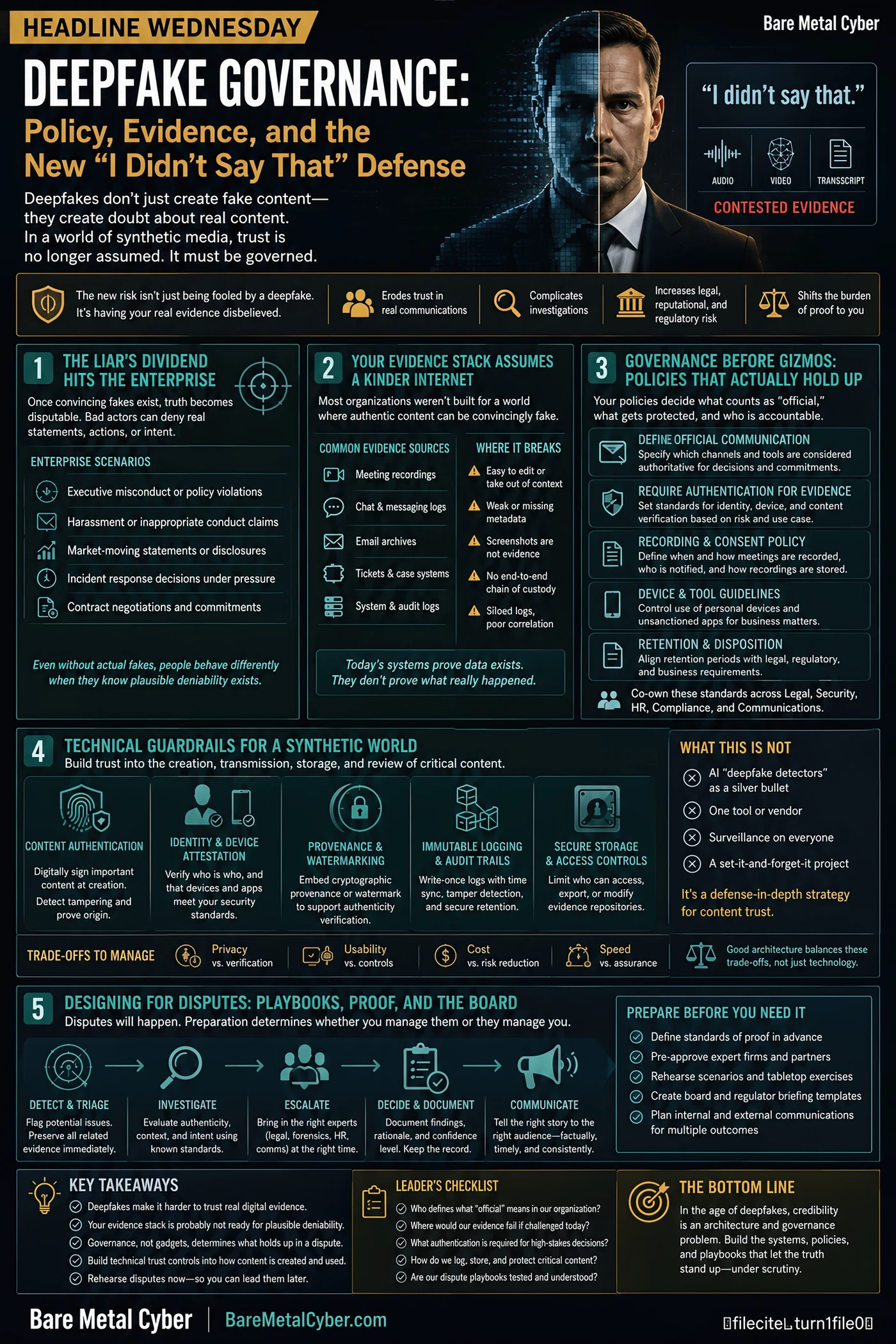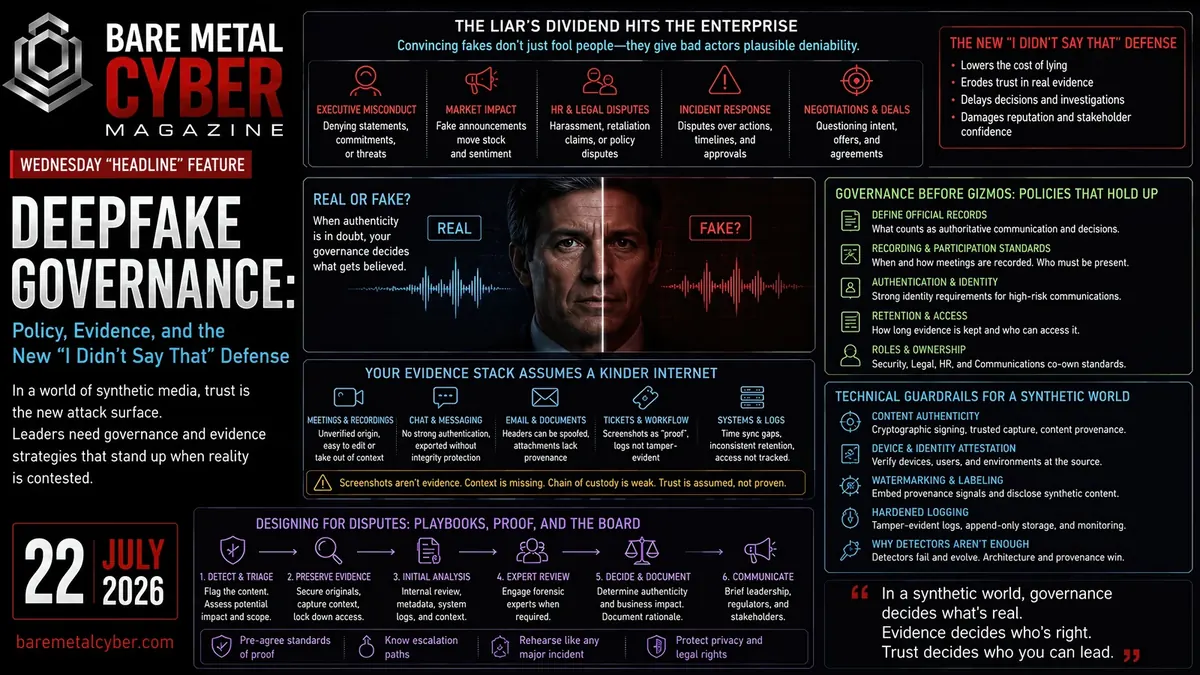
The room is quiet except for the audio clip playing from a phone on the table. It sounds exactly like your chief revenue officer promising a partner something your lawyers would never allow. Heads turn toward them, and they do what more and more executives will do over the next few years: they shrug and say, “That’s a deepfake. I never said that.” In that moment, your board, your regulators, and your own team are not really asking whether deepfakes exist. They are asking a harder question: how do we decide what to believe when digital evidence is contested and plausible deniability is just a download away.
This Wednesday “Headline” feature in Bare Metal Cyber Magazine is about deepfake governance as a first-class security concern, not a sci-fi curiosity. As artificial intelligence (AI) tools make it trivial to clone voices, faces, and writing styles, the most destabilizing risk is not that people fall for every fake. It is that they stop trusting what is real. Policies built for a world of bad emails and tampered spreadsheets do not hold up when an executive can credibly deny a recording, or a manager can dismiss chat logs as fabricated. The “I didn’t say that” defense becomes a strategic weapon, not just an awkward moment.
For security and technology leaders, this shifts the center of gravity from detection gimmicks to governance, evidence, and design. You are not just defending infrastructure; you are defending the organization’s ability to establish facts: who said what, who approved what, and what actually happened when a decision is challenged months later. That means rethinking what counts as official communication, which systems produce evidence that will stand up to scrutiny, and how disputes will be handled when both sides can point to “proof.” Over the next twelve to twenty-four months, the leaders who treat deepfake governance as a cross-functional discipline—spanning security, legal, HR, and communications—will be the ones whose organizations are still believed when it matters most.
The Liar’s Dividend Hits the Enterprise
The phrase “liar’s dividend” describes what happens when the existence of convincing fakes makes it easier for liars to dismiss real evidence. In the consumer world, this usually shows up as politicians or celebrities waving away uncomfortable videos as “obvious deepfakes.” Inside an enterprise, the same pattern takes on sharper edges. Imagine an executive accused of making discriminatory comments in a small-group meeting, with a recording captured on someone’s laptop. Ten years ago, the argument would focus on context and intent. In today’s environments, the first move may be to question authenticity itself: “Anyone could have faked that.” That question alone can stall investigations, fracture trust, and turn every sensitive allegation into a fight over the evidence rather than the behavior.
This dynamic is not confined to headline-grabbing misconduct. It touches harassment complaints, whistleblower claims, market-moving statements, and even incident response narratives. A sales leader might dispute a recording of an off-the-books promise to a customer. A product lead might deny having approved a risky change that later contributed to an outage. A senior engineer might challenge a screen recording showing dangerous workarounds, arguing that the footage could have been manipulated. The more leaders know about deepfakes, the easier it becomes to float this defense—and the harder it becomes for HR, legal, and security to move quickly and confidently. What used to be a question of “Did this really happen?” becomes “Can we prove this wasn’t fabricated?”
For security and technology leaders, the liar’s dividend is a governance problem with real operational consequences. If every high-stakes dispute triggers a forensic circus, the organization becomes slower, more politicized, and more risk-averse. If, on the other hand, you declare “we won’t accept deepfake claims,” you ignore a real and growing technical threat and expose the company to genuine manipulation. The enterprise response needs a middle path: a pre-agreed standard for when evidence is presumed trustworthy, when claims of fabrication are taken seriously, and how those claims are tested. The rest of this article is about designing that middle path on purpose, instead of improvising it in the heat of your first “I didn’t say that” incident.
Your Evidence Stack Assumes a Kinder Internet
Most organizations treat digital evidence as if it were a neutral, faithful witness. Meeting recordings live in collaboration suites. Chat histories sit in SaaS archives. Email threads, ticketing systems, CRM notes, and log exports are all assumed to reflect “what really happened,” give or take human error. That mental model was built for a world where the primary risks were accidental deletion, sloppy documentation, and the occasional insider editing a record. Deepfakes and cheap media manipulation change the baseline. When synthetic or altered content can be produced as easily as a screenshot, every artifact you rely on for accountability has to be reconsidered: who controlled it, how it was captured, and how it could be challenged.
The fragility shows up in small ways that compound. Screenshots are still widely used as “proof” in internal disputes, even though they are trivial to fabricate. Audio recordings from personal devices are submitted to HR and legal without any clear policy about whether they are permitted, authenticated, or retained. “Official” decisions might be summarized in Slack or Teams messages that could be edited, deleted, or re-posted out of context. System logs may be exported to spreadsheets or PDFs, breaking their original integrity guarantees. In many environments, there is no consistent chain of custody from the moment evidence is created to the moment it is reviewed by an investigator, counsel, or a regulator. Everyone assumes good faith until they cannot.
This is where security and technology leaders have to reframe the conversation. The evidence stack is a system like any other, with threat models, trust boundaries, and attack surfaces. It includes collaboration platforms, recording tools, log pipelines, identity systems, retention policies, and the human habits of how people document decisions. If you map that system today, you will likely find pockets of strong integrity alongside areas that are effectively “trust me” zones. In a synthetic media world, those zones are where the “I didn’t say that” defense thrives. The goal is not to wrap every artifact in cryptography, but to deliberately decide which sources are authoritative, how they are protected end-to-end, and where you will no longer accept weak evidence as the basis for a major decision.
Governance Before Gizmos: Policies That Actually Hold Up
When deepfakes enter the picture, the instinctive response is often to look for tools: detectors, watermarks, forensic services. Those matter, but they sit on top of something more fundamental: governance. Without clear policies that define what counts as “official” and what counts as “evidence,” you end up arguing one-off cases from first principles. A better approach is to treat deepfake risk as a catalyst for tightening how your organization records decisions and commitments. That starts with a deceptively simple question: through which channels can the company make a binding promise or a material statement, and under what conditions will that statement be treated as authoritative if it is later disputed. Most enterprises have fragments of this in contracts and HR policies; very few have connected it into a coherent model.
One practical move is to define tiers of communication and decision-making. For example, “Tier 1” might include board-level decisions, public market communications, executive employment actions, and high-risk changes to critical systems. For those, the policy may require that the decision is documented in approved systems with strong identity, time, and retention guarantees—think governed minutes, controlled collaboration spaces, and integrated workflows. “Tier 2” decisions might include departmental strategy, customer commitments above a certain threshold, or notable exceptions to policy, with slightly more flexible channels but still a clear record of who agreed to what. Below that, routine chatter and brainstorming can remain informal. The key is that when a conflict surfaces, you have already agreed which artifacts you will rely on, and which ones are, by design, not authoritative.
This governance lens extends beyond channels into roles and co-ownership. Legal, HR, security, and IT operations all have stakes in how evidence is created, retained, and challenged. A deepfake-aware policy framework should spell out who defines the standards for recordings, who approves the use of personal devices, how long disputable evidence is kept, and how requests to alter or delete records are handled. It should also address employee expectations: whether they may record meetings, when they must disclose it, and what happens if they bring “personal evidence” into an internal investigation. These are not purely technical questions; they are about trust, fairness, and power. The organizations that answer them explicitly will be in a much stronger position when their first contested recording or “fake” chat log lands on the general counsel’s desk.
Technical Guardrails for a Synthetic World
Once governance clarifies what needs to be trustworthy, you can start designing the technical guardrails that make that trust more than an aspiration. The key shift is from assuming authenticity to engineering it. For critical evidence sources—executive communications, incident timelines, major customer commitments, high-risk changes—you want content that is anchored to identities, devices, and systems under your control. That can mean using platforms that cryptographically sign recordings or documents at capture time, binding them to a user, a device, and a timestamp. It can mean ensuring that logs for high-value systems are streamed into tamper-resistant stores with integrity checks and strong access control, rather than living as loose files that can be edited and re-exported. The goal is to create a small but robust spine of artifacts that are, by design, much harder to dispute.
There is a growing ecosystem of standards and technologies that can help. Content provenance frameworks and secure media pipelines can attach verifiable metadata about how a piece of audio, video, or an image was captured and processed. Identity-aware collaboration platforms can provide signed attendance, transcript, and recording metadata for sensitive meetings. Hardened logging architectures can combine centralized collectors, write-once storage options, and integrity verification so that “the logs” are not just another spreadsheet anyone can doctor. Against that backdrop, traditional deepfake detectors and forensic tools become escalation mechanisms: you use them when something in the provenance or behavior looks off, not as the first or only line of defense.
Leaders will have to navigate trade-offs. Stronger authenticity guarantees often introduce friction: people may have to use specific devices or applications for certain decisions, accept more visible recording and consent prompts, or adapt to tighter retention and access rules. Some executives will resist, especially if they are used to operating via informal channels and personal phones. Privacy and regulatory requirements can also constrain how aggressively you track and retain metadata. The design conversation, then, is not “How do we perfectly block deepfakes?” but “Where do we invest in authenticity so that, when a dispute arises, we have enough hard, verifiable evidence to make a call?” Answering that at an architectural level is one of the most strategic security decisions leaders will make in the deepfake era.
Where Leaders Go From Here
At its heart, this topic is about defending your organization’s ability to establish what is real when it matters most. Deepfakes and cheap media manipulation do not just threaten to fool people with fabricated clips; they enable the liar’s dividend, where any uncomfortable truth can be dismissed as synthetic. The “I didn’t say that” defense is just the most visible symptom of a deeper shift: digital evidence is no longer self-authenticating. Leaders who rely on screenshots, ad hoc recordings, and loosely governed logs as if the internet were still kind will find themselves arguing philosophy instead of facts at the worst possible moments.
Closing that gap means treating evidence as a designed system, not a by-product. Governance defines which channels can make binding commitments and how those commitments must be documented. Technical guardrails make that documentation resilient: signed recordings, provenance-aware media, hardened logs, and identity-aware collaboration platforms that can withstand scrutiny. Dispute playbooks then tie it together, so that when evidence is contested, investigations follow a known path, boards and regulators see a consistent standard, and opportunistic denials do not derail accountability. The opening scene—an executive disowning a damning clip—becomes less chaotic when everyone in the room already understands what will count as proof and why.
What changes, ultimately, is the leadership conversation. Instead of asking “Can we trust anything anymore?” the question becomes “Where have we chosen to invest in trust, and is that enough for the disputes we care about most?” This is a strategic discussion to have now, not after your first contested recording. The next time you meet with your legal, HR, and security leads, ask them how they would handle a major case where both sides claim the other’s evidence is a deepfake—and whether your current policies, systems, and playbooks would give them an answer they are confident to defend in front of your board.