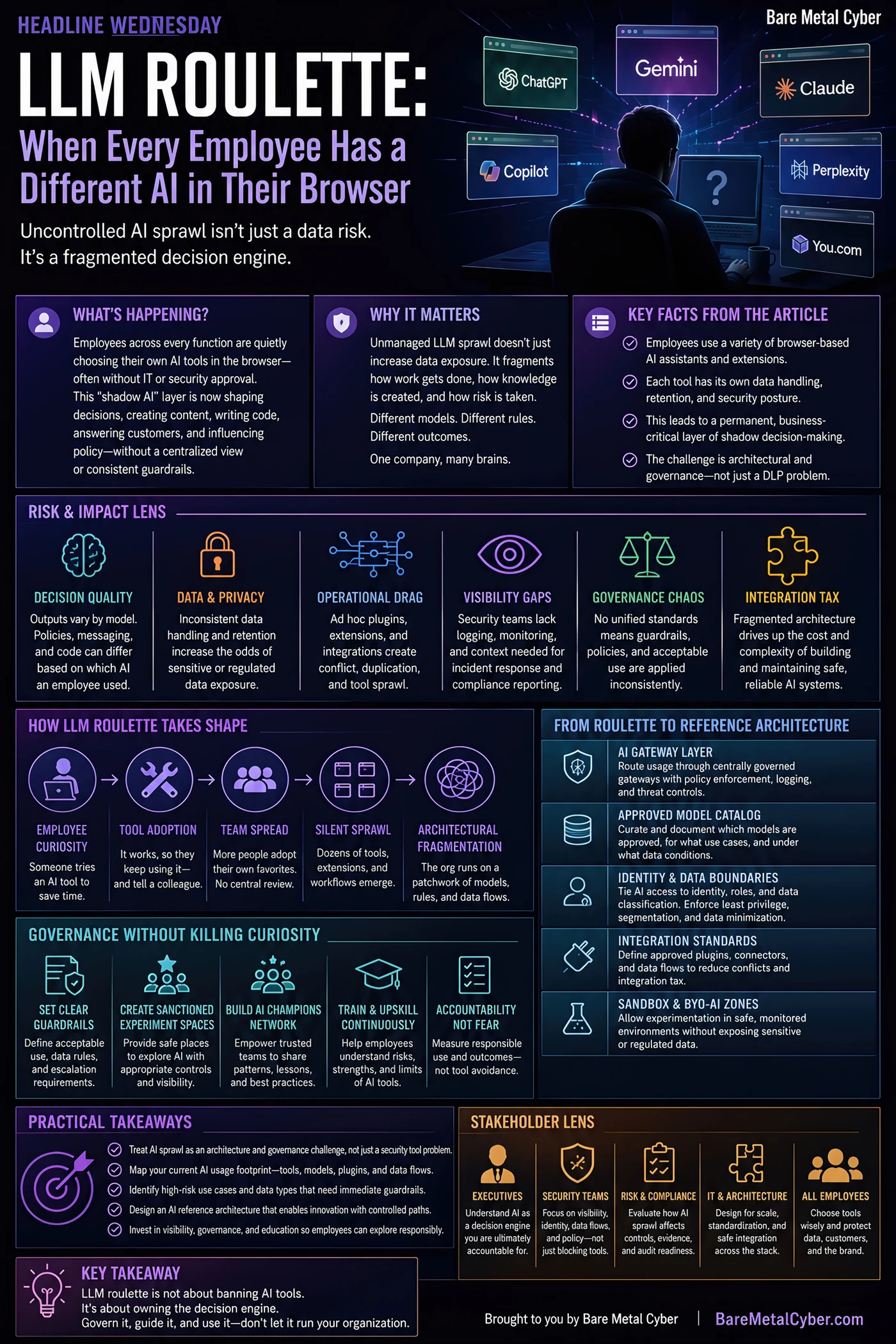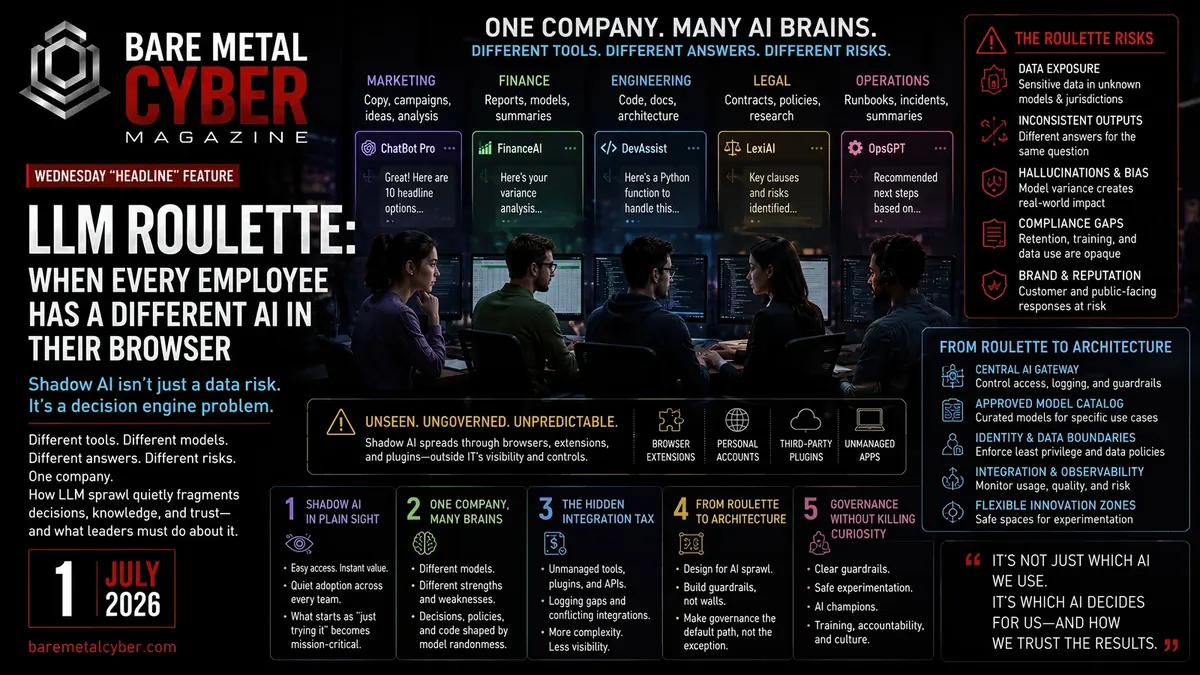
By mid-morning, your organization is already running on at least half a dozen different brains. A sales lead is pasting redlined contracts into one browser-based assistant, an engineer is asking another model to sketch out a new API, and a marketing manager is quietly workshopping messaging in a consumer chat app on their personal laptop. None of these tools were procured, reviewed, or even really discussed. They were just opened in a tab, tried once, and never closed again. This is where many enterprises now live: not with “an AI strategy,” but with a swarm of personal copilots shaping work in ways leadership can’t quite see.
This Wednesday “Headline” feature in Bare Metal Cyber Magazine is about that swarm. The industry talks a lot about large language model (LLM) platforms, private deployments, and formal roadmaps, but in most organizations the reality starts much lower in the stack: whatever AI people can get into a browser without asking permission. Over the next few years, that quiet layer becomes a real decision engine. It touches customer communications, internal policy, product architecture, and even how incidents are framed. The risk is not just that someone pastes sensitive data into the wrong chat window; it is that the organization’s behavior diverges based on which tab someone happened to click.
For security and technology leaders, this is a governance and architecture moment, not just a data loss prevention moment. LLM roulette changes who effectively “owns” decisions, how much you can trust your own artifacts, and where your actual control points sit. Leaders who treat this as a passing fad or a narrow compliance concern will be left with an unintentional federation of AIs steering the business in different directions. Leaders who treat it as a chance to design the decision layer can turn messy experimentation into a durable advantage without crushing curiosity in the process.
Shadow AI in Plain Sight
If you walk floor by floor in most organizations today, shadow AI is not hiding at all. It is on second monitors in split-screen with email, pinned tabs in multiple browsers, and side panels in tools employees already live in. The marketing team has a few favorite writing assistants and image generators, each with different settings and terms. Finance analysts are quietly feeding budget narratives and vendor decks into tools that promise better summaries. Product managers are pasting user feedback into whatever model gives them the quickest clustering. None of this feels like a “system” to the people doing it. It feels like small, tactical help that saves ten minutes here and an hour there.
For security and technology leaders, the uncomfortable reality is that these small, tactical choices add up to a new layer in the environment. Each AI tool has its own data retention rules, training behaviors, plugin ecosystem, and identity handling. Some are signed in with corporate accounts, some with personal email, some with “continue with Google” tied to a browser profile that no one even remembers creating. You do not have a single “enterprise AI” deployment so much as a loose constellation of endpoints, all capable of ingesting sensitive context and emitting business decisions, without any consistent line of sight back to the organization.
This quiet expansion also reshapes expectations. Once employees get used to an AI helper that drafts emails, reviews documentation, or writes code snippets, they build that speed into how they promise work to their peers and customers. The organization’s cadence gradually assumes AI acceleration as a given, but without any guarantee of consistency or quality. When someone moves teams or changes roles, they do not hand over a formal system; they hand over a set of bookmarks and “this one works pretty well for X.” That means key workflows and decisions are, in practice, embedded in personal AI setups that leadership neither designed nor can easily reproduce.
Shadow AI in plain sight is not just a data leakage issue; it is a visibility and dependency issue. The longer leaders delay acknowledging this reality, the more normal it becomes for critical work to run through tools that were never intentionally selected or integrated. At that point, any later attempt at governance feels like taking away productivity rather than designing for it. The first step out of LLM roulette is admitting how many decisions are already being made with dice you did not choose.
One Company, Many Brains
Once you accept that people are already using multiple large language models, the next question is not “how many tools do we have,” but “how many different brains are steering our decisions.” Each major model family has its own training corpus, alignment choices, and failure modes. Some are verbose and cautious, others terse and speculative. Some hallucinate confidently in niche domains, others stall when data is thin. When employees pick different tools for similar work, you are effectively running parallel decision engines inside the same organization, with no common baseline for what “good” looks like.
You see this most clearly in knowledge work that relies on judgment rather than simple lookup. A customer success manager might ask one model to rewrite a tricky escalation email and get a calm, de-escalating response. Another, using a different tool, gets a punchier, more sales-forward tone that increases short-term upsell but subtly erodes trust. In policy and compliance teams, one assistant tends to over-index on formal language, while another casually blends internal rules with whatever it has seen in the wild. Over time, your artifacts diverge. The organization stops speaking with one voice and starts speaking with whichever AI answered fastest on a given day.
For leaders, the risk is not just inconsistent tone. It is inconsistent risk appetite. Some tools will push toward aggressive automation or optimistic interpretations of policy; others will default to safe, slow, and heavily caveated guidance. If one engineering team leans on an AI that happily generates brittle shortcuts and another uses a model that constantly reminds them about edge cases, you are not managing one engineering culture; you are managing several. The same applies to legal reviews, HR communications, vendor negotiations, and even internal memos.
This fragmentation also complicates accountability. When a poor decision traces back to “what the AI said,” whose decision logic was that, exactly? The vendor’s default configuration? The employee’s prompt? A plugin that quietly changed how the model reasoned about context? Without clarity on which “brain” was in use and how it tends to behave, after-action reviews become guesswork. Leaders need to recognize that LLM roulette is not only about where data goes, but about which underlying risk posture gets silently embedded into day-to-day choices.
The Hidden Integration Tax
Underneath the surface of all these browser tabs is a tangle of integrations that no one really owns. Every AI assistant that plugs into email, calendars, customer relationship management tools, code repositories, or document stores is effectively a new integration project that skipped the usual design review. You do not see a formal diagram; you see browser extensions that read the contents of pages, sidebars that pull in meeting context, and “connect your data” wizards that a product manager clicked through on a Friday afternoon. Each one may be reasonable in isolation, but together they create a shadow integration layer that fragments telemetry, monitoring, and control.
From a security architecture perspective, the tax shows up in all the places you do not have logging or policy hooks. One AI plugin can see the same data that a sanctioned, fully reviewed integration sees, but it reports activity back to a completely different backend that you never instrumented. Identity context is often just whatever the browser session exposes, rather than a well-defined corporate identity and role. When an incident investigation starts, you may be able to trace data flows inside your core platforms, but you have almost no visibility into what a constellation of third-party assistants saw, cached, or learned from those same artifacts. That is a blind spot you pay for later.
This hidden tax also affects resilience and change management. When you update a core application, you typically know which downstream systems to test and notify. With AI extensions and ad hoc “connect your data” features, dependencies are implicit. A change to how you format log messages, structure support tickets, or tag records can quietly break someone’s AI-powered workflow. They do not file a formal bug; they just get frustrated, find another tool, or bypass the system altogether. That behavior in turn makes it harder to standardize on shared patterns because the lived experience of “what works” is fractured across teams.
Leaders should recognize that uncontrolled AI integrations function like a parallel integration program with no architecture board. The cost is not just in potential data exposure, but in duplicated effort, brittle workflows, and the eventual need to retrofit governance and observability into a mess that grew organically. Paying down that integration tax means treating AI assistants like any other system that touches critical data and workflows, instead of assuming that a browser frame makes them somehow less real.
From Roulette to Reference Architecture
If LLM roulette is the starting point, the destination is an explicit reference architecture for how AI interacts with your people, data, and systems. That does not mean a single monolithic model for everything. It means a deliberate set of building blocks that define where models live, how they see data, how they authenticate users, and how their actions are traced. At a high level, this often looks like two complementary lanes: centrally governed capabilities for high-risk and high-volume workflows, and clearly bounded spaces where employees can still experiment with less oversight. The goal is not to standardize curiosity out of existence; it is to standardize the places where decisions that matter are made.
A practical pattern many leaders explore is an AI gateway: a broker that sits between users and models, regardless of vendor. Instead of every browser extension making its own direct calls, requests pass through a layer that understands enterprise identity, applies data policies, and enforces logging and rate controls. Behind that gateway, you maintain an approved catalog of models and configurations tuned to different use cases, from customer support drafting to code review to policy analysis. Employees still experience “an AI in the browser,” but under the hood you are steering them toward vetted engines with known behaviors, rather than letting any random tab become a de facto system of record.
Another key component is a clear separation of data zones. Sensitive customer records, regulated datasets, and confidential strategy materials should only be reachable through pathways that honor your data residency, retention, and masking requirements. Less sensitive content, like marketing drafts or generic technical questions, can live in a more flexible zone that supports external experimentation. This zoning is what lets you carve out safe bring-your-own-AI spaces without pretending that all data is created equal. Combine that with identity-aware routing, and you can make sure that a senior engineer’s query about a production incident is handled very differently from a new hire asking about general best practices.
Finally, a reference architecture has to include observability and feedback loops. You need to know which models are actually being used, on what types of problems, and with what outcomes. That means collecting telemetry at the gateway and integration points, not trying to reverse-engineer behavior from a sea of browser history. It also means baking in mechanisms for teams to flag when an AI workflow becomes business-critical so it can graduate from “experiment” to “supported service.” Leaders who invest in this structured foundation can gradually pull work off the roulette table, not by banning tools, but by giving people a better default path that feels faster, safer, and more reliable than doing everything on their own.
Governance Without Killing Curiosity
Once you have a reference architecture in mind, the hard part is culture. Employees did not start using AI because a committee told them to; they started because the tools were easy, impressive, and immediately useful. If governance shows up only as “thou shalt not paste,” people will either ignore it or quietly route around it. Effective leadership starts by admitting that experimentation is a feature, not a bug. The question is not how to stop employees from exploring, but how to give them a safer, more coherent way to do it that still feels fast. That mindset shift is what separates sustainable AI programs from another round of security theater.
One practical move is to formalize the experimentation lane. Instead of pretending shadow AI does not exist, create sanctioned sandboxes and “AI play labs” with clear rules: what data is allowed, what must never be pasted, and how to escalate when a workflow becomes critical. Pair this with simple, explicit training that respects people’s intelligence. They do not need a thirty-slide deck on “what is a large language model”; they need concrete boundaries, vivid examples of what has gone wrong for others, and clarity on which approved tools are actually better than the random ones they might find on their own. When employees see that governance comes with useful defaults rather than only with restrictions, they are more likely to opt in.
At the same time, you need human connectors. An internal AI champions network drawn from different functions can provide feedback on real use cases, pressure-test policies, and surface emerging patterns before they become problems. These champions should have a direct line to security, architecture, and legal, so the conversation is not just “stop doing that,” but “here is how we can bring this into the fold.” Tie accountability to roles and outcomes, not to fear of tools: managers remain responsible for decisions their teams make, regardless of which AI assisted, and leaders remain responsible for ensuring that critical workflows use governed pathways.
Governance without killing curiosity ultimately comes down to control by design instead of control by surprise. If people learn about your AI policies only when something gets blocked or someone is reprimanded, you have already lost. If they encounter guardrails early, inside tools that make their lives easier, those same guardrails start to feel like part of the value proposition. Over the next few years, the organizations that thrive will be the ones that treat LLM roulette as a design problem in human systems, not just a security problem in browser tabs.
Where Leaders Put Their Chips
At its heart, this topic is about who really owns your organization’s decision engine when large language models are everywhere and mostly invisible. We started with a simple scene: different employees, in different roles, each leaning on a different AI in their browser to get work done. That people-first reality has big structural consequences. Shadow AI becomes a new layer in your environment, LLM roulette turns one company into many brains, and a hidden integration tax builds up in all the places your monitoring and governance were never designed to reach. None of that waits for a formal AI strategy slide; it accrues quietly, day by day.
When leaders choose to treat this as architecture and culture instead of just “users misbehaving,” the picture changes. A reference architecture for AI usage gives you a way to separate experimental lanes from governed workflows, route requests through an identity- and data-aware gateway, and actually see which models and patterns are becoming critical. Governance that respects curiosity creates sanctioned places to explore, supported tools that are better than the random ones, and human champions who bridge teams with security and legal. The organization still benefits from the creativity and speed of personal copilots, but those gains are anchored in consistent risk posture and observable behavior, rather than luck.
The real shift is mental. Leaders who internalize this argument stop asking “How do we stop people pasting into random AIs?” and start asking “Where do we intentionally place AI in our decision-making, and how do we make that placement trustworthy?” That reframing alters board conversations, changes how you fund integration work, and clarifies which AI practices you will not tolerate because they erode trust in your own outputs. A useful next step is simple: ask your teams where AI is already in their browser today, and what would make them willing to move those workflows into something governed that still feels as fast. Then listen carefully to the answers.