The deal room is buzzing, the bankers are happy, and the integration slide in the board deck has a neat arrow showing “Day 1 value.” Somewhere on page thirty-eight, there’s a single line that says “Cyber due diligence: completed.” For most executives, that line is enough to move on. For the security leader, it is the moment of maximum discomfort, because everyone is about to sign a binding promise on the basis of partial telemetry, optimistic assumptions, and a target environment no one has really interrogated. This is where mergers and acquisitions quietly become one of the fastest ways to import security debt at scale.
This Wednesday “Headline” feature in Bare Metal Cyber Magazine is about treating that security debt as first-class deal risk, not an afterthought. In today’s environments, growth-by-acquisition is a core strategy, especially in software, fintech, healthcare, and data-heavy industries. But the same dynamics that make M&A attractive for revenue and market share make it attractive for attackers: uneven controls, legacy stacks, inherited third-party exposure, and entire histories of incidents and near-misses embedded in the target’s infrastructure. Leaders who treat “clean up the acquired IT” as a generic integration task are effectively buying future incidents and regulatory pain at a discount.
Over the next few years, the organizations that handle M&A well will be the ones that pull cyber risk into the valuation model, not just the integration plan. They will change who sits at the table, what evidence is demanded before signing, and how the acquired environment is treated from Day 1 onwards. This article offers a decision-first lens: what to question in the deal room, how to see the anatomy of acquired security debt, why the integration window is prime time for attackers, and what governance it takes to say no to a bad deal—or insist on a different price.
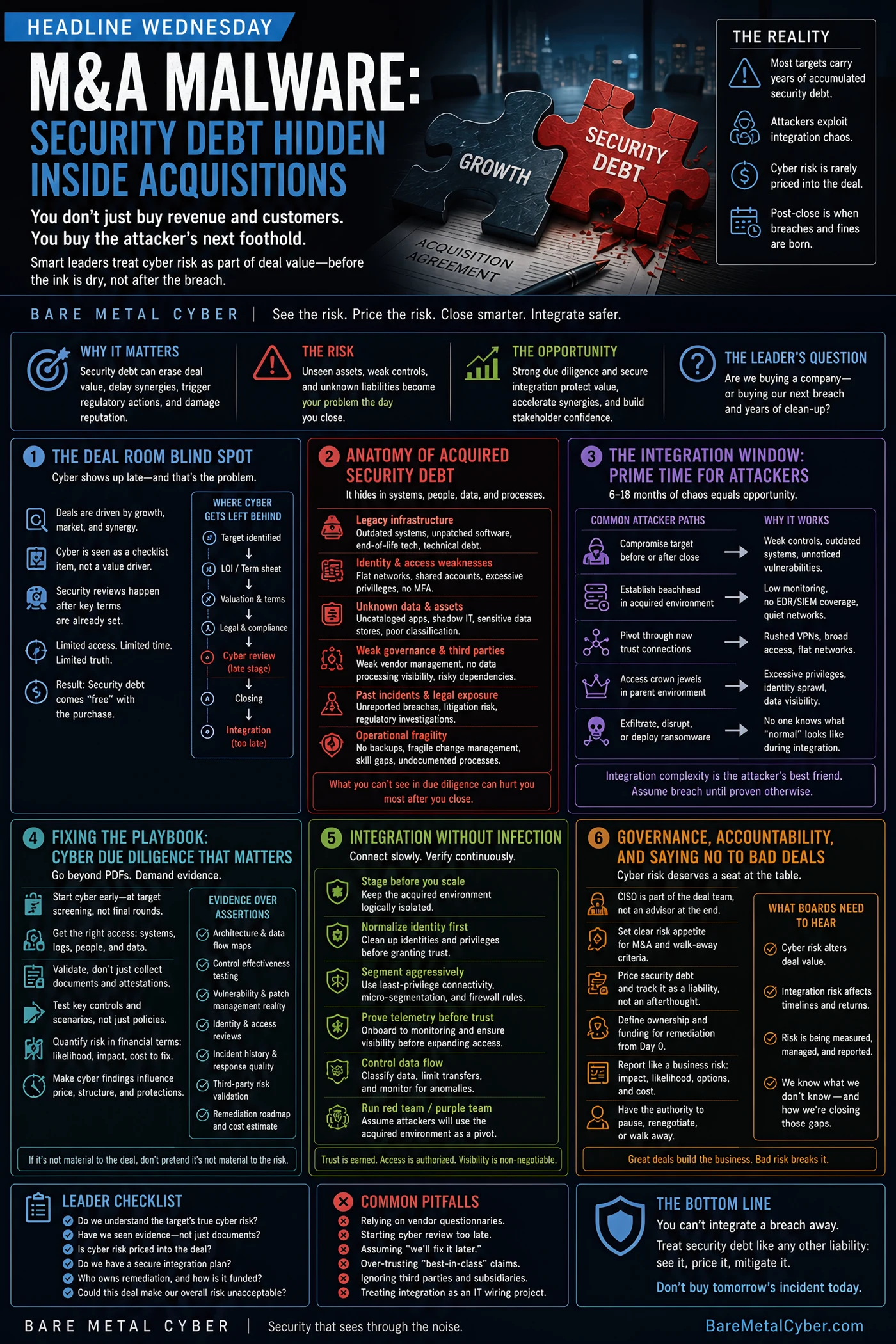
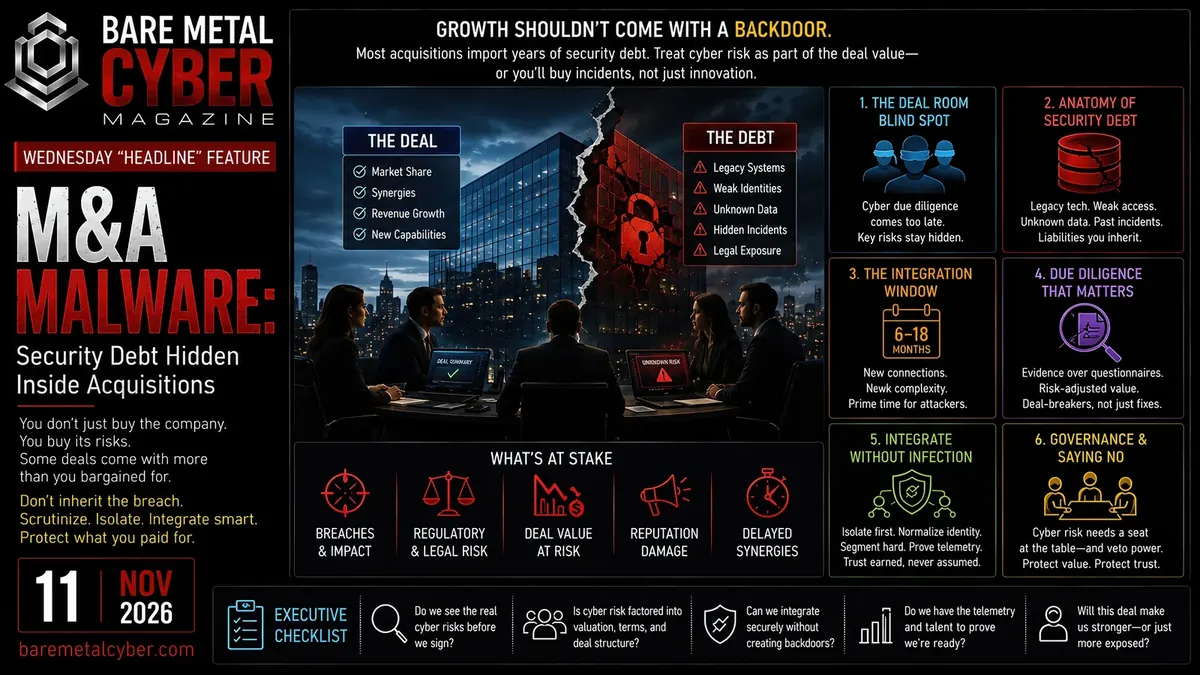
The Deal Room Blind Spot
In most companies, the M&A process starts long before security even hears rumors of a deal. Bankers, corporate development teams, and business sponsors shape the narrative around synergies, market capture, and speed. By the time the CISO is invited in, key assumptions are already cemented, timelines are fixed, and optimism has hardened into a deal thesis. This timing gap creates the first and most damaging blind spot: security teams end up validating a decision rather than informing it. That dynamic all but guarantees the acquirer will inherit more risk than anyone anticipates, because the machinery of the deal is built for momentum, not caution.
The blind spot widens when due diligence is treated as a box-ticking exercise. Most M&A playbooks rely on document packages, self-attestations, and vendor-style questionnaires that are easy to complete and easy to misread. Leaders get answers like “industry standard controls,” “certified environment,” or “segmented architecture,” with little sense of how much is marketing language. Even when there’s no intent to mislead, target companies often believe their posture is stronger than it is, simply because they’ve never been asked to defend their assumptions with evidence. The result is a deal sheet full of green indicators that hide the real fragility underneath.
For the CISO, the structural challenge is that they are one voice against a room full of people with incentives aligned to close. Finance wants to preserve valuation. Legal wants to avoid conditions that complicate the purchase agreement. The business sponsor wants to land the strategic win. In that atmosphere, security risk becomes something to “manage after signing,” rather than a lever that can change the deal itself. Leaders who have lived through post-close surprises know this pattern well: the moment integration teams connect networks, enable shared identity, or onboard workloads, the optimistic due diligence narrative collapses into “why didn’t anyone see this coming?”
A more mature approach starts with acknowledging the blind spot and designing the M&A process so that security has genuine influence early enough to matter. That means direct access to operational leaders in the target, enough time to test assumptions, and the authority to challenge deal momentum based on evidence—not fear or hypotheticals. Without that foundation, every acquisition is a gamble in which the acquirer is betting their own environment on someone else’s unverified posture.
Anatomy of Acquired Security Debt
Security debt in acquisitions is not an abstract idea; it shows up as very specific liabilities that quietly alter your risk profile the day the deal closes. Some of it is obvious: aging servers still running unsupported operating systems, flat internal networks that ignore segmentation, or brittle identity systems that grew organically. But much of it is more subtle, like a sprawl of unmanaged SaaS applications bound to personal email accounts, orphaned privileged accounts tied to former employees, or a tangle of homegrown integrations that no one fully understands. Each of these carries its own probability of failure and its own blast radius, and when you buy a company, you buy the entire distribution.
One useful way for leaders to think about acquired security debt is in a few broad categories. First, there is technical debt with direct security impact: legacy infrastructure, unpatched systems, weak authentication patterns, and fragile monitoring. Second, there is identity and access debt: inconsistent role design, ad hoc exceptions for “power users,” and third-party access that no one owns. Third, there is data and privacy debt: unknown data stores, shadow analytics projects, and informal data sharing agreements with partners. Finally, there is governance and legal debt: policy frameworks that were never enforced, incomplete incident documentation, or prior exposures that might be reportable under your regulatory regime once you own them.
Each category lands differently on your balance sheet. Technical debt can sometimes be remediated with clear investment and sequencing, but identity and data debt are often entangled with how the target actually operates day to day. Governance and legal debt are the most dangerous, because they may represent obligations you did not price into the deal: incidents that were treated as minor internally but would be material for a publicly traded acquirer, or practices that were acceptable in a start-up but violate expectations once the business sits inside a regulated group. When you frame security debt in this structured way, it becomes much easier to translate risk into deal language: remediation cost, timeline impact, and potential regulatory exposure.
For CISOs and technology leaders, the goal is not to eliminate security debt from every acquisition—that would be unrealistic—but to force clarity on what kind of debt you are willing to buy, at what discount, and under what conditions. That requires discipline in asking for tangible artifacts rather than accepting generic assurances: actual asset inventories, access reviews, incident reports, and third-party contracts, not just certificates and slideware. Only then can you look your board in the eye and say, with a straight face, that you understand the shape of the risk you are about to bring inside the walls.
The Integration Window: Prime Time for Attackers
The most dangerous phase of an acquisition is not the signing announcement; it is the messy middle when systems are being connected, identities are being mapped, and teams are under pressure to show “Day 1 synergies.” In that window, both the acquirer and the target are changing configurations at high speed. Firewalls are being opened, routing is being adjusted, and new trust relationships are being defined. Monitoring teams are flooded with alerts that look like harmless integration noise, and change windows are stretched to accommodate migration work. For a patient attacker already sitting in the target environment, this is perfect cover: every anomaly can be explained away as “just another integration artifact.”
From the attacker’s point of view, an acquisition can suddenly expand the playground. A foothold in a small SaaS vendor or niche product company may have modest value on its own, but once that company becomes part of a larger group, new paths open. The attacker can watch for new VPN trusts, identity synchronization, or shared admin tools that bridge the acquired environment and the parent. Where the acquirer sees “onboarding a new business unit,” an adversary sees a newly built lateral movement corridor into a better-resourced, more data-rich target. If your detection and response capabilities do not explicitly account for this pattern, you are effectively giving the attacker a clear runway during integration.
The integration window is also when risk decisions go undocumented or are made under duress. Temporary exceptions become permanent because no one circles back to close them. Shared service accounts are created with broad permissions “just for the migration” and never fully tightened. Legacy protocols are re-enabled to support a one-time data transfer and stay in place for years. Each of these shortcuts is understandable under pressure, but together they create an environment that is more permissive and harder to reason about than either side before the deal. Leaders should assume that any “temporary” security concession during integration has a high probability of becoming part of the long-term baseline.
To make this phase less attractive for attackers, security and technology leaders need to treat integration as a high-risk program in its own right, not just a project management exercise. That means defining explicit guardrails before connectivity, agreeing on what “good enough” monitoring looks like for the combined environment, and setting thresholds where activity must be treated as suspicious, even if it could plausibly be a migration artifact. It also means acknowledging that integration timelines may need to flex to accommodate security controls, not the other way around. The cost of slowing down a deal integration is almost always smaller than the cost of discovering, months later, that you imported an active compromise along with the business.
Fixing the Playbook: Cyber Due Diligence That Matters
If the deal room blind spot is structural, the way out is to redesign the M&A playbook so cyber is not a parallel workstream but a core part of how value and risk are assessed. That starts with elevating security from “input provider” to a named decision function in the deal process. The CISO should know about serious targets at the same time finance and legal do, not two weeks before signing. More importantly, the questions security asks must be tied to outcomes the deal team cares about: valuation adjustments, indemnities, escrow amounts, and integration timelines. If cyber findings do not affect these levers, they will always be treated as noise.
Traditional due diligence packages lean heavily on certifications, policies, and self-reported maturity levels. Those inputs are not useless, but they are insufficient. Evidence-driven due diligence goes further, seeking things like: a current asset inventory and how it is maintained; examples of access reviews and how exceptions are handled; recent incident reports and what changed afterward; and a map of critical third parties and their security obligations. Leaders should be wary of any target that cannot produce these basics, or that insists everything must be “walked through” rather than shared in writing. In practice, the inability to produce simple evidence is often a more reliable signal than a polished security slide deck.
To influence the deal, cyber findings need to be converted into deal language. That might mean estimating the cost and time required to remediate key gaps, expressing prior incidents as potential regulatory exposure, or quantifying how integration must be staged to avoid unacceptable risk. A blunt but effective way to frame it is: “If we buy this company as-is, we are implicitly committing to spend this much on remediation and accept these windows of elevated risk.” At that point, the sponsor and CFO can decide whether to reduce price, adjust terms, or walk away. The crucial shift is that security debt is no longer an invisible add-on; it is a negotiated part of the purchase, with eyes open.
Integration Without Infection
Once the ink is dry, the temptation is to treat integration as a race: the faster you can fold the acquired company into your standard platforms, the faster you “unlock value.” But if you assume trust on Day 1, you are effectively inviting an unvetted environment into your core. A more resilient pattern is to treat the acquired entity as untrusted until it proves otherwise. That does not mean freezing business collaboration; it means designing a staging phase in which connectivity is tightly scoped, identities are normalized, and telemetry is validated before broad trust is granted. Think of it less as “plug and play” and more as “observe, constrain, then connect.”
Practically, this looks like a few concrete integration decisions. Network access can be mediated through well-defined segments or software-defined perimeters, rather than full mesh connectivity. Identity integration should prioritize understanding and reconciling roles and entitlements before enabling single sign-on across the board. Critical shared services—such as email, collaboration tools, and source code platforms—can be brought under your monitoring and logging standards early, while more complex workloads are evaluated in phases. Throughout, security teams should define explicit “go/no-go” criteria for expanding trust, tied to evidence: endpoint coverage, vulnerability exposure, incident history in the integration period, and closure of the riskiest exceptions granted for migration.
Integration without infection also depends on how you organize people and accountability. Many organizations treat post-close security work as just another task on the general integration workstream, which guarantees it will be deprioritized when schedules slip. A stronger model is to run a dedicated security integration program with its own governance rhythm, clear executive sponsorship, and the authority to slow or reorder technical milestones. That program should report regularly to the same forum that tracks deal synergies and financial performance, so that leadership sees security work as part of realizing value, not a side quest. When integration is framed this way, saying “we are delaying this connection for three weeks to close these gaps” becomes a rational business choice, not security obstructionism.
Governance, Accountability, and Saying No to Bad Deals
At the end of the day, M&A security posture is not a tooling problem; it is a governance and accountability problem. The question is simple: does cyber risk have real standing in the deal process, or is it advisory noise? If the CISO is not a named stakeholder in M&A governance, with direct access to the board or deal committee on significant transactions, then security debt will always arrive as an unpleasant surprise. Formalizing that role means documenting when and how security input is required, what decisions it can influence, and what thresholds trigger escalation. Without that clarity, even well-intentioned leaders default to closing the deal and promising to “fix it later.”
Boards and executives also need a more honest narrative about what they are buying. Instead of generic lines about “strong security practices,” they should expect to see a simple articulation of imported security debt: what categories of risk are being accepted, how they might manifest as incidents or regulatory obligations, and what the remediation plan costs in money and time. When those elements are visible, it becomes much easier for a board to ask the right questions: are we comfortable with this exposure at this price, on this timeline, given our other priorities? The answer will not always be no, but the decision will at least be deliberate.
Perhaps the hardest cultural shift is accepting that sometimes the right move is to walk away or materially reshape a deal because of cyber risk. That might mean insisting on remediation as a condition precedent to close, negotiating price reductions to fund future controls, or deciding that the strategic benefit is not worth the security debt. CISOs must be prepared to translate their concerns into this language and stand behind those recommendations, and boards must be willing to back them. Saying no to a risky acquisition is rarely celebrated, but it can be one of the most value-preserving security decisions an organization ever makes. When governance, accountability, and courage align, M&A stops being a stealth malware vector and starts being a managed, intentional part of the organization’s risk story.
Where Leaders Go From Here
At its heart, this topic is about recognizing that every acquisition is also a massive security decision, whether or not anyone names it that way. The deal room blind spot, the hidden categories of security debt, and the chaos of the integration window all push in the same direction: risk becomes invisible at precisely the moment the organization is betting the most on a growth story. When leaders internalize that, they stop treating cyber as a post-close clean-up function and start treating it as part of the deal logic itself. That shift is not about paranoia; it is about pricing reality into strategy.
Closing the loop with the opening scene in the deal room, the question is no longer “did we check the cyber box?” but “do we truly understand what we are buying, and are we willing to live with it?” When cyber due diligence feeds directly into valuation, terms, and integration planning, security debt becomes a negotiable component instead of a surprise. When integration is run as a high-risk program with staged trust and explicit guardrails, the post-close window becomes something you manage, not something you fear. And when governance gives the CISO a true voice in go/no-go decisions, the organization gains the ability to say no to bad deals instead of inheriting someone else’s liabilities.
For security and technology leaders, the practical change is in conversation and posture. You start talking about acquisitions using the same language you use for major architecture changes: what categories of risk are we adding, which ones are we reducing, and how does that alter our overall resilience? You ask for evidence, not just assurances, and you are explicit about the cost and timeline of remediation. Above all, you bring a few deceptively simple questions into the deal room: If we discovered these risks after close, would we feel misled? And if we had to live with this security debt for three years, would we still think this was a good deal? Those questions, asked early and consistently, are what turn M&A from malware into managed risk.