The room is quiet except for the murmur of a dashboard wall. Bars and dials glow in reassuring colors, service names scroll by, and a single, triumphant metric sits at the top: “Alerts processed today: 9,842.” The operations leader is about to brief the CIO, and the plan is simple: point to the screens, talk about volumes and mean time to detect, and signal that the operation is “under control.” But everyone in the room knows the uncomfortable truth: the team is exhausted, investigations are shallow, and when you ask which attacker behaviors they are confident they can actually catch, the answers get vague very fast.
This Wednesday “Headline” feature from Bare Metal Cyber Magazine is about that gap between visual comfort and real coverage. Over the next few years, leaders will be forced to choose between doubling down on dashboard worship and building detection engineering as an intentional discipline. One path optimizes for screenshots, vendor narratives, and executive theater. The other treats detections like a product: designed, tested, iterated, retired, and explained in plain language to the people who have to bet their risk decisions on them. The tension is not just technical; it is political, cultural, and budgetary.
For senior security and technology leaders, the core question is no longer “do we have alerts?” but “do we have a trustworthy, evolving detection pipeline aligned to how real attackers operate in our environment?” This article will argue that shifting to detection engineering is not about buying yet another platform, but about changing ownership, metrics, and expectations. It will give you a vocabulary to push back on vanity dashboards, a mental model for what real detection engineering looks like, and a way to talk about alert quality that does not collapse into simple counts and charts.
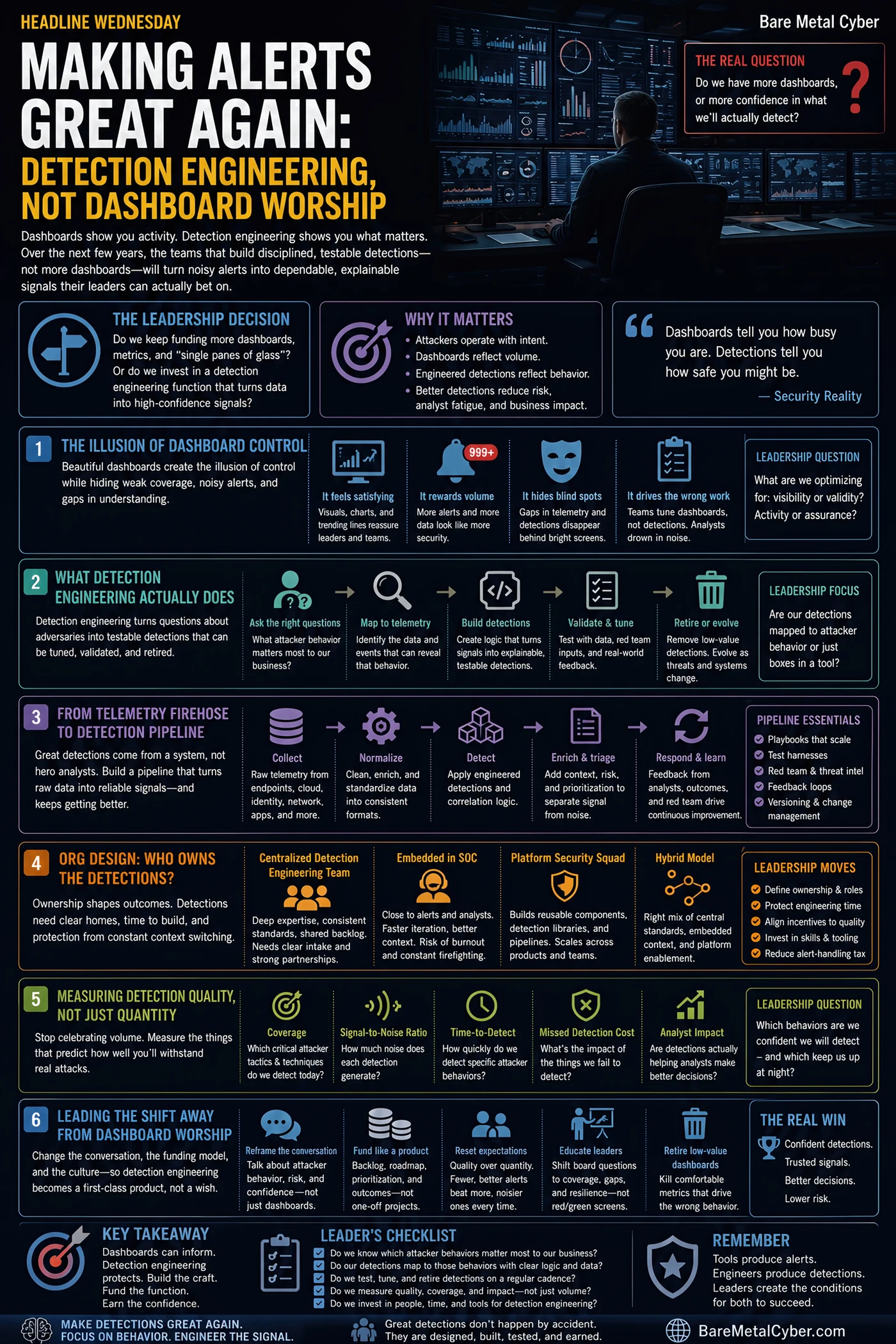
The Illusion of Dashboard Control
Dashboard worship usually starts from a good place. Leaders want visibility, security operations centers want to demonstrate progress, and vendors are eager to showcase what their platforms can surface. The result is often an impressive “command center” view: stacked monitors, real-time charts of alerts by source, lists of “top talkers” and “critical incidents,” all wrapped in a story that says, “We see everything that matters.” The comfort is real. So is the illusion. Most of those views are thin slices of a much more complex detection landscape, and almost none of them answer the question that boards and regulators increasingly care about: which specific threats are we prepared to catch, and with what level of confidence.
In many environments, the dashboard becomes the product rather than the by-product. Analysts spend time tuning widget layouts, adding labels, and curating views for different stakeholders. Leaders ask for “one more tile” to show something that sounds intuitive: phishing trends, cloud login anomalies, endpoint alerts per week. But underneath, detections are often a random walk: default rules from the security information and event management (SIEM) platform, vendor-provided content toggled on and off, one-off rules written after incidents and never revisited. The visual layer looks increasingly refined while the underlying logic remains brittle, overlapping, and full of blind spots.
Over time, this creates a dangerous feedback loop. Metrics like “alerts processed” and “cases closed” become proxies for effectiveness, even when most alerts are noise and most cases are closed with shallow triage. Dashboards make it easy to talk about volumes and performance, and very hard to talk about coverage, quality, and reasoning. When an executive asks, “Are we protected against this new class of attacks?”, the answer too often routes back to a screenshot rather than a grounded explanation of detections, telemetry, and known gaps. Dashboard control feels like progress, but without a detection engineering discipline behind it, leaders are effectively steering by looking at the reflections on the glass instead of the road.
What Detection Engineering Actually Does
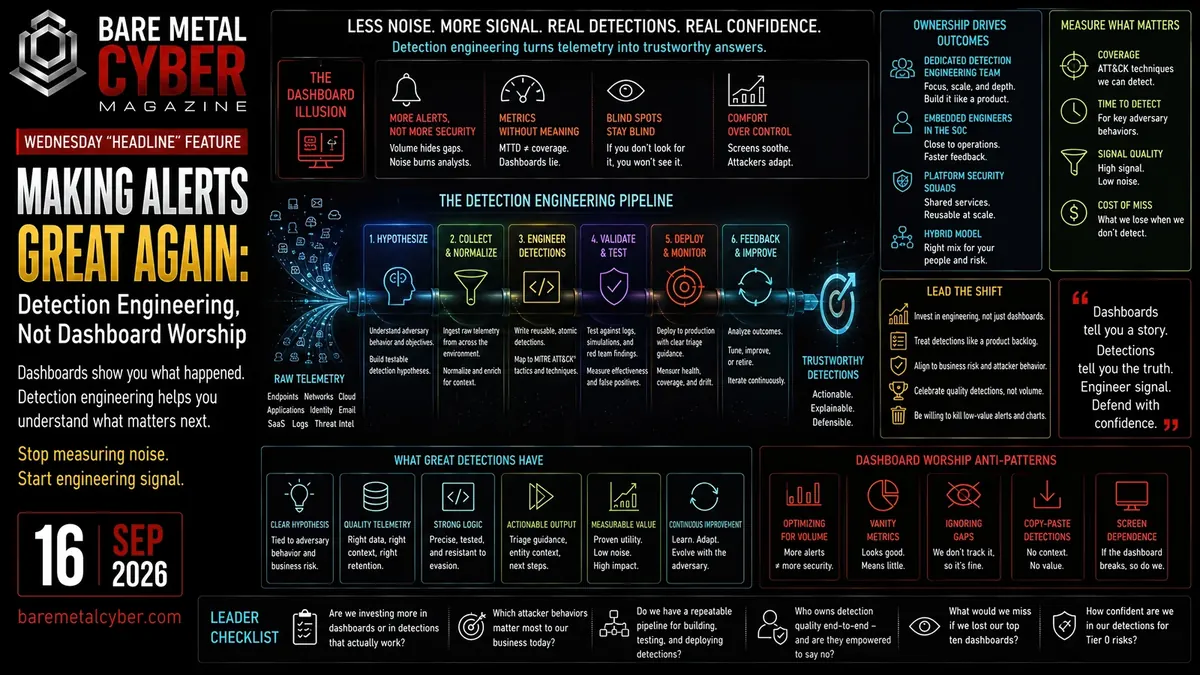
Detection engineering starts from a different question than most dashboard projects. Instead of asking, “What can the tool show me?”, it asks, “How would an attacker actually move through our environment, and what traces would they leave behind?” From there, the work looks less like wiring up widgets and more like building hypotheses. A detection engineer takes a specific behavior – say, a cloud admin role being assumed from an unusual region, or a production database accessed from a build system – and maps it to the concrete telemetry that could reveal it. That mapping becomes the core of a detection: a repeatable, testable description of something that should never happen, or should only happen rarely and with clear justification.
Done well, this looks very much like a product discipline. Detections have life cycles: they are proposed, designed, implemented, tested, deployed, monitored, tuned, and eventually retired. There are backlogs of candidate detections derived from threat intelligence, red team findings, incident postmortems, and architectural reviews. There are acceptance criteria: how much noise is acceptable, what coverage is expected, who owns handling the alerts. There is documentation that explains, in plain language, what the detection does and why it exists. Crucially, all of this sits on top of platforms like security information and event management (SIEM) systems and endpoint detection and response (EDR) tools, rather than being dictated by them.
For leaders, the key is recognizing that detection engineering is not just “writing rules.” It is a way of encoding your understanding of attacker behavior and business risk into the infrastructure of your operations. A good detection engineering function continuously asks whether the current library of detections still reflects the environment, whether telemetry gaps are blocking important use cases, and whether the team has the right data and capabilities to express complex behaviors. That function becomes a bridge between threat modeling, architecture, and day-to-day operations. When you fund and staff detection engineering properly, dashboards stop being the main event and revert to what they should have been all along: a useful lens on a well-engineered detection system, not a substitute for one.
From Telemetry Firehose to Detection Pipeline
Most organizations do not lack data. They lack a way to turn that data into dependable, explainable detections. Cloud platforms, endpoint detection and response tools, identity providers, and application logs all emit a steady firehose of telemetry. Without structure, this becomes an undifferentiated stream that feeds a security information and event management system and generates alerts based largely on whatever rules are easiest to turn on. A detection pipeline imposes order on this chaos. It defines how raw events are ingested, normalized, enriched, evaluated against detection logic, triaged, and then fed back into improvements and new hypotheses. Instead of a flat lake of logs and a pile of alerts, you have stages with clear responsibilities.
In a mature detection pipeline, each stage adds value that leaders can understand. Ingestion and normalization make events comparable across sources, so a login from the cloud console and a login to a critical internal app can be correlated reliably. Enrichment layers in context: asset criticality, ownership, business function, past incident history. Detection logic then operates on this enriched view, allowing for more nuanced patterns than “failed logins over threshold.” Triage processes turn detection hits into cases with clear context, not just raw events. Along the way, test harnesses validate that detections still fire when they should, and that changes in logging or infrastructure have not quietly broken critical coverage.
The pipeline model also gives leaders a way to reason about investment and risk. If telemetry is weak or inconsistent, detection engineers can show which attacker behaviors are currently uncatchable in practice, not just in theory. If enrichment is thin, they can quantify how much analyst time is being burned on figuring out basic context. If triage is overloaded, they can demonstrate the cost of noisy, poorly scoped detections. Instead of arguing about whether to buy “more AI for the SIEM,” you can talk about strengthening specific pipeline stages: improving logging in key systems, funding automation for enrichment, carving out time to build and test new detections. That is how you move from drowning in a firehose to owning a pipeline that reflects how your attackers, and your business, actually work.
Org Design: Who Owns the Detections?
If detection engineering is everyone’s job, it is no one’s job. In many organizations, detections are scattered artifacts: some live with the security information and event management administrators, some with individual analysts, some buried in infrastructure-as-code repositories, and some owned implicitly by vendors. The result is predictable. No one feels fully accountable for coverage, quality, or consistency. When an incident review uncovers a missed behavior, the fix is often a one-off rule added under pressure, with little thought given to how it fits into the broader library. Leaders experience this as drift: the environment and threats change, but the detection landscape evolves in a lumpy, reactive way.
Creating real ownership means deciding who gets to say, “this is our detection strategy” and backing that statement with time and authority. Some organizations stand up a dedicated detection engineering team that collaborates with security operations but is not consumed by daily alert handling. Others embed detection engineers within the operations center or platform security squads, with explicit time carved out to work on backlog items rather than only triage. Each model has trade-offs. Dedicated teams can move faster on design and testing but risk becoming detached from frontline reality. Embedded engineers stay closer to the pain but can be overwhelmed by immediate fires unless leaders guard their calendars.
The crucial move for leaders is to make detection ownership visible and protected. That means defining clear responsibilities: who maintains the detection backlog, who approves new rules, who tracks coverage against attacker techniques, who owns the test harness. It means aligning performance goals so that engineers are rewarded for reducing noise and increasing explainability, not just for pumping out more content. And it means setting expectations with stakeholders that detection engineering is not a side project to be squeezed in between incidents. When the organization knows exactly who owns the detections, it becomes much easier to have honest conversations about gaps, trade-offs, and where to invest next.
Measuring Detection Quality, Not Just Quantity
Once detection engineering is treated as a discipline, the usual metrics stop being satisfying. Counts of alerts, cases, or “correlated events” tell you something about volume and maybe about workload, but very little about whether you are catching the right things. Quality metrics start from attacker behaviors and business impact, not from tool output. A leader should be able to ask, “For these specific techniques we care about – credential theft, lateral movement into crown jewels, data staging in cloud storage – what are our detections, how noisy are they, and how confident are we that they still work?” That is a different conversation than “how many alerts did we process last quarter,” and it forces the organization to connect metrics to real risk.
Practically, this means designing a small set of core measures that detection owners can explain without hiding behind jargon. Coverage against attacker techniques, using models like the MITRE ATT&CK framework, gives a structured way to talk about what is in scope and what is missing. Signal-to-noise ratios, calculated for specific detections, show whether analysts are spending their time on rich leads or on clearing junk. Time to reliable detection for important behaviors – not just time to first alert – highlights whether triage and enrichment are set up to turn a hit into a decision quickly. Leaders can also track the health of the detection library itself: how many rules are deprecated, how often critical detections are tested, how many come directly from lessons learned in incidents.
The point is not to chase a perfect scorecard. It is to build a metric language that reflects how well your detection system supports judgment and action. When you shift from quantity to quality, certain investments become easier to justify. Funding better telemetry in a critical application is no longer “more logs,” it is closing a coverage gap for a high-impact attacker technique. Giving engineers time to tune or retire noisy detections is no longer “reducing visibility,” it is improving signal-to-noise so analysts can go deeper. Over time, leaders who insist on quality metrics find that dashboard screenshots become less central to the story. The real artifacts of progress are maps of coverage, tested detections, and the ability to answer, with specificity, “what can we see, and what are we blind to?”
Leading the Shift Away from Dashboard Worship
Shifting from dashboard worship to detection engineering is not a tooling tweak; it is a leadership move. It starts with changing the questions you ask in every forum where security performance is discussed. Instead of opening with “how many alerts?” or “what is our mean time to detect?”, you begin with “which attacker behaviors are we confident we will catch, and how do we know?” That one shift puts the focus on detections, coverage, and evidence, not on visualizations. It also surfaces uncomfortable realities: gaps in telemetry, brittle rules, and places where the organization has been relying on vendor content without understanding what it actually does. Leaders have to be willing to sit with that discomfort and treat it as the starting point for improvement, not as a failure to be hidden behind more charts.
The next step is to visibly allocate time, budget, and attention to detection engineering as a product function. That might mean funding a small detection engineering team, carving out dedicated cycles for engineers in the security operations center, or investing in test harnesses and pipelines rather than another dashboard module. It almost always means saying “no” to some requests for new views and reports so that the same people are not trying to both build a discipline and feed an endless appetite for optics. Leaders can model this by asking to see detection backlogs, coverage maps, and test results, not just the latest command-center screenshots. Over time, the signal becomes clear: the organization values explainable detection capabilities over performative visibility.
Finally, there is the political work of resetting expectations with peers, boards, and regulators. Many stakeholders have been conditioned to equate security maturity with glossy dashboards, and walking that back requires careful framing. Instead of disparaging dashboards outright, leaders can position them as one of several ways to view a deeper detection system. The story becomes, “We are investing in engineered detections tied to attacker behaviors, and these views help us monitor how that system is performing.” When incidents occur, postmortems should highlight where detections succeeded or failed, how the pipeline responded, and what changed as a result. That narrative, repeated consistently, gradually rewires what “good security” looks like in the minds of decision-makers. The goal is not to make dashboards disappear, but to make them supporting actors in a story where detection engineering holds the lead.
Where Leaders Go From Here
At its heart, this topic is about choosing substance over optics in how you run security operations. You can keep optimizing for the comfort of dashboards – volumes, colors, and charts that look impressive in a board deck – or you can invest in detection engineering as a discipline that encodes your understanding of attacker behavior into your environment. When you make that choice consciously, the definition of “visibility” changes. It stops being a wall of screens and starts being a library of well-understood detections, backed by telemetry, tests, and people who can explain exactly what they expect to catch and why.
Closing that gap requires leaders to pull several threads together. Technically, you need a pipeline that turns noisy telemetry into structured, enriched signals. Organizationally, you need clear ownership for detections, protected time to design and maintain them, and metrics that reward quality rather than raw volume. Culturally, you need to normalize the idea that gaps will always exist and that admitting them is a sign of maturity, not failure. When those pieces line up, the relationship between your operations center and your leadership team changes. Conversations move from “how busy were we?” to “how prepared are we against the specific behaviors that matter for our business?”
The practical shift starts with the questions you bring into the room. Instead of asking for another dashboard, ask to see the detection backlog. Instead of celebrating alert counts, celebrate retired noisy rules and newly tested coverage for an important technique. And in your next leadership or board discussion, you might pose two simple prompts: which attacker behaviors are we genuinely confident we will catch today, and what would it take to be equally confident about the ones we worry about most? The answers to those questions, not the brightness of the screens, will tell you whether your alerts are finally great again.