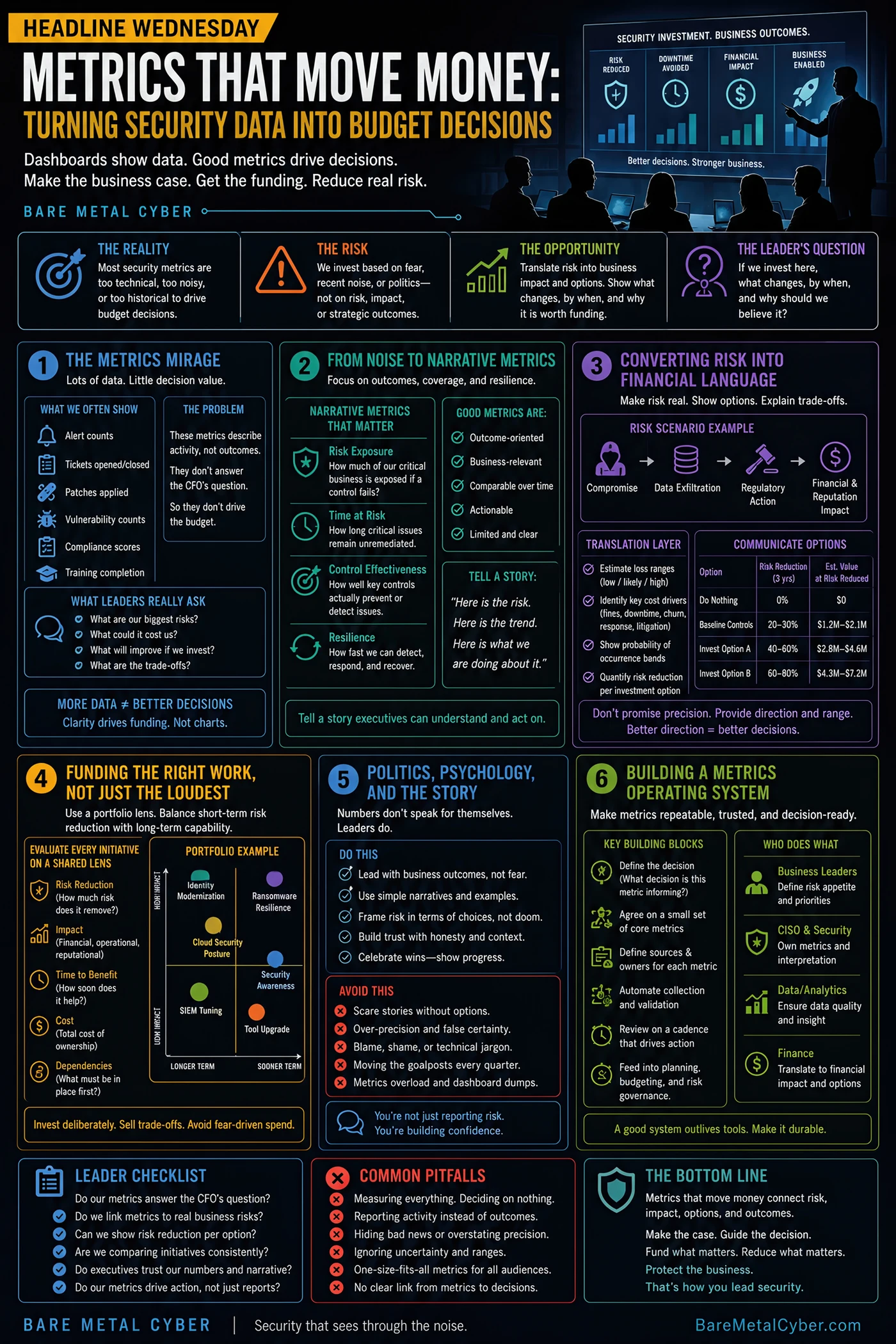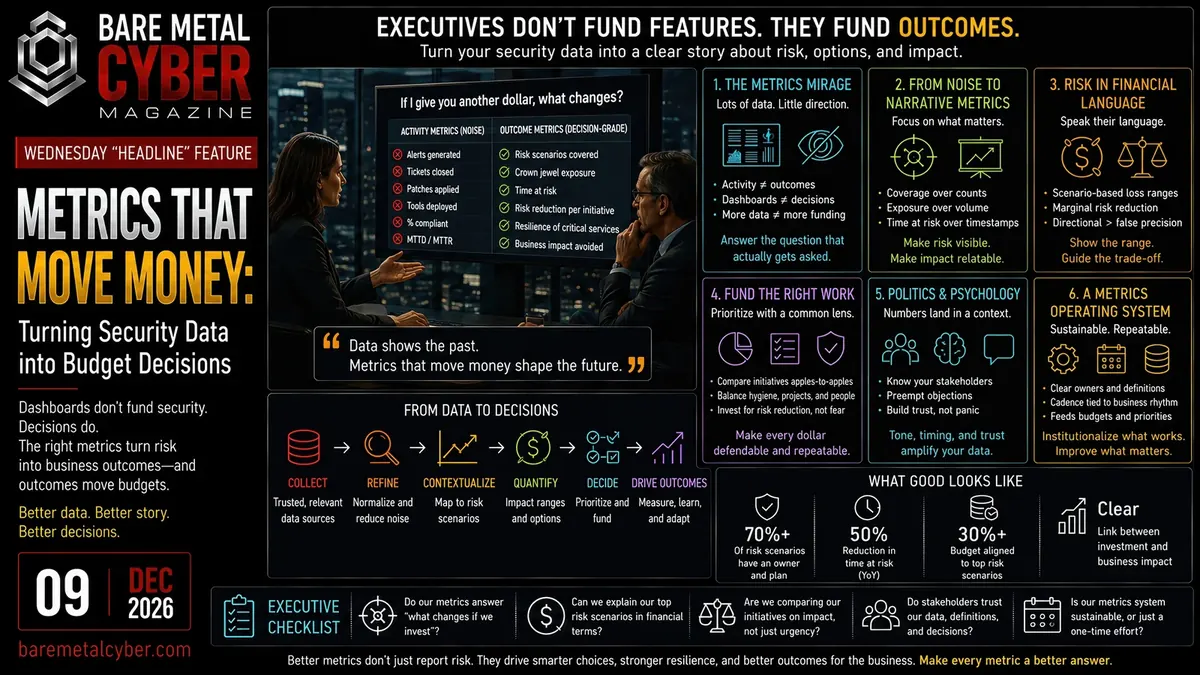
The room is full of charts. Vulnerability counts by business unit, phishing click rates trending down, mean time to detect edging in the right direction. The Chief Information Security Officer (CISO) is walking the executive team through slide twenty-seven when the Chief Financial Officer (CFO) politely interrupts with the only question that really matters: “If I give you more money, what changes?” In too many organizations, that’s the moment the dashboards stop helping and everyone realizes the metrics were never actually designed to move budget decisions.
This Wednesday “Headline” feature in Bare Metal Cyber Magazine is about closing that gap. Most mature security teams are not short of data. They are short of framing: the ability to turn telemetry, ticket queues, and scan results into a small set of decision-ready signals that tell leaders where the next dollar does the most good, when it needs to land, and what risk remains if it doesn’t. Over the next few years, as boards and regulators sharpen their expectations and budgets tighten, that framing becomes the difference between security as a cost center and security as an essential risk function that earns its funding.
For security and technology leaders, the challenge is not to invent yet another metric. It is to build a thin, credible narrative that connects the messy reality of incidents, exposures, and constraints to the language of options and trade-offs that finance and business leaders already use. That means shifting away from volume and activity metrics toward outcome metrics that describe coverage, exposure, time at risk, and resilience in business terms. It means being honest about uncertainty without hiding behind it. And it means treating every metric as part of a story about where you are deliberately placing, reducing, or accepting risk—so when you ask for money, the answer is grounded in more than fear or habit.
The Metrics Mirage
If you sit in on enough governance meetings, a pattern appears. Security walks in armed with dense dashboards: open vulnerabilities, blocked attacks, patch cadence, endpoint coverage, phishing simulation scores. The visuals look sophisticated, and the trends often point in the right direction. But somewhere around slide ten, the non-security executives check out. What they see is motion, not meaning. Activity, not outcomes. The metrics give a sense that something is happening, but they do not answer the question the business is actually asking: “Are we safer in ways that matter to our strategy?”
This is the metrics mirage. It is especially common in organizations with mature tooling and thin connective tissue between security and finance. Tools generate data by default, so teams report what is easy to measure: alert volumes, ticket counts, scan coverage, mean time to detect and respond. Those numbers often improve when a team works hard, so they become a comfort blanket. But to executives responsible for allocating capital across sales, product, operations, and risk, they are at best a health check, not a funding rationale. Busy does not equal better.
The mirage is reinforced by how these metrics are presented. Security leaders often show data in isolation rather than comparison. “We closed twenty percent more critical vulnerabilities this quarter” sounds positive, but it lacks context: relative to what exposure, on which systems, compared to which alternative investments? Without that comparative frame, executives hear “we are doing more work” rather than “we are changing the risk profile in a way that justifies reprioritizing money and headcount.” The absence of clear alternatives keeps the conversation stuck at “give us more” versus “we can’t afford it,” rather than “here are the trade-offs between these three options.”
Leaders who recognize the metrics mirage start to treat many familiar dashboards as internal instrumentation, not board material. The job shifts from reporting everything that moves to curating the few signals that truly inform where risk is concentrated, how fast it is changing, and which investments will move those curves in a meaningful way. That is the pivot point toward metrics that actually move money.
From Noise to Narrative Metrics
Once you see the limits of activity metrics, the next step is not to throw them away. It is to demote them. Alert counts, patch volumes, and phishing click rates still matter as operational dials for teams, but they should feed into a smaller set of narrative metrics that tell a story an executive can repeat to someone else. Narrative metrics answer questions like: where is our exposure concentrated, how long do we stay exposed when something breaks, which capabilities are robust versus fragile, and how does that picture change if we fund a specific initiative. They compress complexity into a few consistent, comparable signals.
A useful pattern is to structure metrics around four themes: coverage, exposure, time at risk, and resilience. Coverage metrics describe how much of the environment is protected or governed by a given control family in business terms: which revenue lines, products, or critical processes rely on covered systems versus legacy or unmanaged ones. Exposure metrics describe the scale and criticality of known weaknesses tied to those same business services. Time-at-risk metrics show how long important assets remain exposed once issues are discovered. Resilience metrics describe the organization’s ability to absorb and recover from incidents that do occur, in terms of customer impact, regulatory impact, and internal disruption.
When you present the same themes over time, with a stable structure, executives begin to build intuition. They see that a project to expand strong identity controls shifts coverage and exposure in a specific business segment. They see that investments in automation change time at risk for certain classes of issues. They see that incident exercises and playbooks improve resilience for high-value services even when the broader vulnerability landscape is messy. The value is not in the absolute numbers but in how they show movement within a consistent story about the organization’s posture.
Narrative metrics also force discipline around ownership. Each metric should map to a steward: someone in security or a partner function who can explain the drivers, articulate realistic targets, and propose options for moving it. That ownership, combined with a stable narrative framework, turns metrics into a living model of how the organization manages digital risk, rather than a quarterly slide ritual. At that point, the conversation about budget begins to sound less like pleading and more like co-managing a portfolio of risks and investment options.
Converting Risk into Financial Language
Even strong narrative metrics hit a ceiling if they never cross the bridge into financial language. Executives live in a world of trade-offs between revenue growth, cost efficiency, and risk. When security metrics stop at “high, medium, low” or “red, amber, green,” they still require translation before a CFO or business leader can compare them to other demands on capital. The goal is not to pretend that cyber risk can be priced with the precision of a bond. It is to give decision-makers a directional, scenario-based view of financial impact that is good enough to compare options and timing.
A practical way to do this is to anchor metrics in a few representative loss scenarios and ranges. For example, a cloud-native SaaS provider might frame one scenario around a prolonged outage in a core service, another around a significant data exposure in a regulated region, and a third around fraud or misuse of customer accounts. For each scenario, the security, finance, and business teams co-create rough impact bands: direct incident response and remediation costs, revenue loss from downtime or churn, contractual penalties, and likely regulatory or legal exposure. Those bands become the backdrop for discussing how changes in coverage, exposure, time at risk, and resilience affect the likelihood and scale of those scenarios.
From there, the conversation shifts to marginal risk reduction. Instead of selling a specific initiative as “improving our security posture,” leaders describe it in terms like: “If we fund this identity modernization work, we reduce the probability of this particular fraud scenario and shorten our time at risk for compromised accounts by a defined amount.” The numbers will always carry uncertainty, but even directional estimates framed as ranges allow executives to compare an additional security dollar against other investments using a familiar financial lens.
Importantly, converting risk into financial language does not mean overpromising return on investment in the way a sales project might. Trying to calculate a precise “ROI of security” can undermine credibility when incidents do not follow the model. Instead, leaders position security spend as reducing the tail risk and volatility around critical business outcomes. When that framing is consistent, executives begin to treat security metrics as inputs to real capital allocation decisions, not as a separate, inscrutable domain.
Funding the Right Work, Not Just the Loudest
Once risk is expressed in narrative and financial terms, the next challenge is where to point the money. In many organizations, budget flows toward the loudest risks: the last breach in the news, the control gap an auditor just highlighted, the area where a senior leader had a painful near miss. Those concerns are not fake, but they distort the portfolio. Quiet, structural weaknesses in identity, visibility, or backup integrity may pose a larger cumulative risk than the headline-grabbing issues that dominate meetings. Metrics that move money force leaders to confront that imbalance.
A portfolio mindset starts by grouping initiatives by the kind of risk they change and the time horizon on which they pay off. Foundational hygiene work—such as hardening identity, cleaning up network segmentation, or stabilizing endpoint management—often moves multiple narrative metrics at once: coverage, exposure, and time at risk across broad swaths of the environment. Targeted projects—for example, adding specialized monitoring around a high-value payment system—may dramatically improve resilience for a narrow slice of the business. Both can be valid, but when you place them side by side against the same set of loss scenarios and financial ranges, the conversation becomes less about who shouts loudest and more about which combination of moves gives the organization the best risk-adjusted outcome for the next budget cycle.
This portfolio view also helps avoid the trap of over-investing in tools at the expense of people and process. Many executives have learned to ask “Do we already own something that does this?” and the answer is often yes, but underused. Narrative metrics can reveal that adding staff to tune and operate existing detection capabilities reduces time at risk more than buying another platform. They can show that investing in incident exercises and playbooks for a critical business line meaningfully improves resilience metrics, where yet another dashboard would simply add to the noise. When leaders see security spending options presented as comparable changes to shared metrics, instead of as isolated requests, they are more willing to rebalance toward the unglamorous work that actually changes outcomes.
Finally, portfolio thinking supports dynamic adjustment. As new threats emerge or the business shifts into a new market, leaders can revisit the metrics and scenarios and adjust the mix of investments without discarding the model. The same narrative and financial frame applies; only the relative weights change. Over time, this makes security a more credible partner in planning, because its funding requests are visibly grounded in a consistent way of weighing trade-offs rather than in episodic fear.
Politics, Psychology, and the Story Around the Numbers
Even beautifully structured metrics do not speak for themselves. Budget conversations are human events, shaped by history, trust, and unspoken fears. Many security leaders have learned the hard way that leading with catastrophe scenarios or red heat maps can backfire. Executives either tune out or become defensive, especially if they feel they are being blamed for underfunding. The story around the numbers matters as much as the numbers. Metrics that move money are delivered with a posture of partnership: “Here is how we see our risk and investment options,” not “Here is why you should be scared.”
One psychological trap is confirmation bias. If finance leaders already view security as a cost center that never has enough, they will look for data that reinforces that view. Similarly, security teams may overemphasize metrics that validate their preferred projects. The way to cut through this is to make the trade-offs explicit and symmetric. For example, a CISO can walk into a planning session with three clearly framed options, each with associated changes to coverage, exposure, time at risk, and resilience, plus rough financial impact ranges. That framing invites shared ownership: the decision is not “approve my budget or not,” but “choose which risk profile we are most comfortable running the business with.” It turns a defensive argument into a joint design problem.
Another dynamic is trust. If past security communications have leaned heavily on worst-case language that did not materialize, leaders may quietly discount new warnings. Conversely, if security has a track record of being transparent about residual risk and admitting uncertainty in estimates, their numbers carry more weight over time. Metrics can either erode or build that trust depending on how they are used. Overstating precision, cherry-picking data points, or moving goalposts to claim success will eventually be noticed. Anchoring on stable narrative metrics, openly updating assumptions, and showing when risk increases as well as decreases signals maturity.
Ultimately, the story wrapped around the metrics should reinforce a simple message: security is here to help the organization make conscious choices about risk, not to win internal battles. When CISOs consistently frame their metrics as tools for joint decision-making, rather than as weapons in a funding fight, they change the emotional temperature in the room. That shift in tone, over multiple planning cycles, can have as much impact on budget outcomes as any individual data point.
Building a Metrics Operating System
If metrics are reinvented every quarter, they never become decision infrastructure. To move money consistently, they need to behave more like an operating system than a slide deck: a small set of stable concepts, clear ownership, and predictable rhythms where the data is reviewed and acted on. That starts with agreeing on the core narrative dimensions—coverage, exposure, time at risk, and resilience—and mapping each to a small number of concrete measures. The specifics will evolve as tools and assets change, but the scaffold stays the same. Executives should recognize the frame from one planning cycle to the next, even if the underlying numbers and examples are different.
Ownership is the next layer. Each metric needs a steward in security who understands its drivers and limits, plus partners in finance and the business who help interpret it. For example, a security lead might own the data feeding a “time at risk for critical internet-facing assets” metric, while a finance partner helps calibrate which assets matter most to revenue, and a product or operations leader provides context on upcoming changes. This joint stewardship makes it more likely that the metrics will reflect real business dynamics, not just whatever a given tool can easily report. It also spreads the cognitive load: no single team is responsible for translating everything into business language alone.
Finally, a metrics operating system requires deliberate integration into planning and review rituals. Quarterly business reviews, annual budget cycles, risk committee meetings, and major product launch decisions are all touchpoints where the same core metrics can be used to inform choices. Instead of creating new custom reports for each forum, leaders reuse and adapt the same narrative framework, updating only the numbers and scenarios. Over time, this creates muscle memory: when a new risk emerges or a major investment is proposed, everyone knows which metrics to ask for and how to read them. Security becomes part of the organization’s standard way of understanding and trading off risk, rather than an occasional, opaque voice at the table.
Where Leaders Go From Here
At its heart, this topic is about treating security metrics as a language for shared decisions, not as decoration for a dashboard. When a CISO walks into a budget meeting armed only with activity counts and red heat maps, they are asking executives to make capital allocation choices in a foreign tongue. When those same numbers are recast as a narrative about coverage, exposure, time at risk, and resilience, anchored in a few clear risk scenarios and financial ranges, they start to answer the real question: “If we invest here instead of there, how does our risk profile change, and when will we feel it?”
The opening scene of a CFO interrupting slide twenty-seven does not have to be a recurring ritual. Leaders who build a metrics operating system—stable concepts, known stewards, predictable review rhythms—turn those tense moments into more matter-of-fact portfolio discussions. Instead of defending line items, security and business leaders weigh combinations of options, acknowledging uncertainty without being paralyzed by it. The politics and psychology around risk are still present, but the story around the numbers shifts from fear and blame to design and trade-offs. Over multiple planning cycles, that shift builds trust and makes it easier to secure funding for the unglamorous work that actually moves the metrics.
When a leadership team truly internalizes this model, security stops being a black box in the budget and becomes part of the organization’s normal way of reasoning about risk and value. The question for CISOs and technology leaders is no longer “How do I get more money?” but “How do we build a shared view of risk where the right funding decisions become obvious?” A practical starting point is simple: in your next planning conversation, ask which two or three narrative metrics would make everyone more confident about where the next security dollar should go—and what would need to change in your reporting to make that possible.