The room is full of roadmaps. Product has a three-year vision plastered on the wall, architecture has its platform modernization lanes, and security has a slide with “post-quantum cryptography (PQC)” circled in red. Everyone agrees quantum will matter “someday,” but no one can give a date, a budget, or a clear trigger for when the real work starts. The risk feels abstract, the timelines feel political, and the easiest move is to push the conversation to “next planning cycle” while everything else screams for attention. This is where post-quantum paralysis sets in: leaders know a foundational change is coming, but they cannot justify stopping the world to prepare for it.
In this Wednesday “Headline” feature from Bare Metal Cyber Magazine, we are not going to argue about which algorithm wins or what year “Q-day” arrives. The more consequential question for security and technology leaders is how to prepare your estate and your teams so that a cryptographic shift can happen without blowing up everything else you are trying to deliver. PQC is not just a crypto problem; it is a systems, governance, and product problem that unfolds across years, not sprints. The risk is not only “harvest now, decrypt later” against long-lived data; it is also the operational and political damage of discovering, too late, that your identity stack, PKI, or embedded fleet cannot move at the pace regulators and customers now expect.
Over the next decade, the organizations that handle PQC well will treat it less like an emergency rewrite and more like a controlled refactor of critical assumptions. That means mapping where cryptography truly anchors trust in your environment, separating hype from legitimate long-horizon risk, and building crypto agility into the platforms and contracts you are signing today. It also means resisting two equal and opposite temptations: the performative, all-or-nothing “quantum program” that derails more urgent security work, and the quiet hope that standards, vendors, or regulators will eventually resolve everything for you.
This article is about how to lead through that tension. How to identify the “crypto gravity wells” that will slow you down, how to prioritize long-lived data and systems without freezing your roadmaps, and how to move PQC from a scary slide at the end of the deck into a steady, governed part of how you build and ship.
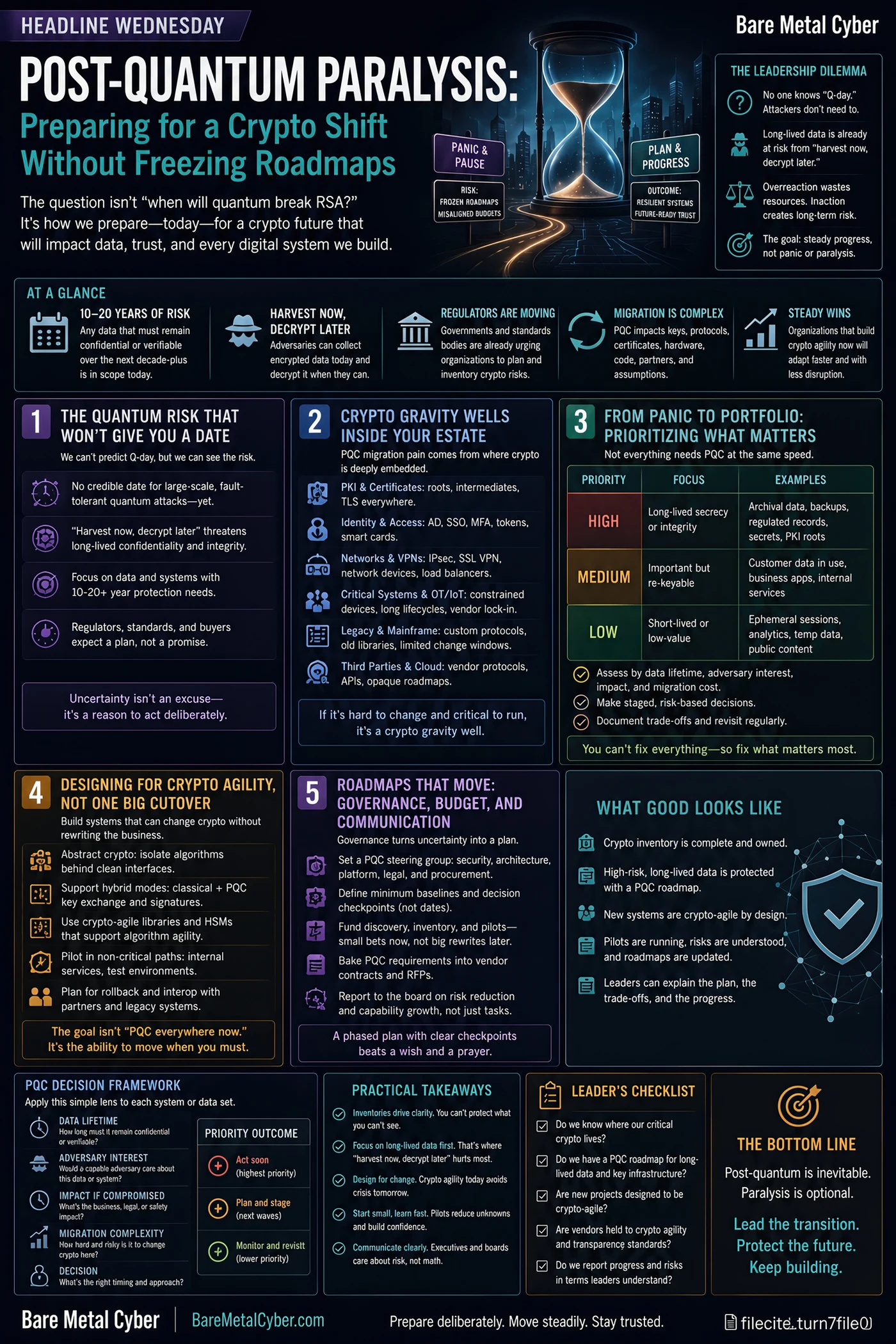
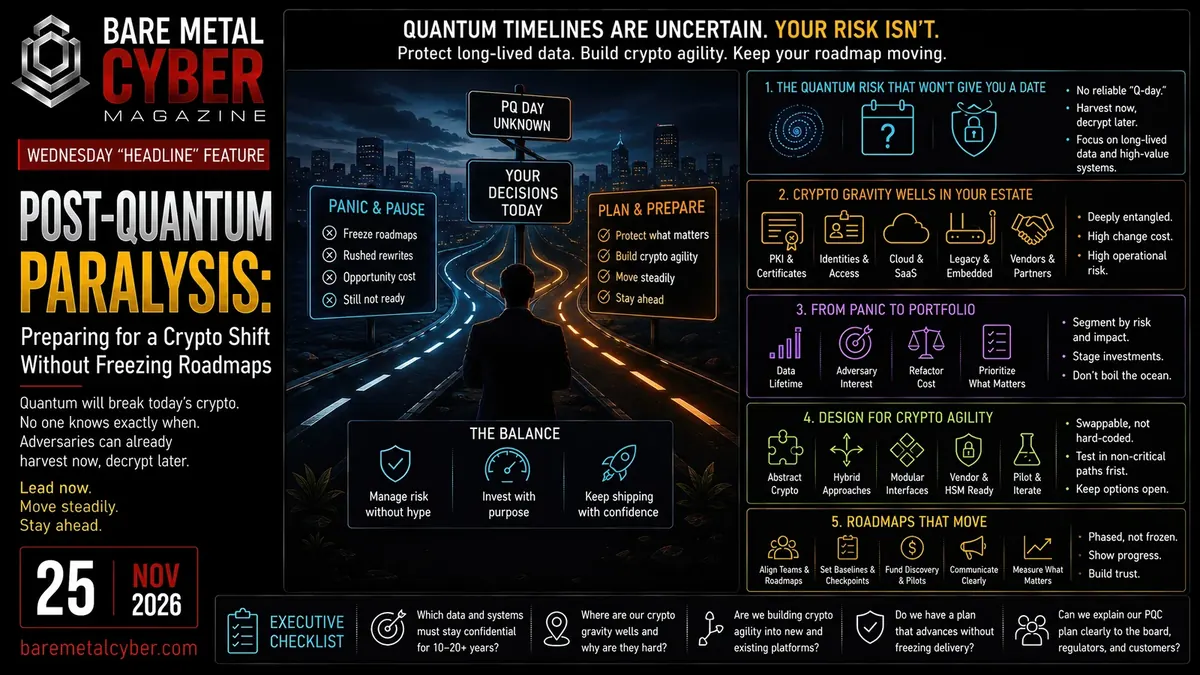
The Quantum Risk That Won’t Give You a Date
The hardest part of post-quantum planning is that there is no calendar event you can anchor to. Quantum capability will not show up as a clean “Q-day” alerting you that RSA and elliptic curve are broken in production; it will emerge as gradual, uneven progress that only becomes obvious in hindsight. Meanwhile, the cryptographic assumptions your business relies on are already baked into contracts, architectures, and regulatory expectations. The result is a messy ambiguity: you know that long-lived secrets are exposed to “harvest now, decrypt later” threats today, but you cannot prove when that exposure turns from theoretical to real.
For leaders, the risk is not just futuristic espionage. It is the combination of adversaries quietly recording traffic now, the long shelf life of certain data sets, and your own inability to retrofit trust anchors on demand. Long-lived assets like intellectual property archives, health records, financial histories, critical infrastructure telemetry, and state-sensitive communications do not care that your product roadmap is built around two-year horizons. If an attacker can store encrypted traffic today and decrypt it in 10–15 years, many of your “old” design decisions will suddenly look reckless. That is the time horizon where post-quantum cryptography (PQC) actually bites.
At the same time, standards bodies and vendors are still moving. The National Institute of Standards and Technology (NIST) is standardizing candidate algorithms, but details around performance, side-channel resistance, and deployment patterns will continue to evolve. Your cloud providers, hardware security modules, and network stacks are all on different clocks, driven by their own risk and commercial incentives. Betting everything on a specific date, algorithm, or vendor promise is as risky as ignoring the problem altogether. The only honest answer you can give your board today is that quantum risk is real for certain classes of data, uncertain in timing, and unevenly distributed across your estate.
This is the tension that creates post-quantum paralysis: leaders feel they are being asked to commit to an expensive, multi-year migration without a clear external deadline, while every other project on the roadmap has immediate, measurable payoff. The way out starts with reframing. Instead of asking “when will quantum break us?”, you shift to “which decisions today create irreversible exposure for long-lived data tomorrow?” That question leads naturally to the next step: understanding where your cryptography actually lives and which parts of the environment will be slowest to move.
Crypto Gravity Wells Inside Your Estate
When leaders first hear “prepare for post-quantum cryptography,” the instinct is to think about algorithms and key lengths. In practice, the real difficulty lies in the places where cryptography is deeply fused with identity, connectivity, and uptime. These are your crypto gravity wells: systems where certificates, keys, and protocols are so entangled with operations and third parties that any change feels like open-heart surgery. You cannot treat these domains as simple library upgrades; they are trust infrastructures that support everything else.
Public key infrastructure, identity providers, and access gateways are usually the biggest wells. Your certificate authorities underpin device trust, API authentication, mutual TLS between services, and sometimes your entire machine identity program. Your identity stack and VPN or Zero Trust Network Access (ZTNA) layers depend on specific key types and handshakes. If those components cannot support hybrid or quantum-safe modes without major redesign, you are not just changing crypto; you are re-threading the way users, workloads, and partners prove who they are. That is why “we’ll just swap in post-quantum algorithms later” is rarely credible once you look at where these keys actually live.
Then there are the stubborn edges: embedded devices, operational technology, and vendor protocols you do not fully control. IoT fleets that cannot be easily updated, field equipment with long lifespans, payment terminals, and proprietary appliances all represent frozen crypto assumptions. The same is true for mainline business systems that rely on tightly integrated crypto stacks—core banking platforms, trading engines, or healthcare record systems where any change triggers long validation cycles. Even if your cloud and app teams adopt crypto-agile patterns, these heavy systems will dominate your effective speed of migration.
Finally, you have vendor and ecosystem dependencies that sit outside your direct engineering control. Managed services, SaaS platforms, interbank messaging networks, and industry clearinghouses all make their own decisions about when to support quantum-safe algorithms, hybrid modes, and new certificate formats. Your contracts, SLAs, and integration patterns may quietly assume today’s cryptography for the life of the relationship. If you do not surface these gravity wells early, you will discover them in the worst possible way: when regulators or customers start asking for quantum-safe assurances and your answer is “we’re waiting on our providers.”
Seeing these gravity wells clearly changes the PQC conversation. It stops being an abstract “crypto refresh” and becomes a map of where your trust foundations are likely to resist change. That map is what you need to move from fear and vague mandates to a portfolio of concrete, prioritized decisions.
From Panic to Portfolio: Prioritizing What Really Matters
Once you see where cryptography actually anchors trust in your estate, the temptation is to either declare a grand “post-quantum transformation program” or quietly bury the topic under more immediate fires. Both are mistakes. The more sustainable move is to treat PQC as a portfolio of bets across data classes and systems. Not everything needs the same level of urgency or investment. Long-lived, high-value data that adversaries would happily store for decades deserves a very different strategy than ephemeral telemetry from an internal test environment. The goal is not to upgrade every cipher at once; it is to remove the worst long-term exposures first while preserving room to maneuver.
A useful way to think about the portfolio is along three dimensions: data lifetime, adversary interest, and refactor cost. High-lifetime, high-interest data includes things like sensitive intellectual property, intelligence or defense information, certain financial and health records, and critical infrastructure designs. If those are protected by public key schemes likely to be broken in a quantum future, you have a real “harvest now, decrypt later” problem. By contrast, a short-lived marketing campaign environment or a low-sensitivity internal app may never justify a complex migration if the cost of refactoring dwarfs the residual risk. Leaders need to explicitly bless this differentiation instead of chasing a uniform standard that silently stalls.
Then you layer in practicality. Some systems may be ideal early adopters because they already sit on modern, crypto-agile platforms or are in active development. Others will be so tightly coupled or regulated that any change requires multi-year planning and external coordination. Portfolio thinking lets you stage PQC work in waves: first, reduce exposure around long-lived, high-interest data using techniques like hybrid key exchange or quantum-safe key management for archives and backups; second, build crypto agility into new platforms so future migrations are cheaper; third, plan for the slow, negotiated shifts in your most stubborn gravity wells. The critical leadership act is to make these trade-offs explicit, visible, and revisitable, rather than allowing them to be decided implicitly by whatever team shouts loudest in a given planning cycle.
Designing for Crypto Agility, Not One Big Cutover
If you accept that there is no clean “Q-day” and no single migration window, then the only sane strategy is crypto agility. Crypto agility means your systems can evolve as algorithms, libraries, and regulatory expectations change, without requiring a full rewrite every time. Many organizations pay lip service to this idea while keeping cryptography wired directly into application logic, protocols, and database schemas. When your TLS choices, key formats, and certificate lifecycles are hard-coded into dozens of services, you are effectively betting that today’s decisions will age perfectly. PQC exposes how unrealistic that assumption has always been.
The architectural move is to treat cryptography as a platform capability, not a per-project detail. That often starts with clean interfaces to key management, signing, and key exchange, so that applications consume “sign,” “verify,” or “establish session” services through well-defined APIs, rather than instantiating specific algorithms themselves. It means standardizing how services obtain identities and certificates, centralizing trust policy, and ensuring that both classical and PQC algorithms can be supported in parallel. Hybrid patterns—like combining a classical key exchange with a quantum-safe one—allow you to experiment, measure performance, and gain operational experience without betting the farm on a single step-change.
Vendors and hardware matter too. Hardware security modules, smart cards, and secure enclaves all have their own roadmaps for supporting new primitives. If your crypto posture depends on hardware that cannot evolve, you have just moved the rigidity problem down a layer. Leaders need their teams to evaluate whether current platforms can support PQC and hybrid modes, what firmware and certification cycles will look like, and how to avoid creating new proprietary dead ends. That includes looking at contract language and support commitments, not just technical datasheets. The end state is not a single PQC standard frozen in time; it is an ecosystem where changing algorithms, increasing key sizes, or adding hybrid schemes becomes part of normal platform maintenance.
When you design for crypto agility, the PQC shift stops being an all-or-nothing cliff and becomes one of many evolutions in your trust stack. You still need to make hard choices about timing and priority, but you are no longer trapped by past decisions that assumed cryptography would stand still. That sets the stage for the last piece of the puzzle: how to embed all of this into roadmaps, governance, and communication so the organization keeps moving instead of freezing.
Roadmaps That Move: Governance, Budget, and Communication
Even with a clear risk picture and crypto-agile architecture, PQC progress lives or dies in your planning process. Roadmaps are where good intent goes to stall. If post-quantum work shows up as an isolated security initiative, it will lose every time to visible feature revenue and compliance deadlines with fixed dates. The governance shift is to embed PQC into the same planning machinery that decides platform upgrades, technical debt paydown, and major product bets. That means describing PQC not as a speculative project, but as part of how you keep your trust infrastructure current over the next decade.
A practical pattern is to create a small number of explicit PQC objectives tied to existing streams rather than launching a single monolithic program. For example, you might tie “crypto agility for internal service-to-service traffic” to your platform engineering roadmap, “quantum-safe protection of long-lived archives” to your data and backup strategy, and “partner and vendor readiness” to your third-party risk program. Each objective gets owners, milestones, and budget within an existing lane. This avoids the trap where PQC sits on a separate slide that never quite makes it into funded work. Progress can then be tracked through concrete indicators: number of systems moved onto crypto-agile interfaces, percentage of long-lived data with quantum-safe key management options, number of critical vendors with articulated PQC plans.
Communication is just as important as governance. Boards and executive committees do not need curve diagrams; they need to understand that quantum risk is real for particular categories of data and systems, that you have identified where it matters, and that you are integrating mitigation into existing investments instead of stopping the business. Regulators will increasingly expect to hear how you are planning for PQC as part of broader resilience conversations. Internally, product teams and architects need a clear message that PQC is not a surprise rewrite waiting to ambush them later, but a set of design expectations and decision checkpoints they can plan around now. When you can show that PQC has a home in your roadmaps, a way of measuring progress, and a narrative that connects it to trust and resilience rather than fear, you break the paralysis and turn quantum uncertainty into one more thing your organization is ready to manage.
Where Leaders Go From Here
At its heart, this topic is about learning to steer through a foundational cryptographic shift without halting everything else your organization needs to build. Post-quantum risk is not a countdown clock; it is a slow-moving fault line running under your long-lived data and your most rigid trust systems. The real danger is not just future decryption by well-resourced adversaries, but discovering, too late, that your PKI, identity stack, or embedded fleet cannot adapt at the speed regulators, partners, and customers now expect. When leaders see PQC as an all-or-nothing cliff, paralysis is almost guaranteed.
Tying back to that roadmap room, the difference between a stuck conversation and a constructive one is the mental model you bring to it. Instead of demanding a date or a single “quantum program,” you map crypto gravity wells, classify data by lifetime and adversary interest, and push architecture toward crypto agility so future shifts are less traumatic. You embed PQC into platform, data, and vendor strategies rather than positioning it as a one-off crusade. Once you do that, quantum becomes another driver of disciplined engineering and governance, not an existential distraction that lives only in security slides.
For leaders, internalizing this argument changes the questions you tolerate. “Can we ignore PQC for a few more years?” gives way to “Which decisions today would we regret if an adversary decrypts this traffic in 10–15 years?” and “Where are we locked into crypto that cannot evolve?” The next step is not a giant initiative; it is a set of pointed conversations. Ask your teams: where are our crypto gravity wells, what is our portfolio of long-lived data, and how do we build crypto agility into the platforms we are already funding? Those questions will do more to break post-quantum paralysis than any speculative date on a slide.