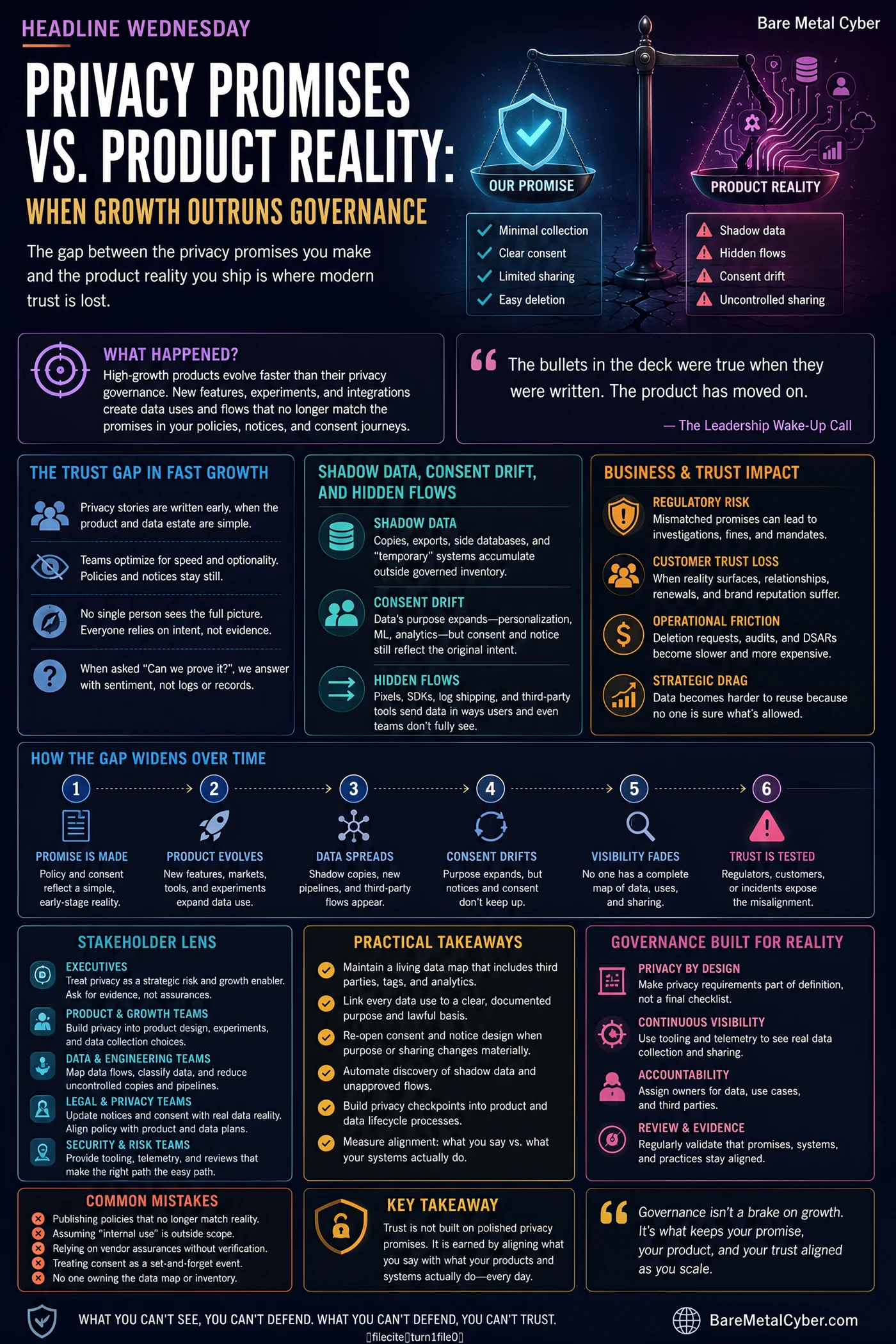
The leadership team is walking through the latest board deck when someone flips from the revenue slide to the “Data Protection and Privacy” page. The bullets are clean: minimal collection, clear consent, limited sharing, easy deletion. Everyone nods, because that story was true when it was written. But in the product, a dozen growth experiments, three “temporary” pipelines, and a quietly rolled-out machine learning feature have turned that story into something no one in the room could confidently defend under scrutiny. That gap between the privacy promises you make and the product reality you ship is where modern trust is lost.
This Wednesday “Headline” feature in Bare Metal Cyber Magazine takes that gap seriously as a governance problem, not just a legal or marketing issue. In high-growth digital businesses, product, data, and growth teams are rewarded for moving fast, instrumenting everything, and reusing data in creative ways. Privacy governance usually arrives later, often anchored in policies and notices that assume a simpler estate than the one that exists today. Leaders find themselves signing off on statements about collection, consent, and sharing that may once have been accurate but no longer match the tangled paths data now takes through tags, third-party tooling, and internal analytics.
Over the next few years, regulators, customers, and boards will care less about polished privacy promises and more about whether you can prove that what you say is actually what happens in production. That means the core question for security and technology leaders is not “Do we have the right policy language?” but “Is governance wired into the way we design, ship, and evolve products?” This article explores how trust gaps emerge in fast growth, how shadow data and consent drift become normal, and how to rebuild governance so that your privacy story and your product reality stay aligned under real-world pressure.
The Trust Gap in Fast Growth
In a young product company, the first privacy story is usually written when someone needs to publish a policy or close a deal. It reflects a relatively simple reality: a handful of core features, a small set of third parties, a straightforward data model. Then growth hits. New markets appear, experiments multiply, marketing wants more attribution data, data science wants a bigger training set, and customer success wants richer telemetry. The organization optimizes for speed and optionality. The privacy words stay still while the data reality accelerates away from them. That is the trust gap: the distance between what you say about data and what your systems now actually do.
The problem is not that people are lying. In most high-growth environments, no single person can see the full picture anymore. Product managers understand the features they own but not the full tracking and enrichment stack behind them. Security teams know the infrastructure but not the nuances of consent language or dark patterns in the user interface. Legal teams negotiate data protection addenda but have limited visibility into which teams stood up “temporary” pipelines in a separate cloud account. Each group relies on a shared belief that the organization is roughly aligned with its stated privacy posture, even when the evidence is thin.
For leaders, the early warning signs are subtle but consistent. You hear confident statements like “we only use this data to improve the service” while knowing that multiple teams are using the same dataset for personalization, pricing experiments, and model development. You see privacy questions handled as one-off ticket responses rather than triggers for updating upstream design and data practices. You notice that when someone asks “Can we prove we are doing what we say?”, the room answers with sentiment and intent rather than logs, diagrams, or decision records. At that point, the trust gap is no longer hypothetical; it is a structural governance failure waiting to be exposed by a regulator, a plaintiff’s lawyer, or a sophisticated customer.
Shadow Data, Consent Drift, and Hidden Flows
Once you look past the high-level architecture diagrams, most organizations discover a second, messier map of where personal data actually lives. Shadow data emerges from the practical shortcuts teams take to ship: exporting CSVs for “quick” analysis, copying production data into lower environments, spinning up sidecar databases for a new feature, or letting a vendor connect directly into event streams. Over time, those copies and side systems accumulate into an ungoverned estate. They are rarely reflected in the privacy risk register, and they almost never get the same lifecycle care as primary systems. When the business later needs to honor a deletion request or prove a retention limit, these forgotten stores become liabilities.
Alongside shadow data sits consent drift. A few years ago, the company may have introduced clear user flows: here is what we collect, here is why, here is how you can opt out. But as product teams add new uses, integrate a recommendation engine, or introduce new behavioral analytics, the data’s purpose quietly expands. What started as telemetry “to keep the service reliable” now fuels personalization, experimentation, and machine learning models. The consent language, however, still reflects the original, narrower purpose. Even in organizations that care about privacy, there is often no routine to re-open consent and notice design whenever data is repurposed in a material way. The drift happens slowly, one JIRA ticket and launch at a time.
Hidden flows are the connective tissue that makes all of this hard for leaders to see. Pixels added by marketing agencies, software development kits in mobile apps, log shipping into third-party observability platforms, sync jobs between internal tools, and “temporary” feature flags that never die all create pathways where personal data moves in ways that are invisible to most decision-makers. On paper, the organization might claim that data is shared only with a defined set of processors under the General Data Protection Regulation (GDPR) or handled within clear boundaries under the California Consumer Privacy Act (CCPA). In practice, data hops across dozens of services and vendors. Until leaders insist on a living, technically grounded view of data flows, shadow data, consent drift, and hidden routes will continue to undermine even the most earnest privacy promises.
Governance That Ships at Product Speed
Traditional privacy programs often assume that governance happens in slow, discrete phases: write a policy, run a one-time data inventory, do an annual training, file a few data protection impact assessments, and call it done. That model cannot survive in a world where product changes roll out daily and data uses evolve through continuous experimentation. Governance that works in high-velocity environments does not sit on the sidelines as a review function; it is embedded into product planning, design, engineering defaults, and release workflows. The key shift for leaders is to stop treating privacy as a separate lane and start treating it as a property of the product, enforced through the same mechanisms that keep uptime and performance on track.
Practically, that means moving beyond static checklists toward controls that are triggered automatically by the work itself. When a product team proposes a new feature that uses sensitive data, the intake process should not just create a legal ticket; it should also initiate a privacy and security review path with clear owners, evidence requirements, and non-negotiable gates. Engineering platforms can enforce patterns like central consent services, approved libraries for tracking and experimentation, and standardized ways to tag and classify data. Product and design reviews can include explicit prompts: “What is the stated purpose for this data? Where is that reflected in user-facing language? What happens if someone revokes access later?” Governance becomes part of the definition of done, not an afterthought.
To sustain this at scale, leaders need observability for privacy, not just for infrastructure. That means dashboards that show where personal data is flowing, which systems handle deletion and access requests, and where new uses of data are being introduced without corresponding updates to notices and controls. It also means tying governance metrics to outcomes that matter to product and growth leaders: time to launch with compliant designs, number of experiments run on properly consented data, or reduction in orphaned datasets over time. When governance is framed as a way to ship faster without nasty surprises, rather than as a brake, high-performing teams will treat it as an enabler instead of a hurdle.
Incentives, Ownership, and the Privacy Theater Trap
If the structures of incentives and ownership stay unchanged, even well-designed governance patterns will eventually collapse into privacy theater. Privacy theater is what happens when the organization learns to perform compliance for auditors and customers without altering the underlying behaviors that create risk. Dashboards show completion rates for training and assessments, privacy notices are updated on schedule, and an impressive roster of policies sits on the intranet. Meanwhile, product teams still feel that their careers depend on velocity and growth more than on respecting consent boundaries or minimizing invasive data uses. The system gets extremely good at looking compliant while remaining fragile under real scrutiny.
Ownership gaps accelerate this slide into theater. Legal teams may feel they “own” privacy because they draft policies and handle regulators. Security teams may feel adjacent but not responsible because they focus on breaches and controls, not purpose limitation. Product and data science leaders are often told they are “accountable” for respecting privacy but are given no concrete authority over third-party choices or data lifecycle. The result is that no one function feels empowered to say no when a proposed experiment or partnership is misaligned with privacy promises, particularly if it has a strong revenue story. Leaders hear, “We’ll document it and move on,” instead of, “This crosses a line we have committed not to cross.”
Fixing this requires aligning incentives and ownership with the reality that privacy is a product and trust issue, not just a regulatory one. That can mean treating significant privacy incidents or misalignments as material product defects, with the same weight as an extended outage. It can mean giving specific executives explicit accountability for keeping privacy promises and tying part of their performance evaluation to measurable alignment between declared practices and observed behavior. It can also mean rewarding teams that design experiments and features to be privacy-respecting from the start, rather than heroizing last-minute legal cleanups. When people see that career progression, budget, and recognition track with genuine stewardship of user data, the organization has a chance to move beyond theater into integrity.
Designing for Auditability and Future Scrutiny
Even when intentions are good and governance is improving, leaders still need to assume that sooner or later they will be asked to prove how personal data has been used. That proof may be requested by a regulator, a court, a major customer, or an internal audit committee. Designing for that moment means treating auditability as a first-class requirement, not a bolt-on task for the compliance team. It is the difference between scrambling to reconstruct a chain of events from scattered logs and tickets, and being able to walk someone through a clear story: here is what we said we would do, here is how the system is built, and here is the evidence that our behavior matches our promises.
Auditability starts with being explicit about purpose and lineage. When a new feature or data use is proposed, leaders should expect to see a short, durable statement of purpose tied to concrete systems and datasets, not just a sentence in a slide deck. Data lineage should show not only where data originates but how it is transformed, combined, and shared across environments and vendors. This does not require perfect, real-time diagrams for every microservice, but it does require enough fidelity that someone outside the implementation team can trace how a given category of personal data moves through the estate. Without that, even honest organizations will struggle to defend themselves under questioning.
The other pillar is decision recordkeeping that matches the scale of change. When a company chooses to repurpose telemetry for personalization, to retain certain events longer for fraud detection, or to introduce a new third-party analytics provider, those decisions should leave an accessible trail. That trail can include risk assessments, approvals, and implementation notes that connect back to the stated privacy posture. Crucially, it should be possible to sample production behavior against those decisions: do logs, configuration settings, and vendor contracts align with what was approved? Leaders who invest in this kind of “show your work” culture are not just preparing for enforcement. They are creating an environment where the organization can learn from its own decisions and adjust course before someone else forces the issue.
Where Leaders Go From Here
At its heart, this topic is about whether leaders are willing to make privacy promises that match how their products actually behave, not just how they wish they behaved. The boardroom moment where privacy bullets no longer feel defensible is not just a communications issue; it is a signal that growth, experimentation, and governance have drifted apart. The trust gap opens when data is allowed to move faster than the mechanisms that shape and document its use. Closing that gap requires more than better policy language. It demands a change in how decisions are made, recorded, and enforced across product, data, and risk functions.
The throughline in this Wednesday “Headline” feature from Bare Metal Cyber Magazine is that the gap is created by ordinary, rational choices: spinning up pipelines to hit a deadline, adding tracking to improve growth, reusing telemetry to unlock new features. Those choices are not going away. What changes when leaders internalize this argument is the posture around them. Shadow data, consent drift, hidden flows, and privacy theater stop being background noise and start being treated as structural risks that can derail strategy, not just irritate compliance teams. Governance becomes something that ships at product speed, auditability becomes a design goal, and ownership and incentives start to align with true stewardship of user data.
The practical move is not to freeze innovation but to insist on integrity at the same tempo as growth. That may mean reworking intake and review paths, redefining executive accountabilities, and investing in data lineage and decision records that can stand up to real scrutiny. It also means changing the conversation. Instead of asking “Are we compliant?” as a binary, leaders can ask their teams: “Where are we most at risk of saying one thing about privacy and doing another?” and “What evidence would we show a regulator or strategic customer tomorrow?” Those questions, asked regularly and taken seriously, are how you keep privacy promises and product reality from drifting into different worlds.