The last purple team exercise “went great” on paper. The red team got in, the blue team caught them, everyone learned a few things, and a dense report landed in a shared drive. Six months later, your incident patterns look the same, your architecture debts are still there, and budget lines have barely moved. The scoreboards, neatly color-coded findings, and slick debriefs felt productive, but they did not actually change how the organization allocates money, accepts risk, or designs systems.
This Wednesday “Headline” feature in Bare Metal Cyber Magazine treats purple teaming as a form of statecraft, not sport. Statecraft is about shaping the environment so that different decisions become possible, and then likely. In security terms, that means using exercises to expose real trade-offs, create shared facts between engineering and security, and drive concrete shifts in ownership and roadmaps. Instead of asking whether the purple team “won,” the more serious question for a Chief Information Security Officer (CISO) or Chief Technology Officer (CTO) is whether any meaningful commitments were made as a result.
Over the next 12–24 months, as more organizations add purple teaming to their playbooks, the differentiator will not be who runs the most exotic scenarios or deploys the fanciest tools. It will be who treats these exercises as an engine for decision-making: which risks get tolerated, which architectural bets get reversed, which identity or data problems finally move from “known issue” to funded program. This article walks through how to design, run, and integrate purple team work so that it behaves less like a one-off war game and more like a steady instrument of strategy. The goal is simple: every exercise leaves your security posture and your governance conversations noticeably different, not just your slide decks.
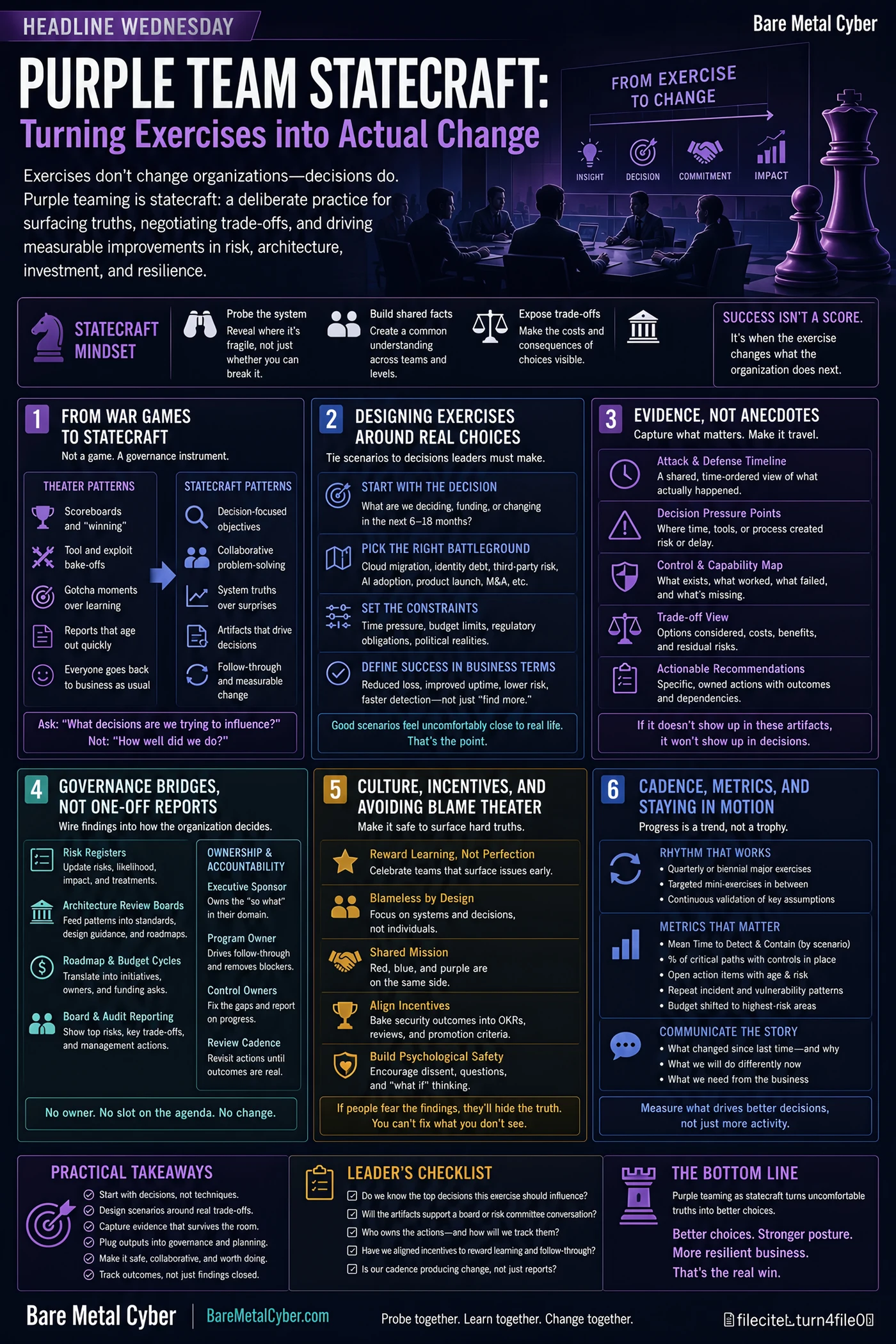
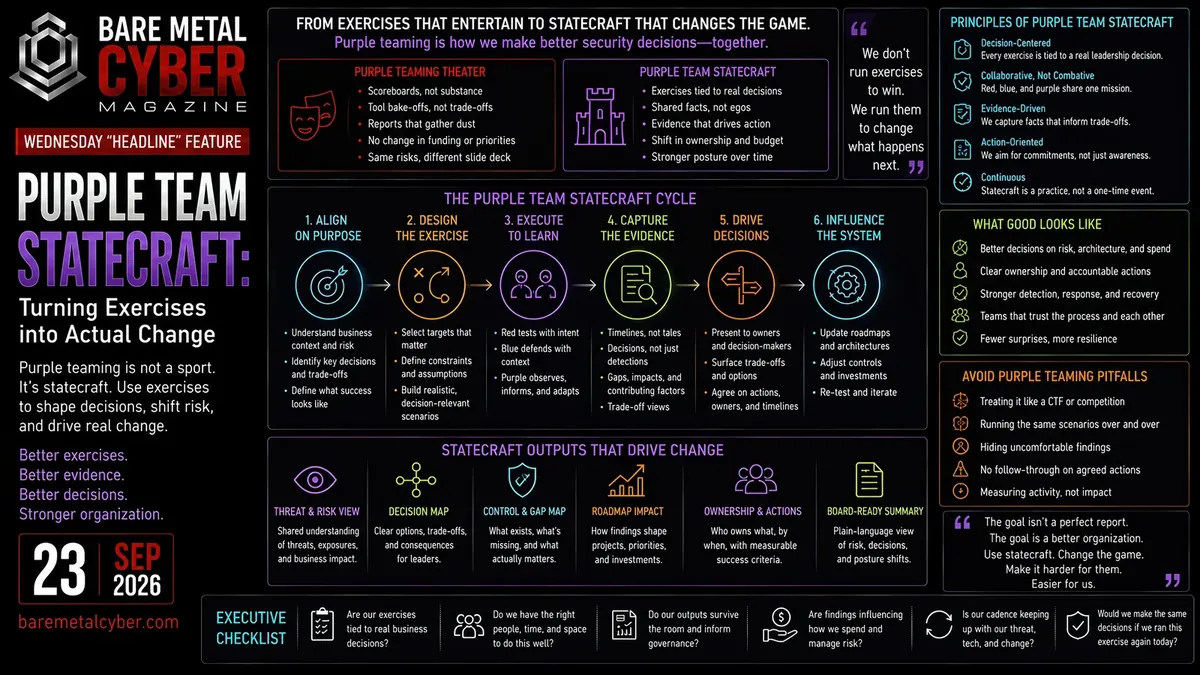
From War Games to Statecraft
Most organizations still talk about purple teaming like a technical war game. Red and blue gather in a room, agree on some rules of engagement, run a scenario, and measure whether detections fired and playbooks worked. The energy is high, the jargon is thick, and the outcome is often framed in win–lose language: did we catch them, how fast, and with which tools. That framing is fine for proving out point products or building camaraderie, but it is a weak instrument for changing how a company actually manages risk.
Treating purple teaming as statecraft means asking a different question up front: what do we want this exercise to change. Not “what do we want to test,” but which assumptions, priorities, or investment patterns should shift if the exercise is successful. In a cloud-native software company, that might be the assumption that every workload must be internet-accessible “for flexibility.” In a regulated financial institution, it might be the quiet belief that identity debt is tolerable because “we’ll fix it in the next directory migration.” When you think in terms of statecraft, the exercise is a probe into the system’s power structures and habits, not just its controls.
This reframing also changes how leaders judge success. A useful purple team engagement might uncover an ugly pattern that everyone already suspected, but that had never been documented in a way the Chief Information Officer (CIO) or product leadership could not ignore. It might produce a simple decision narrative that makes it easier to say no to a risky shortcut in the next steering committee. The point is not to rack up detections or clever attack paths for their own sake. The point is to create shared facts with enough credibility and clarity that they can survive political friction and be used to negotiate real changes in architecture, roadmaps, and budget.
Designing Exercises Around Real Choices
When purple team exercises are scoped around “coverage” instead of choices, they quickly become laundry lists: test some phishing, test a web app, test some lateral movement, and see what happens. Leaders then receive a correspondingly unfocused debrief that is hard to attach to any specific decision. To behave like statecraft, the exercise has to be framed around one or two real choices that sit on a roadmap, in a risk committee, or in a budgeting cycle. You are not just asking “can we detect lateral movement,” you are asking “does our current identity model and segmentation approach actually justify the bet we are about to make on cloud expansion or new AI services.”
A practical way to do this is to start with a genuine leadership dilemma and work backward into the scenario. If your organization is debating whether to consolidate identity providers, the purple team focuses on attack paths that exploit current identity sprawl, privilege creep, and brittle conditional access logic. If you are considering a big push into external AI copilots, the exercise targets how data moves from core systems into prompts, plugins, and third-party connectors. Each step of the scenario is chosen because it tells you something about the cost and risk of specific options on the table, not because it makes for an entertaining kill chain diagram.
This decision-centered design also shapes constraints and scoring. Instead of generic success metrics, you agree up front on what “evidence of risk” would look like in a way that is legible to executives: which assets were reachable, which controls were bypassed, which assumptions about monitoring or incident response turned out to be wrong. You want to emerge with a set of findings that make the choice clearer: maintain the current course and accept these documented exposures, or fund and prioritize changes that the exercise has made tangible. When done well, the purple team becomes a decision rehearsal, not just a test of technical reflexes.
Evidence, Not Anecdotes
One of the fastest ways to squander a good purple team exercise is to let the output collapse into colorful anecdotes. “We pivoted from this forgotten service account into production in ten minutes” makes for a gripping hallway story, but it does not help a Chief Information Officer or product leader weigh trade-offs. Leaders need evidence that can stand up in a planning meeting, not war stories that depend on who happens to be in the room. Purple teaming that behaves like statecraft starts by deciding what evidence will be produced, who it is for, and how it will be used in downstream conversations.
The most useful purple team artifacts are structured, repeatable, and boring in the best possible way. Timelines that show how long an attacker could operate before meaningful detection or containment. Control maps that connect each step of the scenario to specific policies, controls, and responsible teams. Decision trees that make explicit which forks in the road allowed risk to accumulate, and which alternative choices could have prevented or contained the scenario. These artifacts should be legible to leaders who will never read packet captures or SIEM queries, yet precise enough that architects and engineers can trace them back to concrete changes in configuration, design, or process.
Equally important is how those artifacts travel. If the only people who ever see the purple team output are the security engineering team and a handful of interested responders, the impact will be limited to local tuning. When you are practicing statecraft, you design the evidence so that it can survive being forwarded, summarized, and argued over. That might mean a one-page decision narrative for the architecture board, a set of before-and-after views for the roadmap council, and a short briefing that a CISO can use with the board or regulators. The test of success is simple: months later, when a tough trade-off arises, leaders reach back to those purple team artifacts as a shared reference point, not to whoever tells the best story.
Governance Bridges, Not One-Off Reports
Many organizations treat purple team reports as destination documents. The engagement ends, a glossy slide deck is delivered, and everyone congratulates themselves on “closing the loop.” Then quarterly risk reviews, architecture boards, and roadmap councils proceed as if nothing has changed. If purple teaming is going to act like statecraft, the output has to be designed as a bridge into those existing governance structures, not as a standalone artifact. The exercise is only as powerful as its ability to alter what appears in risk registers, portfolio plans, and board packets.
Building those bridges starts with mapping each major finding to an existing decision forum. If a scenario exposes material gaps in identity hygiene, the next step is not just “open a ticket” but “what does this do to the current risk appetite statement for privileged access” and “which steering committee owns the decision to defer or fund a fix.” When purple team outputs are structured around questions that specific forums are already chartered to answer, it becomes much harder for leaders to ignore them. You are not asking for a new process; you are bringing new evidence to the processes that exist.
Ownership and budget authority are the other half of the bridge. Too often, purple team action items are assigned to “security” in a generic way, even when the real leverage sits with platform engineering, product owners, or infrastructure leaders. A statecraft mindset insists on clarity: which team owns the system being exercised, which leader can move money or change priorities, and how will progress be tracked in the governance mechanisms they already live with. That might mean tying follow-up work to a roadmap milestone, making it a standing item in a risk committee, or explicitly linking it to a metric reported to the board. When those links are in place, purple team findings stop being a one-time report and start behaving like a standing part of how the organization decides what to build, fix, and defer.
Culture, Incentives, and Avoiding Blame Theater
Even with smart scenarios and good evidence, purple teaming will stall if the culture treats every finding as a personal indictment. Many teams still carry scars from past audits and red team engagements that turned into name-and-shame sessions. When people expect to be punished for weaknesses, they focus on controlling the narrative, not improving the system. In that environment, purple team work devolves into blame theater: elaborate exercises designed to prove that “security warned everyone” or that “operations dropped the ball,” instead of a shared effort to understand how the organization really behaves under stress.
Leaders set the tone here long before an exercise begins. If a CISO, CIO, or head of engineering uses purple team results to score political points, the message is clear: the safest move is to minimize participation and avoid surprises. A statecraft approach flips that script. It makes participation in purple team work a marker of maturity, not exposure, and treats surprising findings as valuable signals about where the system is silently out of alignment with policy and intent. That shows up in performance management language, in how success is celebrated, and in how leaders respond when an exercise uncovers deeply uncomfortable truths about design shortcuts or chronic underinvestment.
Incentives must also match the rhetoric. If a platform team takes on significant technical debt to close gaps surfaced by a purple team but is punished for delivery delays, the system has taught them that honesty is expensive. By contrast, when leadership explicitly trades scope, timeline, or feature commitments to enable security changes, and says so out loud, the organization learns that it is safe to surface weaknesses. The most effective purple team programs quietly make heroes out of teams that own and fix problems, not teams that look the cleanest in reports. Over time, that shift in incentives is what turns purple teaming from a sporadic show of technical prowess into a durable practice of shared accountability for risk.
Cadence, Metrics, and Staying in Motion
A single well-run purple team can be catalytic, but only if it is part of a deliberate cadence. Many organizations run one impressive engagement, make a flurry of changes, then drift back into old patterns. Statecraft relies on continuity. That does not mean running constant, exhausting exercises; it means setting a tempo that the business can absorb and that leadership can recognize as part of how strategy gets made. For some environments, that might be two or three significant purple team campaigns per year, each tied to a major transformation theme such as identity, cloud migration, or AI adoption.
Choosing topics over time is itself a leadership signal. A sequence of exercises that keeps returning to the same area without visible commitments tells everyone that the organization is willing to study risk but not change it. A more intentional program cycles through domains that matter to the roadmap and external obligations: core payment flows, critical customer data stores, high-risk integrations, and strategic suppliers. Each purple team becomes a chapter in a longer narrative about how the organization is reshaping its attack surface, not a disconnected experiment. Leaders who treat the calendar as a design tool can use it to line up exercises with planning cycles, contract renewals, and major product decisions.
Metrics close the loop. Vanity counts such as “number of scenarios executed” or “number of findings logged” say little about whether purple teaming is driving actual change. Better signals include how many exercise-derived risks are accepted versus funded, the proportion of findings that lead to architecture or process changes rather than local patches, and how often purple team artifacts are referenced in governance forums months later. Over time, you can also watch for shifts in incident patterns that align with past exercises: fewer repeat weaknesses, faster containment in scenarios similar to those already rehearsed. When leaders track these kinds of metrics and adjust cadence and focus in response, purple teaming stops being an episodic event and becomes a normal instrument of motion in the security program.
Where Leaders Go From Here
At its heart, this topic is about treating purple teaming as a tool of statecraft rather than spectacle. When you design exercises around real choices, insist on evidence that survives the room, and wire the outputs into governance, purple teaming stops being a one-off technical war game and starts to shape how your organization actually allocates money, accepts risk, and builds systems. The war stories and detection wins are still there, but they are by-products, not the point. The point is a more disciplined way of probing your own environment and turning what you learn into durable commitments.
Returning to the decision-first dilemma, the question is no longer “did the exercise go well” but “what did this change.” A statecraft mindset means you can track that change: which roadmap items were modified, which identity or data issues moved from polite acknowledgment to funded remediation, which risk statements were updated. It also means you pay attention to culture and cadence, because you know that a program built on blame or novelty will not survive more than a few cycles. Leaders who embrace purple team statecraft create safety for uncomfortable truths, then follow through by trading time, scope, and budget to address them.
For security and technology leaders, the practical shift is to see purple teaming as one of the most flexible levers you have for aligning security posture with business reality. You can aim it at emerging bets like AI, long-standing debts like identity sprawl, or fragile third-party dependencies, and you can tune the scenarios to the decisions that matter most in the next year. A simple way to start is to ask your teams two questions before the next engagement: which real decision is this exercise meant to inform, and how will we ensure the evidence reaches the forum that owns that decision. When those questions have clear answers, the odds that your next purple team translates into actual change go up sharply.