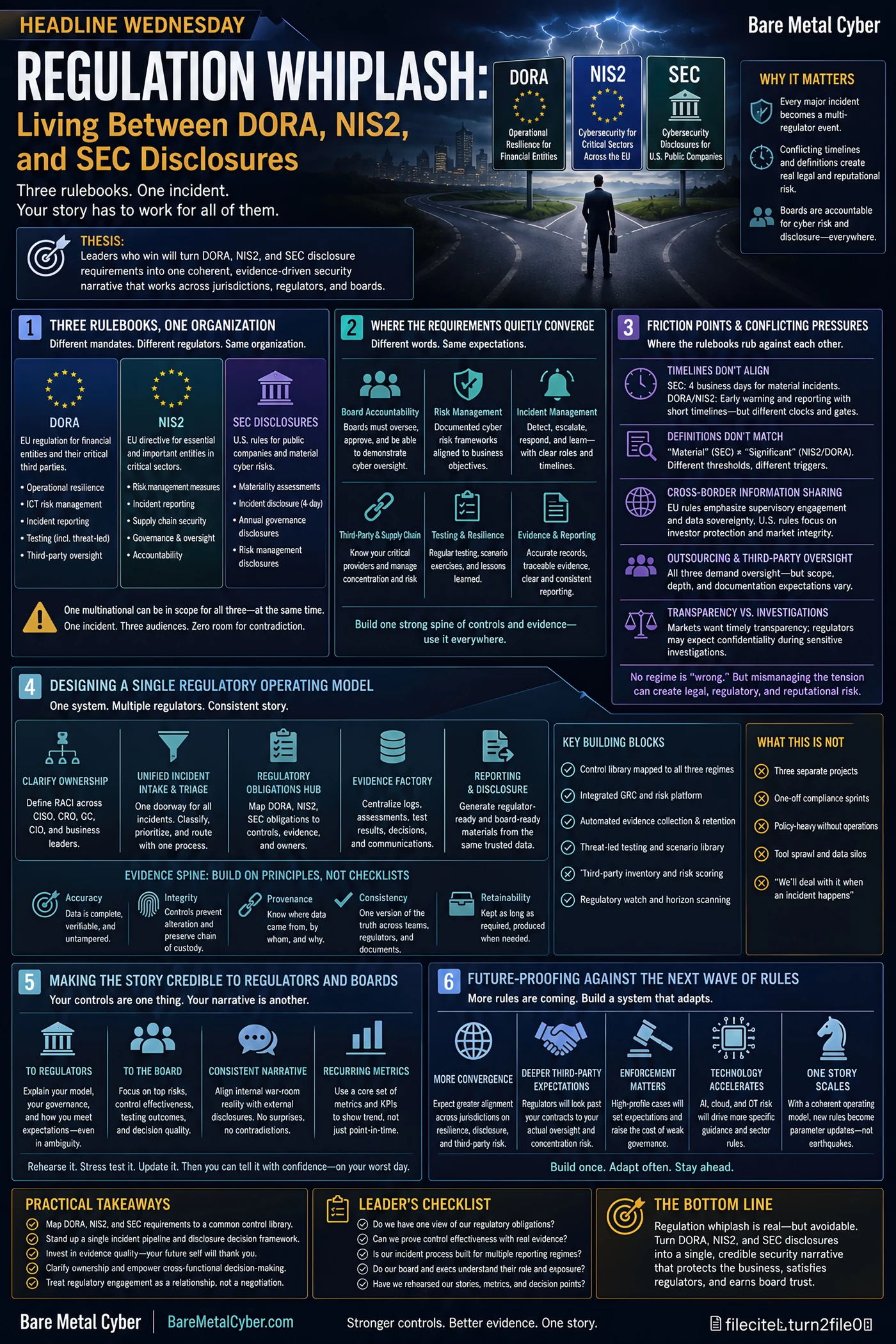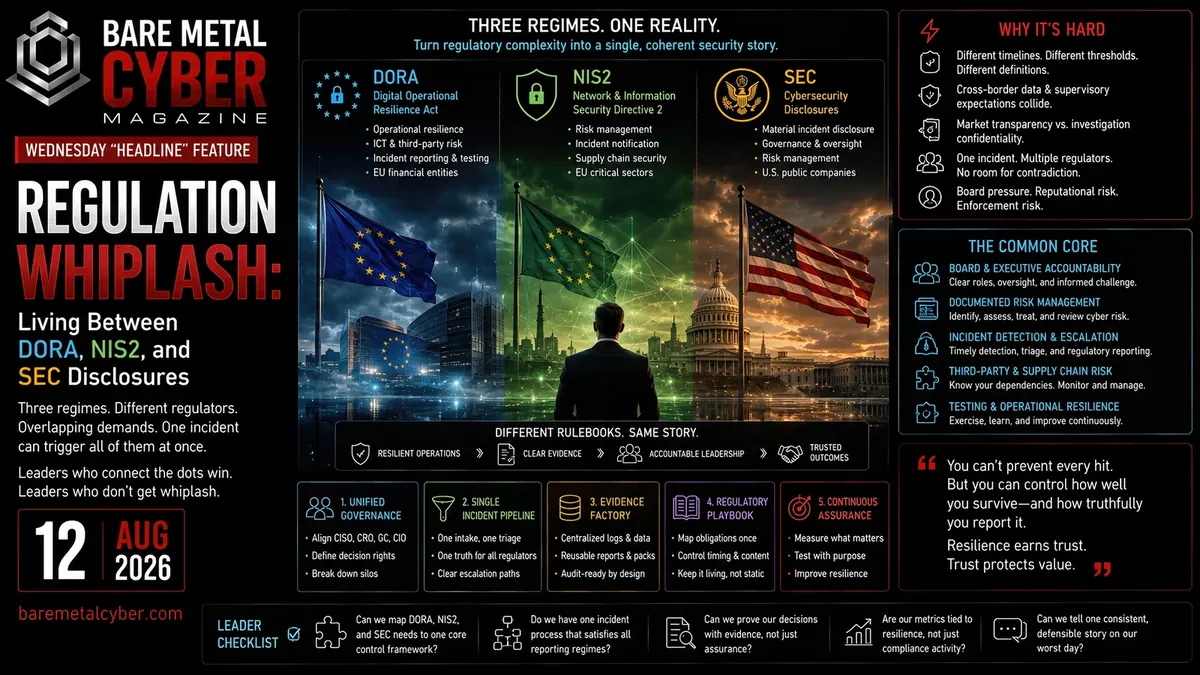
The meeting should have been routine. A major incident has just been contained, and the executive team is reviewing the draft communications plan. Legal wants to hold back until they can pin down “materiality” for the U.S. Securities and Exchange Commission (SEC). The European team is waving the Digital Operational Resilience Act (DORA) clock, counting hours until they must notify supervisors. Somewhere in the mix, someone asks how this all plays with the NIS2 Directive (NIS2), and the room goes quiet because nobody is sure if they are telling one story or three. This is the lived reality of regulation whiplash for global, digitally dependent organizations.
This Wednesday “Headline” feature in Bare Metal Cyber Magazine is about turning that chaos into a coherent security narrative. DORA pushes financial entities toward demonstrable operational resilience. NIS2 pushes critical sectors toward structured cyber risk management and serious enforcement. SEC cybersecurity disclosure rules push public companies toward investor-grade transparency about incidents and governance. None of these regimes were written solely with your organization in mind, yet your board, your regulators, and your customers will judge you on how well you make them fit together.
For security and technology leaders, the next 12–24 months are not just about “complying” with DORA, NIS2, and SEC rules in isolation. They are about designing a single operating model that can withstand cross-border scrutiny on your worst day. That means one incident pipeline that can serve multiple regulators, one evidence spine that supports both operational resilience and disclosure, and one story that looks consistent whether it is told in Brussels, Frankfurt, London, or New York. This article explores how to see the convergences, navigate the conflicts, and build a regulatory operating model that makes your security program stronger instead of slower.
Three Rulebooks, One Organization
In most board decks, DORA, NIS2, and SEC cybersecurity disclosures show up as three separate lines of pain. But on the ground, they all land on the same people, the same systems, and the same incidents. A European bank with a U.S. listing, a cloud-native payment processor serving critical services in the European Union (EU), or a global SaaS platform selling into regulated sectors can find itself simultaneously answerable to financial supervisors, national competent authorities, and securities regulators. It does not matter that each regime has a different history and philosophy; what matters is that they all expect you to be in control when things go wrong.
At the operating level, this often shows up as parallel universes. Legal and investor relations think in terms of “material incidents” and market impact for the SEC. Risk and compliance teams think in terms of “significant incidents” and supervisory expectations under NIS2 and DORA. Security operations sees one messy reality: a cloud outage that cascades through a third-party provider, a compromised administrator account, a data leak that might or might not involve regulated services. Each group builds its own timeline, its own email threads, and its own view of what “really happened,” because the regulatory frameworks are treated as separate projects instead of different lenses on the same event.
The result is a subtle but dangerous fragmentation. The CISO, the chief risk officer, and the general counsel can all be acting in good faith yet still send mixed signals: conservative early warnings to EU supervisors, cautious external disclosures to investors, and an internal narrative that sounds different in every room. Over time, that fragmentation corrodes credibility. Supervisors start to doubt whether your story hangs together. Boards struggle to see whether they are hearing the whole picture. Staff lose trust in the process when every incident turns into an improvised negotiation between regimes. Section by section, this article will argue that the only sustainable answer is to treat these rulebooks as one integrated operating environment, not three separate storms.
Where the Requirements Quietly Converge
If you strip away the acronyms and political backstory, DORA, NIS2, and SEC cybersecurity disclosures all orbit a similar gravitational center: they want to know whether your organization can understand, manage, and communicate its technology risk in a disciplined way. DORA talks about operational resilience, NIS2 talks about risk management and incident response, SEC rules talk about governance and material incidents, but they are all, in different languages, asking: do you actually run this environment like it matters to the real economy and to investors. That shared intent is the starting point for a unified approach.
Look at the building blocks each regime cares about. All three put the board or top management on the hook for cyber risk oversight. All three expect you to have structured processes for identifying, assessing, and mitigating cyber risk, not just a collection of tools. All three care about incident detection, triage, and timely escalation, including cross-functional involvement from technology, risk, and legal. And all three are increasingly explicit about third-party and outsourcing risk: regulators and investors do not accept “our provider went down” as a full explanation when critical services fail. The language differs, the emphasis shifts, but the underlying picture is familiar: accountable leadership, documented processes, and traceable evidence that those processes run.
For leaders, this convergence is the lever. Instead of building one set of controls “for DORA,” another “for NIS2,” and a third “for the SEC,” you can build a single core control spine that covers board reporting, risk assessments, incident response, testing, and third-party oversight. Around that spine, you layer jurisdiction-specific thresholds, timelines, and disclosure mechanics. This is not just a simplification exercise; it is a credibility play. When regulators see that your incident runbook, risk register, and board materials all tell the same story, the discussion shifts from “do you comply with my rule” to “how mature is this system.” That is a far better place to be when the questions get hard.
Friction Points and Conflicting Pressures
Of course, if this were pure convergence, there would be no whiplash. The real pain comes from the edges where these regimes pull you in slightly different directions. Timelines are a prime example. Supervisors under DORA and NIS2 often expect early incident notifications based on partial information, plus updates as your understanding evolves. SEC disclosure rules, by contrast, center on when an incident becomes “material” to investors and expect a more considered, public statement. Security leaders are stuck in the middle: one side wants speed and provisional detail; the other punishes premature or inaccurate public disclosure. That is not just a legal nuance; it is a real stress on your war room.
Definitions are another source of friction. NIS2 and DORA talk about “significant incidents” in terms that blend technical impact, service disruption, and potential harm to users or the wider economy. SEC rules talk about “material incidents” in the familiar language of investor decision-making and financial impact. A single breach can cross both thresholds at different times. If you do not consciously decide how these definitions interact, you drift into inconsistency: an event that is “significant” in Europe but somehow not “material” in your U.S. narrative, or vice versa. Regulators and boards notice those gaps faster than you think.
Then there are the softer pressures around transparency and confidentiality. European supervisors may expect an ongoing dialogue about serious incidents, including forward-looking remediation plans, while U.S. securities law pushes you to be careful about forward-looking statements and legal exposure. Law enforcement or national security considerations can add yet another layer. Leaders who navigate this well do not pretend the tensions do not exist; they surface them early, agree on principles with legal and risk, and design playbooks that anticipate where you will be conservative, where you will be open, and how you will reconcile differences in the record. That discipline is what prevents an already bad day from turning into a governance crisis.
Designing a Single Regulatory Operating Model
The leaders who are starting to get ahead of regulation whiplash are not hunting for the perfect crosswalk spreadsheet; they are designing an operating model that treats all of these obligations as variations on one theme. At the top, that means clear ownership. Someone has to be accountable for the regulatory overlay on cyber risk, and it cannot be the CISO acting alone. In practice, the most resilient patterns pair the CISO with the chief risk officer and general counsel, anchored by a standing governance forum that owns the regulatory playbook, not just ad hoc crisis calls when something goes wrong.
Underneath that, the incident pipeline becomes the linchpin. Instead of separate workflows for “regulatory incidents” and “everything else,” you define a single intake and triage process that can tag events against multiple thresholds: impact on critical services, exposure of regulated data, potential financial or reputational impact, and jurisdictional footprint. From that common intake, you branch into different reporting tracks, but the underlying facts, timestamps, and technical narrative stay consistent. The same log of decisions, containment steps, and service impacts supports both early notifications to supervisors and later, more polished disclosures to investors.
The third layer is your evidence and documentation spine. Rather than writing bespoke DORA, NIS2, and SEC documents, you invest in a small number of durable artifacts: an integrated risk register that maps critical services, cloud and third-party dependencies, and controls; a board reporting pack that covers governance, testing, and incidents in a way that can be mined for regulatory responses; and a standard incident report format that security, legal, and risk all sign off on. When those artifacts are maintained in calm periods, they become your pre-baked answers when the heat is on. Over time, this operating model turns regulation from a series of one-off sprints into a continuous, predictable part of how you run technology risk.
Making the Story Credible to Regulators and Boards
A single operating model only works if outsiders believe it. Regulators and boards are not inside your war room; they see you through snapshots: supervisory meetings, formal submissions, public disclosures, and board packs. Credibility starts with consistency across those windows. When the incident story told to a European supervisor under NIS2 matches the core facts and sequencing later disclosed to investors under SEC rules, confidence goes up. When board minutes show the same risk themes and remediation priorities that appear in your DORA resilience testing program, supervisors see a joined-up system rather than a façade. The opposite is equally true: small discrepancies, unexplained changes in narrative, or evidence of last-minute scrambling quickly erode trust.
For regulators, the most effective leaders do something that feels simple but is surprisingly rare: they proactively explain the model. Instead of treating DORA, NIS2, and SEC expectations as separate conversations, they walk supervisors through how incidents are detected, triaged, and escalated globally, where thresholds are set, and how the organization reconciles different reporting timelines. They show the repeatable artifacts that underpin this system: standard incident reports, cross-jurisdictional playbooks, and board-level oversight routines. The message is not “we are perfect,” but “we are deliberate, and our story hangs together even when things go wrong.” That framing can significantly shape how regulators interpret your hard days.
Boards need the same coherence, but in a more distilled form. They want to know whether the organization has a realistic grip on its technology risks, a stable way of engaging with regulators across regions, and a plan for when, not if, material incidents occur. Leaders who handle this well resist the urge to bury the board in regulatory minutiae. Instead, they anchor discussions on a small set of narratives: how the global incident model works, what recent events revealed about resilience and communication, and where regulatory expectations are tightening. Metrics and heatmaps still matter, but they sit downstream from the story. When boards can repeat that story back in their own words, you know your regulatory operating model is not just documented; it is understood.
Future-Proofing Against the Next Wave of Rules
If there is one safe prediction, it is that DORA, NIS2, and SEC cybersecurity disclosures are not the end of the story. More regimes are coming: sector-specific resilience obligations, cloud and third-party oversight rules, and potentially tighter expectations around software supply chain risk and AI usage. Leaders who treat each new rule as a discrete project will burn out their teams and their credibility. The point of a coherent regulatory operating model is that it gives you a chassis you can adapt as the landscape shifts, rather than rebuilding the vehicle every time a new acronym arrives.
The first element of future-proofing is to design around stable concepts, not transient labels. Operational resilience, governance accountability, incident transparency, and third-party control are not going away. If your risk register, control framework, and board reporting are anchored on these themes, then aligning to a new law is mostly a mapping exercise: which parts of the existing system already satisfy this expectation, where are the gaps, and what evidence will this new regulator expect. That is very different from starting with a fresh spreadsheet every time a consultation paper hits your inbox.
The second element is institutional memory. Organizations that cope well with regulatory change treat each major incident and each significant supervisory interaction as a learning asset. They update playbooks, refine thresholds, and adjust communication patterns based on what actually happened, not just what was written in the original policy. Over time, this creates a feedback loop where your model gets sharper even if the rule set gets messier. When a new regime appears, you can plug it into a living system that already knows how to absorb change. In that world, regulation whiplash does not disappear, but it becomes a manageable headwind rather than a constant spin.
Where Leaders Go From Here
At its heart, this topic is about telling one honest, defensible security story in a world that keeps handing you new rulebooks. DORA, NIS2, and SEC cybersecurity disclosures may look like distinct regulatory projects, but they all converge on the same question: when technology underpins your business, can you show that you understand the risk, run it deliberately, and communicate about it without losing the plot. The opposite of regulation whiplash is not perfect compliance; it is a coherent operating model that stands up under pressure.
That brings us back to the executive war room, staring at clocks and definitions. In a fragmented world, each stakeholder pulls toward their own regime: legal toward materiality language, European teams toward supervisory obligations, security toward containment at all costs. In a unified model, the same incident pipeline feeds all of them, the same evidence spine supports their decisions, and the same core narrative appears in supervisory briefings, board packs, and public disclosures. The decision is no longer “which rule do we serve first,” but “how do we keep our story consistent while the facts evolve.”
When leaders internalize this, several things change. They fund and staff the regulatory operating model as part of core security, not as an afterthought. They insist on shared artifacts and playbooks instead of one-off templates. They judge their teams less on heroic compliance sprints and more on the calm, repeatable way incidents are handled across jurisdictions. From here, a practical next step is simple: ask your team to show you, on a single page, how one serious incident would flow through DORA, NIS2, and SEC expectations today. If that page does not look like one story, you have just found your most important regulatory project.