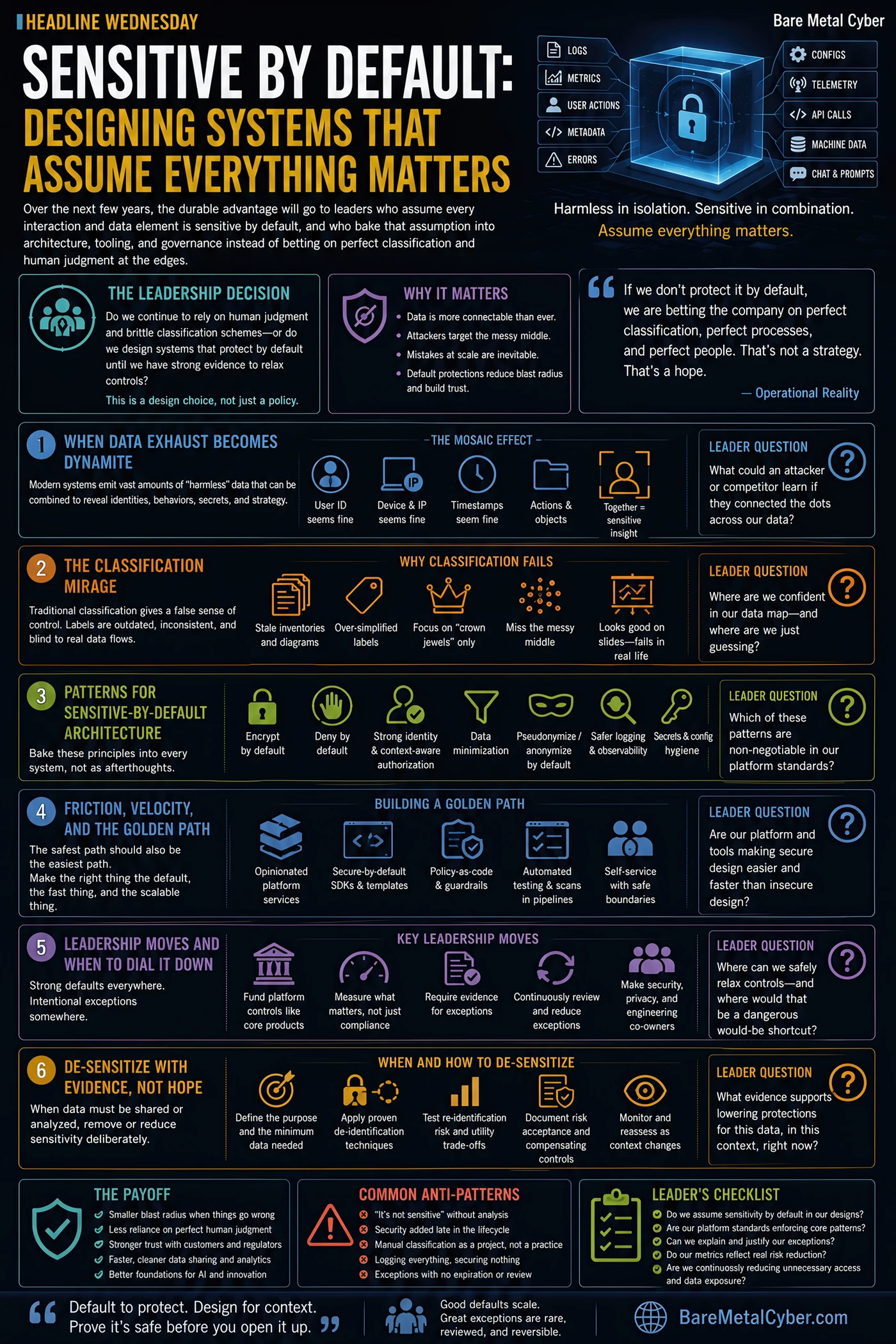
The systems you run today are factories for what used to be called “data exhaust.” Feature flags, A/B tests, observability traces, granular permissions, API gateway logs, internal dashboards, AI copilots watching every keystroke: they all generate fields that once felt harmless. But in modern environments, those fields combine into a detailed picture of people, processes, and decisions. The uncomfortable reality is that a surprising amount of what your organization emits can be used to reconstruct something sensitive, even if nobody labeled it that way.
This Wednesday “Headline” feature from Bare Metal Cyber Magazine looks at what it really means to treat that reality seriously. Instead of betting everything on perfectly tagged “crown jewels” and heroic users who always pick the right option from a sensitivity drop-down, we ask what happens when you flip the default: assume everything matters until proven otherwise, and force that assumption into the architecture. Not as a slogan, but as a set of non-negotiable rails for how data is stored, moved, and exposed.
For leaders, this is not an abstract privacy argument. It is about survivability in environments where regulators, customers, and adversaries are all getting better at seeing the value in your “unimportant” data. Over the next few years, organizations that win will design for sensitive-by-default and then selectively dial risk down with evidence, rather than trying to bolt sensitivity on after something leaks. The question is not whether you care about the obvious secrets. It is whether your systems behave as if every interaction could matter, even on days when nobody is paying attention.
When Data Exhaust Becomes Dynamite
If you zoom out on a typical modern stack, it is hard to find anything that is not being logged, tagged, or traced. Product teams capture user clicks and scroll depth. Growth teams track referral sources and campaign performance. Reliability engineers capture fine-grained telemetry from every service and dependency. AI assistance quietly records prompts, feedback, and operational patterns. None of these fields look like “password” or “credit card number,” yet, together, they can reveal who is doing what, when, and with whom inside your environment. That mosaic is what turns data exhaust into something closer to dynamite.
The sensitivity is rarely in a single field. It is in combinations and context. A timestamped sequence of API calls from a certain IP range might reveal a major customer’s usage pattern and revenue trajectory. A detailed error log may expose internal identifiers, partner names, or internal network layout in ways that make targeted attacks cheaper. Support ticket histories can show which segment of your user base is struggling with which features, which in turn can give competitors or threat actors insight into your roadmap and pressure points. None of this depends on traditional “confidential” labels to cause real damage.
For leaders, the key shift is to stop treating sensitivity as a static attribute and start treating it as a potential energy that grows with correlation. That means looking at telemetry, analytics, and operational data as first-class assets that will be scrutinized by regulators, litigators, and attackers. It also means recognizing that data flows you approved years ago, when the environment was simpler, may now be feeding extremely rich profiles to third parties and internal teams that no one has revisited. Sensitive-by-default starts by assuming that any dataset with enough volume, history, or granularity can become exploitable, even if every record is “harmless” on its own.
The Classification Mirage
Most organizations will tell you they have a data classification scheme. Somewhere there is a slide with neat tiers, colors, and examples: public, internal, confidential, restricted. Policies describe how each tier must be handled, and there may even be banners stamped across documents and dashboards. On paper, it all looks reassuring. The problem is that the real system rarely behaves according to those tidy labels. Data moves, transforms, and recombines far faster than humans can reclassify it, and the most damaging leaks often come from the messy middle that no one treated as truly sensitive.
Classification tends to over-index on the obvious things: regulated personal data, payment details, formal trade secrets. It under-indexes on derivative and contextual data that accumulate in logs, feature stores, models, and analytics platforms. That blind spot shows up in breach reports where the organization insists that “only telemetry” or “only internal metadata” was accessed, as if those categories are inherently harmless. In practice, they can expose authentication patterns, business logic, partner dependencies, or internal segmentation decisions, all of which make subsequent compromise easier and increase legal and reputational risk.
Leaders also need to account for how classification is actually applied. Asking employees to pick sensitivity levels in drop-downs sounds empowering but creates brittle controls; people are busy, context is unclear, and incentives are misaligned. Automation helps, but only at the margins: pattern matching for known identifiers, lineage tracking in well-governed platforms, tag propagation when everything goes through the right pipeline. None of that keeps pace with the spread of SaaS, shadow data stores, and ad hoc scripts. The result is a mirage: you “have classification,” yet your control surface is still defined by where data actually flows and how defaults behave.
A sensitive-by-default posture does not throw classification away, but it stops pretending classification alone can save you. Instead, labels become hints for tightening or relaxing protections that already assume risk. You encrypt broadly, log carefully, and restrict access by default, then use evidence from classification, lineage, and usage patterns to justify exceptions. That flips the burden of proof: the question is no longer “why would we treat this as sensitive?” but “what makes us so sure we can safely treat it as less sensitive in this context?”
Patterns for Sensitive-by-Default Architecture
Sensitive-by-default starts with a brutally simple idea: the system should behave as if any given datum could hurt you if mishandled. Architecturally, that means treating protections as the baseline, not an upgrade. Encryption at rest and in transit is table stakes, but leaders can go further by making strong key management, automatic rotation, and enforced use of service identities the default path, not an optional enhancement. Storage layers, message buses, and data lakes should assume protected payloads, with explicit justification required when someone wants to store or move data in the clear.
Access works the same way. A sensitive-by-default design assumes that broad, long-lived permissions will be abused or leaked. So access control moves toward least privilege and dynamic grants, with systems that hand out time-bound and purpose-bound access by default. Instead of permanent admin rights or all-tables access, you bias the architecture toward request flows, approvals, and automated revocation driven by identity providers and policy engines. Developers and operators can still get what they need, but they do so through mechanisms that leave an auditable trail instead of silent, enduring entitlements.
Data minimization and transformation are the third leg. Rather than transporting raw, richly identifying data everywhere, you standardize patterns like default pseudonymization, tokenization of high-risk fields, and structured redaction in logs and traces. Observability stacks can be configured to drop or obfuscate sensitive attributes before they ever leave the service boundary, while still preserving enough signal for debugging. Analytics platforms can receive pre-aggregated or de-identified datasets by default, with well-governed processes for accessing raw feeds when truly necessary. These patterns do not eliminate risk, but they cut the blast radius when, inevitably, a system is misconfigured or compromised.
From a leadership standpoint, the crucial step is to elevate these patterns from “security best practices” to platform guarantees. That usually means investing in shared components, reference architectures, and paved roads that make sensitive-by-default the easiest way for teams to build. The details will differ across cloud providers and tech stacks, but the principle is consistent: the rails assume everything matters, and exceptions must be argued for and documented, not quietly invented in a sprint.
Friction, Velocity, and the Golden Path
The moment you tighten defaults, you will hear about friction. Product managers worry about delayed launches, developers complain about approvals and extra configuration, and operations teams push back on anything that complicates diagnostics during an outage. If sensitive-by-default is framed as “more gates from security,” it will lose. The only sustainable version is one where the safest way to build is also the smoothest. That is why this posture is fundamentally a platform and developer experience problem, not just a policy problem. Leaders need to treat security defaults as a feature of the internal platform, not a compliance tax.
Platform engineering is where this plays out. If your shared services, SDKs, and templates already handle encryption, key usage, logging hygiene, and default authorization patterns, teams feel the protection as less work, not more. When developers generate a new service from a template and immediately get secure-by-default CI configurations, hardened runtime settings, and pre-wired identity and access management, you are winning. Conversely, when teams have to stitch together their own controls from scattered wiki pages and tool docs, they will cut corners, often in precisely the places where assumptions about “non-sensitive” data live.
The golden path is the mechanism to align friction and velocity. A well-designed golden path embeds sensitive-by-default choices into opinions: which data stores you support, how logging libraries are configured, how secrets are injected, which APIs are blessed. It also comes with clear support: documentation, consulting time, and responsiveness when teams hit edge cases. Leaders have to fund this path like a product, with product management, user research, and service-level expectations, rather than treating it as a loose collection of examples. When the organization sees that the fastest way to deliver features also keeps “harmless” data properly constrained, sensitive-by-default stops being a slogan and becomes part of the culture.
Leadership Moves and When to Dial It Down
Sensitive-by-default is not a toggle; it is a posture that needs deliberate leadership to sustain. The first move is to make it visible as a strategic choice, not a quiet engineering refactor. That means putting it on the agenda with your executive peers and board as part of how you protect customers, protect intellectual property, and manage regulatory exposure. Instead of talking only about “data classification projects” or “hardening initiatives,” articulate that you are redesigning systems on the assumption that most of your data, telemetry, and internal signals are effectively sensitive in modern threat and regulatory environments.
Execution then becomes a sequencing problem. You cannot flip every system at once, so you prioritize the platforms that concentrate the most context and correlation power: observability and logging, analytics and feature stores, integration hubs, identity and access management. For each, you set a clear bar for sensitive-by-default behavior and tie funding to achieving it: encrypted and well-managed by default, access constrained and time-bound, logs scrubbed before leaving service boundaries, data transformations that de-risk use cases without killing value. Metrics shift from “number of classified assets” to indicators like “percentage of core services on the golden path” or “fraction of high-risk data flows covered by strong defaults.”
The final leadership move is knowing when and how to dial it down. There will be legitimate pressures to relax controls for experimentation, analytics, or collaboration. The difference in a sensitive-by-default world is that those relaxations are explicit risk decisions, not quiet exceptions. You require clear purpose, time bounds, and compensating controls. You involve legal and privacy where appropriate. You keep a record of who approved what and why. Over time, this creates a culture where easing protections is treated with the same seriousness as deploying a new external-facing service. That is how you prevent “everything matters” from becoming performative and instead turn it into a durable operating principle.
Where Leaders Go From Here
At its heart, this topic is about refusing to pretend you can perfectly sort the world into “sensitive” and “not sensitive,” and instead treating your systems as if almost everything they touch could matter. The opening picture of innocuous data exhaust becoming dynamite is not a scare tactic; it is a recognition that context and correlation have changed the game. When you accept that, the mental model shifts: sensitivity is no longer a static label; it is a property that emerges from how data flows, combines, and persists over time.
Tying that back to your architecture, the throughline is simple: assume risk first, then tune it down where you have evidence. You stop trusting slideware classifications alone and start building platforms that encrypt by default, constrain access dynamically, minimize and transform data in motion, and keep “harmless” telemetry on a tighter leash. You treat golden paths and platform engineering as strategic levers, making the secure default the fastest, best-supported way to ship. And you put governance around the exceptions, so that relaxing controls requires a conscious, documented decision rather than a quiet config tweak.
When leaders internalize this posture, several things change. Conversations with boards and executives move from “are we compliant?” to “where does correlation power concentrate and how do our systems behave there by default?” Engineering debates move from “do we really need this control?” to “what would justify turning it off?” Teams become more cautious about proliferating raw data and more comfortable investing in strong, reusable rails. The practical next step is not a new policy; it is a focused conversation with your platform, data, and product leaders: if we acted as if everything mattered unless we can prove otherwise, which system would we redesign first, and what would we stop tolerating in how it handles data today?