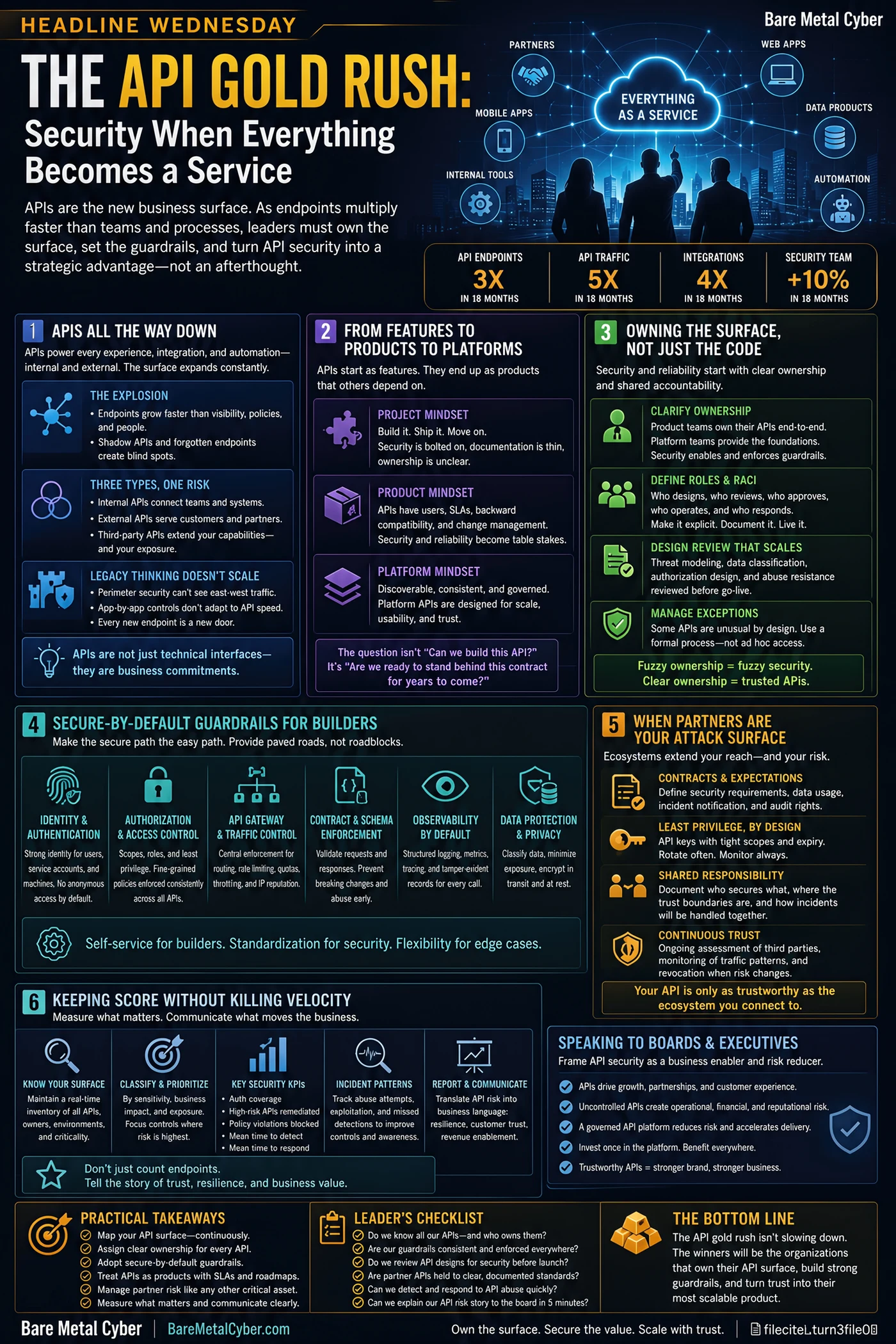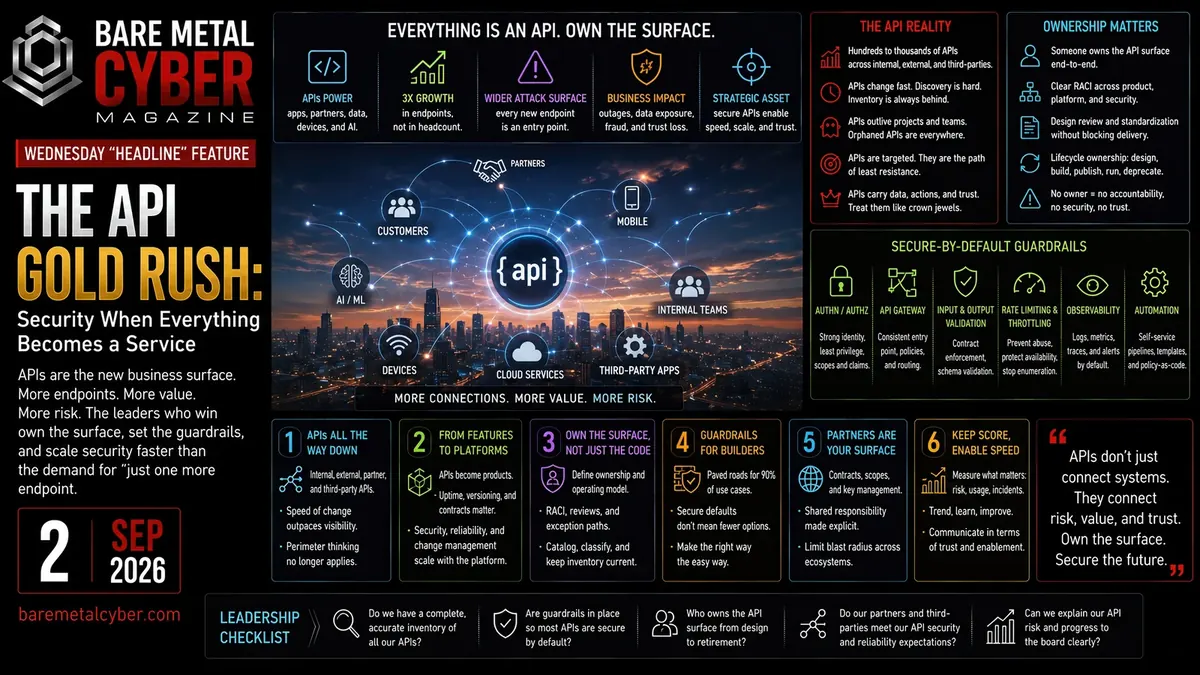
The room is quiet except for the click of keyboards and the hum of the projector. On the wall: a simple chart with one terrifying truth. Your API count has tripled in eighteen months; your headcount, process, and guardrails have not. Every product squad, every partner integration, every internal automation has discovered that exposing “just one more endpoint” is the fastest way to ship value. Welcome to the API gold rush. This Wednesday “Headline” feature in Bare Metal Cyber Magazine is about what happens when everything becomes a service, but security and ownership stay stuck in a world where interfaces were rare and slow to change.
For many leaders, the API story has felt like a side plot. APIs were middleware, plumbing, a details problem for architects and senior engineers. That framing is now dangerously outdated. In today’s environments, the API surface is the business surface: customer experiences, data products, partner ecosystems, and internal platforms are all shaped by the contracts and controls on those interfaces. When the surface grows faster than your ability to see it, own it, and govern it, “API security” stops being a narrow technical problem and becomes an organizational one.
Over the next few years, the gap will widen between organizations that treat APIs as strategic assets and those that treat them as implementation details. The first group will design platforms, ownership models, and secure-by-default guardrails so builders can move quickly without inventing security from scratch. The second group will keep discovering “shadow APIs” through pentests, incidents, and rushed partner deals. This article is about leading in that first category: owning the surface, not just the code, and setting patterns that scale as fast as demand for new services.
APIs All the Way Down
If you map your environment honestly today, it does not look like a neat set of applications behind a clear perimeter. It looks like a dense web of APIs: mobile backends, customer portals, partner integrations, internal tools, admin dashboards, automation hooks, webhooks into SaaS platforms, and experimental endpoints someone stood up for “just a small pilot.” Many of these interfaces never got the ceremony of a formal design review or a security checkpoint. They appeared as side effects of sprint goals, mergers, and rushed integrations with vendors that were “needed for the quarter.” At scale, the organization is running on APIs it has never deliberately decided to own.
This is more than simple “attack surface sprawl.” The real problem is that APIs live at the seam between teams, systems, and companies. A single customer workflow might cross half a dozen APIs you own and half a dozen you consume. That makes it hard to answer basic questions that leaders need to answer: how many distinct interfaces matter to our critical services, who is responsible for each one, and which controls actually apply. When everything talks to everything else via HTTP and JSON, traditional categories like “internal app” versus “external app” stop telling you much about exposure or risk.
Another complicating factor is that not all APIs are created equal. Some are high-volume, customer-facing interfaces with strong uptime commitments and robust authentication. Others are low-volume internal tools, glue code between SaaS products, or automation endpoints used by one team. Yet they often share the same identity providers, data stores, and logs. Treating them all the same leads to over-engineering in low-risk corners and under-investment on the interfaces that carry real business risk. Leaders need a lens that distinguishes the few hundred APIs that truly matter from the thousands that simply exist.
The practical implication is that API security cannot be a bolt-on project owned by a small central team. It has to start with an accurate, living picture of what APIs you have, which business capabilities they expose, and where they sit in critical customer and partner journeys. Only then can you talk about ownership, guardrails, and investment in a way that matches reality.
From Features to Products to Platforms
Most API stories start innocently. A team needs to support a mobile app or a new web experience, so they carve out an endpoint and ship. Another group needs data for reporting, so they expose a simple read API. A partner wants to integrate, so you add a few more calls with bespoke authentication and payloads. None of these decisions feel like “we are building a platform.” Yet over a few years, that is exactly what happens. Your APIs become the de facto backbone for other teams, external customers, and partners, even though they were never designed or funded with that role in mind.
This quiet transition from feature to product to platform changes what “secure enough” means. An API designed for a single app can get by with looser contracts, narrow threat modeling, and informal change management. Once other teams and external parties start depending on it, the interface becomes a product in its own right. Availability, stability, and backward compatibility now matter as much as raw security controls. Authentication and authorization schemes must handle more identities, more scopes, and more ambiguous trust boundaries. A breaking change or misconfigured scope no longer just breaks one feature; it ripples across revenue, partner relationships, and regulatory exposure.
Leaders who recognize this shift early treat critical APIs as products: with named owners, roadmaps, service-level objectives, and explicit security baselines. They also see that a patchwork of ad hoc APIs creates a governance nightmare. At some point, the organization needs deliberate platform thinking: standard patterns for exposing business capabilities, consistent ways to manage keys and tokens, and shared infrastructure for rate limiting, logging, and abuse detection. The decision is not whether you have an API platform, but whether you will admit that you have one and invest in it before incidents and partners force the conversation.
Owning the Surface, Not Just the Code
The hardest part of API security is not rate limits or token types. It is answering a simple question with a straight face: who actually owns this surface. In many organizations, the truth is uncomfortable. Product teams own code. Platform teams own gateways. Security owns policies. Legal owns contracts. No one feels fully accountable for the end-to-end behavior and risk of the APIs that knit it all together. That fuzziness works when you have a handful of interfaces. It fails spectacularly when you have hundreds that are central to revenue and operations.
Healthy ownership models start by treating “the API surface” as something real that can be mapped, budgeted, and governed. Leaders make conscious choices about where accountability sits. One pattern is to assign ownership at the product or domain level, where a team owns not just implementation but the contracts it publishes to others. Another pattern is to create a central API platform group that owns shared gateways, tooling, and standards, while individual product teams own specific interfaces and their behavior. Security’s role becomes clear: define minimum baselines, enable reviews, and drive visibility, not sign off on every endpoint.
Without that clarity, you get predictable failure modes. Security teams discover APIs from bug bounty reports instead of backlogs. Product managers assume the platform team will “handle the security bits.” Platform teams optimize for throughput and uptime but not for the misuse scenarios security cares about. Exceptions pile up in email threads and chat messages nobody can reconstruct during an incident or audit. Leaders end up arbitrating high-stakes decisions ad hoc, with poor data and no repeatable patterns.
Deliberate ownership does not require bureaucracy. It requires explicit agreements: who decides when a new external API is created, how it is classified, which standards apply, and who gets paged when something goes wrong. Simple mechanisms like a lightweight RACI for API types, a standard intake path for new external interfaces, and a small review forum for high-risk changes create enough structure without centralizing every call. Once that foundation is in place, secure-by-default guardrails can actually stick, because someone clearly owns using them.
Secure-by-Default Guardrails for Builders
Once ownership is clearer, the next challenge is giving builders guardrails that make the right thing the default, not a heroic act. In an API-heavy organization, this usually means a small set of standard patterns that cover most use cases: a preferred authentication and authorization stack, one or two approved API gateway patterns, a consistent way to define and publish contracts, and a baseline for observability and abuse detection. These are architectural choices as much as security choices. If every team can pick its own stack and gateway pattern, you are not just fragmenting technology; you are fragmenting risk posture and making it nearly impossible to answer basic questions about who can call what.
The most effective leaders design “paved roads” that feel faster than going off on your own. A central platform team can offer templates and scaffolding for new APIs that come with authentication, authorization, logging, and rate limiting wired in. Teams still write their own business logic, but they do it inside an opinionated envelope. Access tokens are handled consistently, scopes are defined in recognizable patterns, and logs land in the same places with the same fields. When a new team spins up a service, they inherit these defaults automatically rather than re-negotiating every decision. Security focuses on evolving the envelope, not micromanaging each lane.
Guardrails also need a clear model for exceptions. There will always be APIs that must handle unusual trust relationships, legacy consumers, or extreme performance constraints. If the only way to serve these cases is to “turn everything off,” teams will either fight the platform or build shadow paths. A better approach is to define a small number of exception patterns with explicit conditions, controls, and lifetimes. For example, a legacy authentication scheme might be allowed behind stricter network controls and limited scopes, with a sunset date documented in the same place as the API’s contract. Leaders then see risk as a manageable portfolio of standard and exceptional patterns, rather than a mysterious mix of one-off deals.
When Partners Are Your Attack Surface
At some point in the API gold rush, your biggest risks stop being the interfaces you control and start being the ones you expose to or consume from others. Customer and partner APIs are often treated as pure upside: new integration logos, frictionless onboarding, automation that makes joint workflows smoother. Yet every external consumer you grant access to is a new way for credentials to leak, scopes to be misused, and errors to cascade across company boundaries. When a partner’s environment is compromised, the attacker does not need to break into your systems directly; they only need to understand and abuse the contracts you have given that partner.
The complexity lies in how trust is actually encoded. It is rarely a single “partner API key.” More often it is a mesh of OAuth clients, service accounts, IP allowlists, webhook endpoints, and shared secrets glued together by contracts that live partly in code, partly in legal agreements, and partly in slide decks and emails. Ownership is even fuzzier here: business development owns the deal, product owns the interface, legal owns the paper, and security owns the residual risk. Without a clear pattern, you end up with one-off exceptions for big customers, custom scopes for every partner, and no reliable way to see which external identities can actually move money, change data, or impersonate users.
Leaders who navigate this well treat partner and customer APIs as a separate class of surface with explicit rules. They standardize integration patterns and scopes so that external parties can only do what their role truly requires, and they make those scopes legible to non-engineers. They ensure that monitoring and anomaly detection cover partner traffic specifically, looking for unusual volumes, access patterns, or sequence of calls. They also insist that commercial deals and legal agreements mirror technical reality: contracts reflect the actual controls, logging, and notification behaviors in the platform, rather than hand-waving about “industry standard security.”
A mature posture does not mean saying no to partner integrations; it means saying yes in a way that is explainable and reversible. That includes having a clean offboarding pattern for partners, the ability to rotate keys or revoke access quickly, and an incident playbook that assumes an external party will eventually be compromised. When those pieces are in place, partner APIs become a competitive advantage instead of a lingering worry at every board meeting.
Keeping Score Without Killing Velocity
Once APIs are treated as a real surface with owners and guardrails, leaders face the uncomfortable question of how to measure progress without smothering delivery under dashboards and approvals. Counting raw endpoints is a dead end; it tells you nothing about risk, dependency, or quality. Instead, meaningful metrics focus on coverage and health. How many critical business capabilities are exposed through APIs, and of those, how many are behind standard authentication and authorization patterns. How many have clear owners, documented contracts, and observability that lets you see who is calling what. These are the kinds of questions a board or regulator will ask when something goes wrong, and they are the ones that help leaders steer investment.
The best measurement systems start small and grow with the program. A simple classification of APIs into a few risk tiers, tied to different baseline expectations, gives everyone shared language. A handful of health indicators, such as the percentage of tier-one APIs using approved identity patterns or the time to detect and contain a misused key, are enough to anchor conversations. Overloading teams with dozens of metrics creates noise and encourages gaming; focusing on a few that clearly tie to risk and resilience encourages real improvement. Leaders should also resist the temptation to track individual teams’ “API security scores” as a blunt instrument, which often leads to defensive behavior rather than open discussion of trade-offs.
Just as importantly, API metrics need to coexist with, not fight, delivery metrics. If every control requires manual attestation or spreadsheet updates, teams will perceive security as a tax. When guardrails are embedded into platforms and pipelines, much of the “keeping score” can be automated: coverage of standard patterns, presence of basic logging, and adherence to contract versioning rules can all be derived from code and configuration. That gives leaders a live picture of how the surface is evolving and where to intervene, without weekly status reports. The goal is not a perfect API inventory; it is a living, shared understanding of where your interfaces are strong, where they are fragile, and where investment will most reduce the chance of ugly surprises.
Where Leaders Place Their Bets
At its heart, this topic is about whether leaders treat their API surface as a deliberate, ownable product or as an accidental side effect of delivery. The gap between those two mindsets shows up everywhere: in how clearly you can answer basic questions about which interfaces matter, who owns them, and what controls guard them. The organizations that thrive in the API gold rush are not the ones with the fanciest gateway or the most detailed inventory; they are the ones that recognize this surface as the primary way the business exposes value and risk to the outside world, and invest accordingly.
This brings us back to that quiet room with the API growth chart on the wall. The numbers will keep climbing. New products, partner deals, and internal automations will create new interfaces faster than any central team can review them one by one. The only sustainable response is to change the shape of your decisions: assign clear ownership for the surface, build paved roads that make secure-by-default patterns the fastest path, treat partner and customer APIs as a distinct class of exposure, and measure health in terms of coverage and resilience rather than raw counts. When you do that, incident response and board conversations shift from “we had no idea this endpoint existed” to “this was a tier-one API, here is who owns it, here is how it was supposed to behave, and here is what we are changing.”
For security and technology leaders, the practical fork in the road is simple. Either APIs remain a messy byproduct that you rediscover through incidents and audits, or they become a strategic surface you can explain and defend. The next time you see your own API chart, you might ask your teams: which parts of this growth are on paved roads, which are still one-off experiments, and who is accountable for turning the former into your default. That conversation is where API security stops being a reactive cost and starts becoming part of how the organization builds trust at scale.