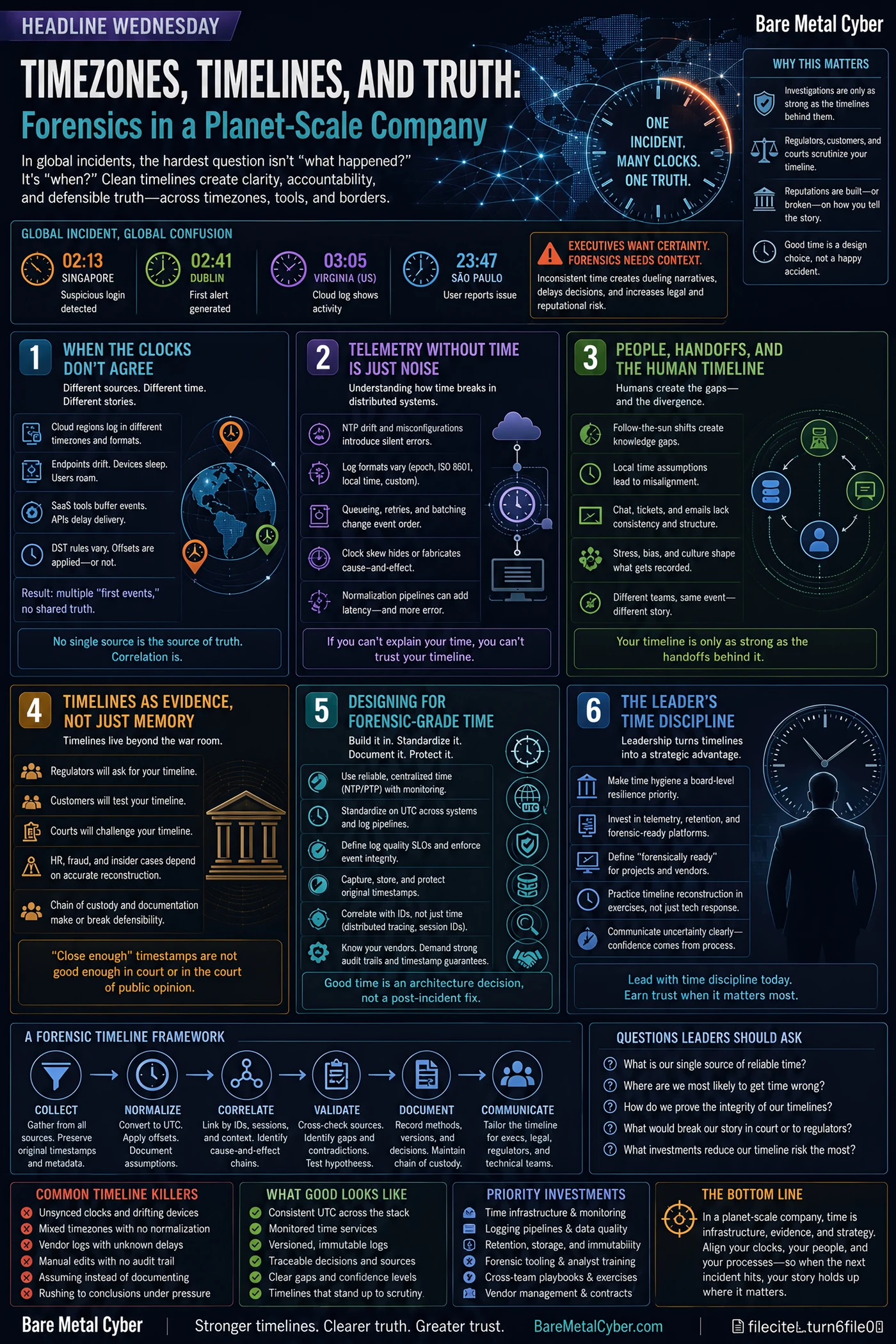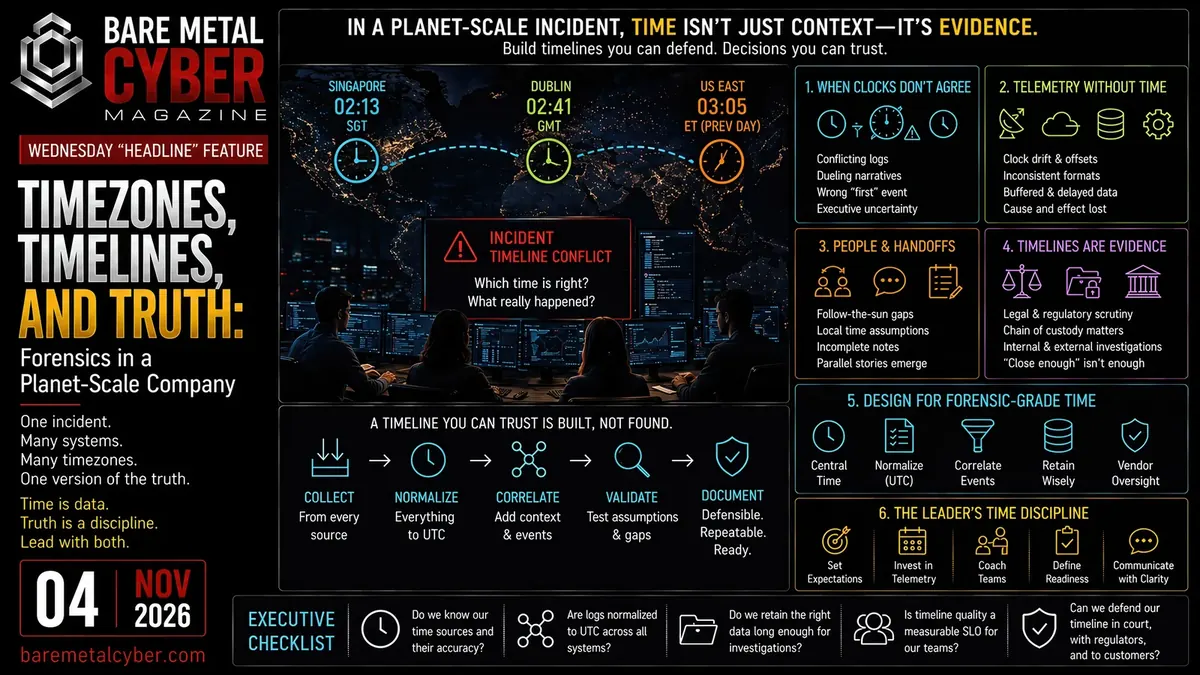
The incident bridge is full. One team in Singapore insists the first suspicious login was at 02:13. The identity team in Dublin has it at 02:41. The cloud logs from a U.S. region say 03:05… yesterday. Executives want one simple answer: when did this start? Your forensics lead wants something much harder: a timeline that is defensible when lawyers, regulators, and customers start asking how long the attacker was inside. In a planet-scale company, “what happened” is inseparable from “when it happened,” and your clocks are quietly voting on the truth.
This Wednesday “Headline” feature in Bare Metal Cyber Magazine looks at forensics through that lens: not as a collection of tools, but as an exercise in reconstructing reality across timezones, systems, and people. As organizations spread across regions, clouds, and SaaS platforms, every investigation now depends on dozens of loosely aligned time sources: endpoint logs, identity events, chat exports, ticket histories, third-party audit trails. Each one is formatted differently, stored differently, buffered differently, and wrong in slightly different ways. The result is a maze of partial truths that can turn even a well-run incident response into a debate about whose clock is “right.”
Over the next 12–24 months, leaders who treat time as an architectural and governance concern will pull away from those who treat timelines as an afterthought. They will ask different questions about logging, monitoring, and collaboration tooling. They will define what “forensic-grade” means in their environment and expect vendors to meet it. Most importantly, they will understand that when your company spans the planet, time is not a neutral backdrop; it is a core part of how you prove what happened, how fast you acted, and whether others should trust your story.
When the Clocks Don’t Agree
In a global incident, the first real argument often isn’t about root cause. It is about time. One region is convinced the attacker’s first foothold came via a contractor’s VPN. Another insists the earliest sign is an anomalous OAuth grant in a SaaS admin panel. Each team shows logs and screenshots that support their view, and each artifact has a timestamp that looks authoritative. The problem is that all of these systems live in different timezones, some drifted, some adjusted for daylight savings, some not. Before anyone touches containment, the investigation is already split into competing narratives.
At planet scale, you rarely have a single, blessed source of temporal truth. Cloud providers run services across multiple regions and internal time domains. SaaS platforms log activity using their own notions of “user local time,” “tenant time,” or “system time.” Endpoint agents may buffer events and send them late, while identity providers write audit logs into separate backends with different latency and normalization rules. The SIEM tries to make sense of this by re-stamping or normalizing events, but that normalization itself becomes a transformation step you have to trust and defend.
For leaders, the impact is not just forensic aesthetics; it directly shapes decisions. If your timeline says the first confirmed compromise was at 03:00 UTC, then your obligations to notify regulators, customers, or markets are calculated from there. If, six weeks later, someone discovers a misconfigured timezone or clock drift that pushes “patient zero” back by eight hours, your previous statements can suddenly look misleading or incompetent. You did not lie. Your clocks did. But the outside world will not see the distinction.
This is why the opening move in many mature organizations is not “what did the attacker do?” but “what can we trust about our time sources?” The answer often reveals that the hardest part of forensics is not finding the malicious event; it is aligning hundreds of events into one coherent story that will stand up under pressure.
Telemetry Without Time Is Just Noise
Most large organizations have already gone through a telemetry arms race. They collect everything: endpoint detections, identity events, API calls, database queries, cloud control-plane logs, and SaaS audit trails. On paper, this looks like maturity. In practice, if the time dimension is unreliable, that firehose degenerates into expensive noise. A suspicious token creation, an unusual IP change, and a privilege escalation might all be parts of the same move, but if their timestamps don’t line up, analysts either over-connect events that are unrelated or miss the real kill chain hiding in plain sight.
Under the hood, the issues are mundane and brutal. Network Time Protocol (NTP) is configured inconsistently across data centers, Kubernetes clusters, and Windows domains. Some systems log in UTC, others in local time with or without daylight savings adjustments, and some bury the offset in a separate field that not every parser respects. Message queues and event streaming platforms introduce buffering and back-pressure, so an event that occurred at 10:01 might not hit your SIEM until 10:04, reordered among hundreds of others. Cloud and SaaS vendors apply their own formatting quirks and regional timestamp conventions, which your ingestion pipelines then have to reinterpret. Every one of these steps is a chance for a small skew that, multiplied across thousands of events, warps causality.
From a leader’s perspective, the danger is that dashboards and correlation rules hide this fragility. The SIEM shows tidy timelines and attack paths, but those views depend on assumptions about time normalization that may not be documented or regularly validated. If your detection engineering teams are tuning rules based on noisy time data, they may be building confidence in patterns that only exist because of pipeline behavior, not attacker behavior. When a major incident lands, your ability to say “here is what happened, in order” depends less on any single tool and more on whether your entire telemetry ecosystem treats time as a first-class field, checked and tested like any other critical dependency.
People, Handoffs, and the Human Timeline
Even if every system clock were perfect, the human timeline would still be messy. In a planet-scale company, incidents unfold across follow-the-sun operations, regional on-call rotations, and a sprawl of communication channels. One analyst notices a pattern at the end of their shift and drops a note in chat. Another opens a ticket with incomplete context. A third, waking up six timezones away, sees an alert in the queue with no clear priority and pushes it to tomorrow. Days later, when executives demand a “minute-by-minute” reconstruction, you realize that the most important early decisions were made in side threads and hallway conversations that never made it into the record.
The tools that manage these human interactions often make time confusion worse. Chat platforms display messages in the viewer’s local time, ticketing systems log actions in yet another timezone, and email threads span entire weekends in multiple regions. During an incident, responders are not thinking about evidentiary quality; they are trying to survive the moment, juggling alerts, approvals, and workarounds. As a result, you end up with parallel human narratives about when someone “raised the concern,” when leadership “was first told,” and when “we decided to pull the plug,” all anchored to different local clocks and hazy memories. This is where trust erodes internally long before any regulator shows up.
Leaders cannot control every message or note, but they can shape the discipline around how decisions and observations are captured. That means being explicit about which systems of record define the official timeline, how timestamps are displayed and normalized there, and what is expected of people during and after an incident. It also means training managers and incident commanders to think about time the way they think about scope and impact: something to be made explicit, checked, and discussed, rather than assumed. When your teams understand that their notes may one day be read in a courtroom or regulator briefing, time consistency stops being a bureaucratic detail and becomes part of how they protect each other.
Timelines as Evidence, Not Just Memory
The moment an incident crosses certain thresholds, your timeline stops being an internal artifact and becomes potential evidence. Regulators, auditors, customers, and sometimes courts will treat it as a representation of what your company knew and when. That includes not just the technical markers of compromise, but also the human decisions: when the anomaly was first detected, when it was escalated, when the impact was understood, and when external notifications went out. In that context, every rough edge in your timekeeping becomes a point of challenge. A one-hour discrepancy between two systems may not change the technical story, but it can be enough to raise questions about whether you actually met a statutory notification deadline.
This is where leaders have to think differently about incident documentation. A timeline assembled in a hurry, with unclear sources and hand-edited timestamps, might work for an internal retrospective. It will not stand up well when a regulator’s team, with weeks to review, starts asking how you reconciled conflicting logs or why key events are missing. The chain-of-custody questions that security teams routinely ask about malware samples and disk images apply just as much to time: where did each event’s timestamp come from, what transformations were applied, and who validated that it was correct enough to support a conclusion. If those answers aren’t clear, your own narrative can be used against you.
Treating timelines as evidence pushes you to tighten the interfaces between technical logging, collaboration tools, and incident reporting. It encourages explicit tagging of time sources, clear notation when approximations are used, and an honest accounting of uncertainty instead of false precision. Paradoxically, a timeline that admits “± five minutes” for certain events may be more defensible than one that pretends to know them down to the second. Leaders who understand this shift can guide their teams to write timelines that are not just compelling stories, but also resilient artifacts that will still make sense under skeptical scrutiny months or years later.
Designing for Forensic-Grade Time
If you want timelines you can defend, you cannot bolt them on after the fact. You have to design for forensic-grade time as part of your architecture, platform strategy, and vendor expectations. At a minimum, that means agreeing internally on a canonical standard such as Coordinated Universal Time (UTC) for all security-relevant systems and making it a non-negotiable requirement in infrastructure and SaaS onboarding. It means treating Network Time Protocol configuration and monitoring as reliability work, not low-level plumbing that can be left to chance. When your estate spans cloud regions, on-premises remnants, and dozens of SaaS platforms, a shared time standard is the only way to turn many partial views into one coherent story.
Beyond standards, you need explicit quality guarantees. Log quality service level objectives that cover timestamp accuracy and completeness sound unglamorous, but they are where truth is either preserved or lost. Your detection and observability teams should be able to tell you which sources are authoritative for specific classes of events, how often clocks are checked, and how skew and drift are detected. Normalization pipelines in your SIEM or data lake should record original timestamps alongside any transformed or derived fields, with clear documentation of how offsets and timezones are applied. These details are what let you reconstruct the chain later when you discover that a particular source was off by several minutes or that a vendor changed their export format without warning.
Vendors deserve special attention. Many of the systems that now dominate incident timelines are third-party: identity providers, collaboration tools, cloud services, and niche SaaS platforms. When you evaluate them, forensic time readiness should sit alongside features and price. Ask how they handle timezones, what timestamp formats they use, how they expose offsets and clock synchronization, and whether they can provide unmodified raw logs when needed. Make it clear in contracts and security schedules that timely, high-fidelity audit data is not a “nice-to-have” but a core part of your shared risk model. Leaders who consistently enforce these expectations build an ecosystem where truthful timelines are the default outcome, not something reconstructed heroically in the middle of the night.
The Leader’s Time Discipline
For all the technical nuance, the most durable changes start with leadership discipline around time. In a planet-scale company, you cannot personally verify every NTP setting or log pipeline, but you can set expectations that time is part of the security architecture, not an implementation detail. That begins with the questions you ask. When teams propose new platforms, migration plans, or observability projects, you can ask how they will support forensic timelines: which systems will be authoritative for what, how timestamps will be normalized, and how you will detect and correct drift. When these questions show up early and often, your organization learns that time hygiene is as non-negotiable as authentication or backups.
Discipline also shows up in how you handle incidents and reviews. If timelines regularly appear in your incident reports, retrospectives, and board updates, make their construction a visible craft. Ask which sources were used, how conflicting times were reconciled, and what uncertainties remain. Reward teams that surface limitations instead of smoothing them over. When you treat honest ambiguity as acceptable and hidden assumptions as the real risk, you create space for engineers and analysts to tell you where the time story is weak. Over time, that feedback shapes investment in logging, collaboration tools, and training far more effectively than a one-off directive.
Finally, leaders model time discipline in their own communication. During a major incident, the temptation is to offer clean, confident narratives early, even when the underlying timeline is still shifting. A more sustainable posture is to explicitly signal what is known, what is approximate, and what is still under investigation, and to update external statements as the picture sharpens. That approach may feel uncomfortable in the moment, but it aligns your organization’s internal reality with the story you tell the outside world. In the long run, that alignment is what builds credibility when future incidents force everyone, once again, to ask what really happened and when.
Where Leaders Go From Here
At its heart, this topic is about treating time as part of your security architecture, not just a column in a log file. In a planet-scale company, every investigation is really a negotiation between clocks, pipelines, and people, and the “truth” you present externally rests on the weakest link in that chain. The messy bridge calls, conflicting timelines, and retroactive corrections are all symptoms of a deeper issue: you are asking your organization to reconstruct reality without having designed for it. When you see that clearly, the timelines from recent incidents stop looking like unfortunate one-offs and start looking like predictable outcomes of how you handle time.
Returning to that global incident bridge, imagine replaying it with a different foundation. Telemetry sources aligned to a common time standard, pipelines that preserve original timestamps, and collaboration tools configured to show consistent, explicit time references. Incident commanders trained to capture decisions in systems of record, with clear notes about uncertainty and source. Executives accustomed to hearing ranges and confidence levels rather than artificial precision. The same attacker, the same environment, but a very different ability to answer the question “when did this start?” in a way that will hold up months later. That is the practical difference between hoping your clocks are good enough and knowing your timelines are built on purpose.
For leaders, internalizing this argument changes how you see your own role. You stop treating timelines as something analysts assemble at the end of a crisis and start seeing them as products that your organization designs, tests, and improves. You bring time questions into vendor reviews, architecture boards, and incident governance. You normalize conversations about uncertainty instead of punishing teams for not having perfect answers on day one. Over the next few years, the companies that do this will move through major incidents with less internal friction and more external credibility. A useful place to start is simple: ask your teams, at the next review, what it would take for your next high-profile investigation to produce a timeline that everyone in the room actually trusts.