The quarterly renewal meeting starts out like so many others: a slide with last year’s observability and security analytics spend, another with this year’s proposed “optimized” pricing, and a worried finance leader asking why the number keeps going up when incidents keep slipping through. Your teams insist the logs are essential. The vendors insist you are getting “unparalleled visibility.” Yet nobody in the room can clearly explain which risks would actually increase if you turned any of it down. That quiet gap between spend and specificity is where this Wednesday “Headline” feature in Bare Metal Cyber Magazine lives.
Security telemetry and observability are no longer side notes on a SIEM invoice; they are structural costs in how you run digital infrastructure. Between application logs, cloud trails, endpoint events, identity telemetry, metrics, and traces, it is easy to end up paying more for data than for the systems that generate it. The reflexive answer has been to “log everything just in case,” then try to design detections, dashboards, and reports from an ever-growing stream. But for many organizations, the economics and attention required to sustain that stream now exceed the marginal risk it actually reduces.
Over the next 12 to 24 months, leaders will be pushed to make uncomfortable decisions: Which data do we truly need to detect the threats we care about? Where is telemetry a regulatory requirement versus a comfort blanket? How much analyst and engineering time are we willing to trade for another terabyte of “maybe useful someday” logs? This article is about approaching those questions deliberately. Instead of treating telemetry as an untouchable fixed cost, we will treat it as a design space: mapping where signal really matters, where noise is quietly eroding your defenses, and how to right-size observability to the risks you actually own.
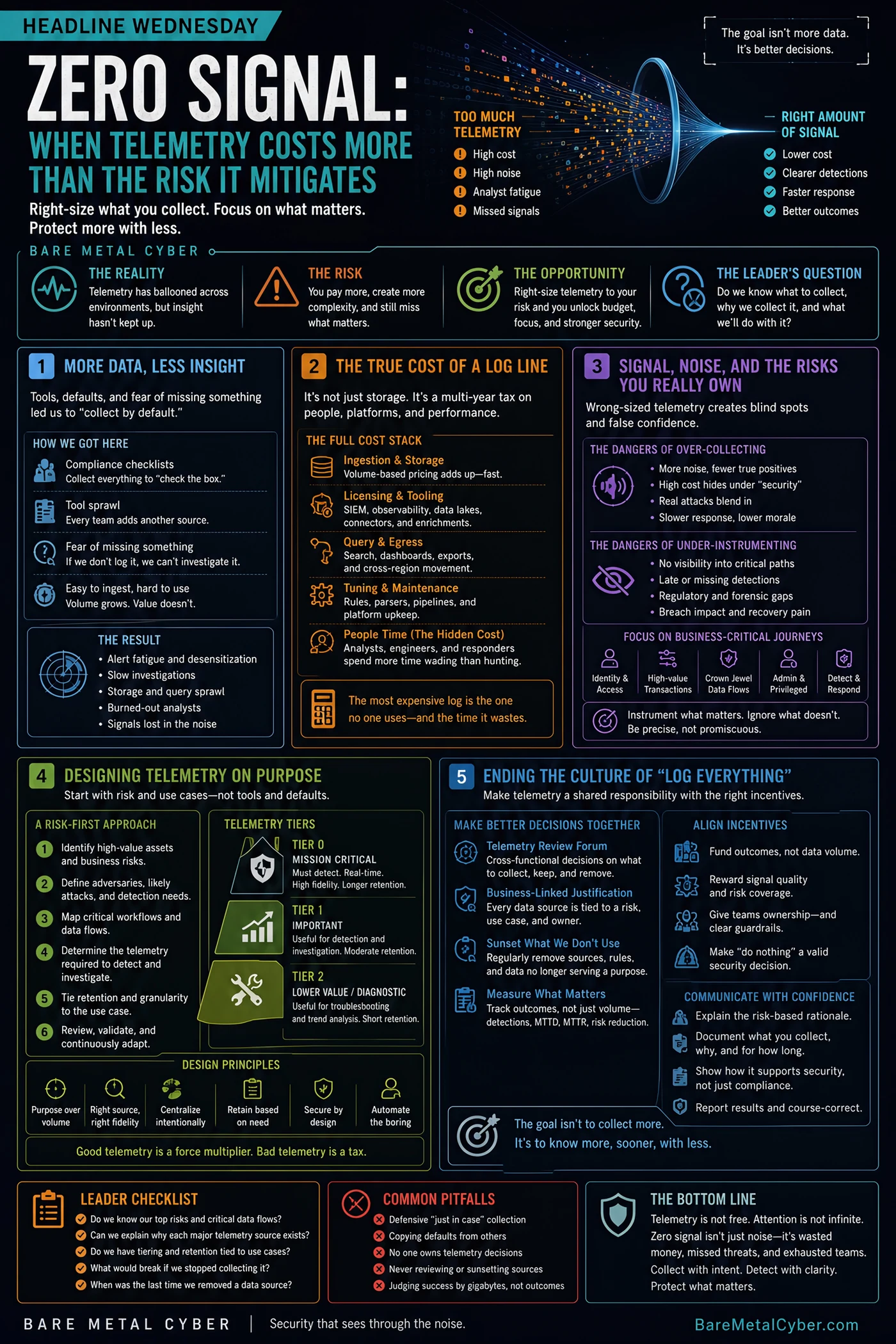
More Data, Less Insight
In most environments, the telemetry story starts innocently. A team enables extra logging to debug a hard production issue. Cloud services ship with “recommended” audit trails turned on. A new endpoint platform promises richer events “at no extra effort.” Over a few years, those incremental decisions accumulate into a mesh of logs, metrics, traces, and security events streaming from every layer of the stack. Each addition felt rational in isolation. Taken together, they leave leaders paying for a firehose where nobody can clearly describe the shape of the stream, let alone its value.
The result is a familiar paradox: more data, less insight. SOC dashboards glow with constant activity, but genuinely new or material signals are rare. Analysts bounce between tools that show overlapping slices of the same behavior. Engineering teams lose time hunting for the “right” log field in a forest of near-duplicates. The noise is not just visual; it becomes cultural. People stop believing that an alert is meaningful, stop trusting that a dashboard will show something new, and quietly move decisions back to instinct and anecdote. Telemetry becomes background radiation rather than a shared decision instrument.
Several forces keep this pattern in place. Compliance checklists that say “retain logs for X days” are interpreted as “retain everything for X days.” Incident retros push teams to add yet more feeds “so we never miss this again,” without removing anything else. Vendors incentivize ingestion growth and pitch new features that assume you have everything turned up to eleven. Over time, “collect by default” turns into an unwritten norm. The organization loses the habit of asking a basic question: what do we expect to learn from this data, and how would we notice if it stopped flowing? That question is where leaders start to regain control.
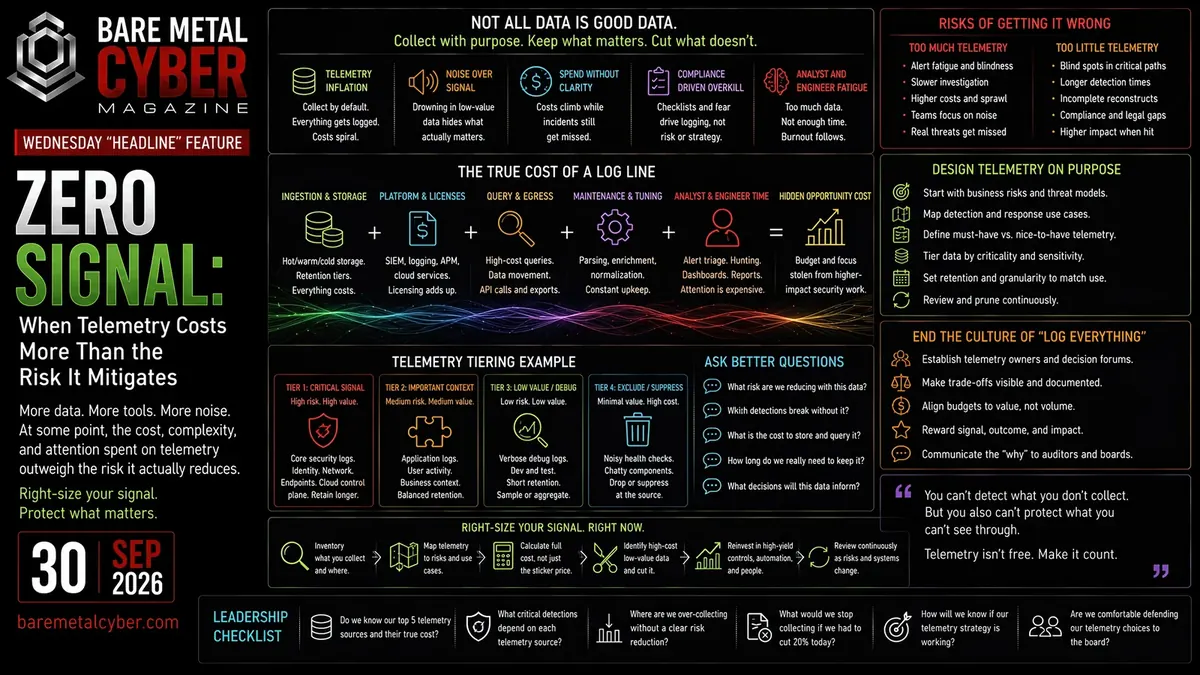
The True Cost of a Log Line
For most leadership teams, the cost of telemetry shows up as a single painful line item. But every log line carries a chain of hidden costs behind it. There is the obvious infrastructure: storage, indexing, replication, and backup for vast quantities of semi-structured data that rarely gets read. Query performance declines as datasets grow, so you pay more for bigger clusters or higher service tiers. What looks like a cheap “hot tier per gigabyte” on a slide becomes a significant recurring spend once multiplied across years of retention and dozens of noisy sources.
Then there are platform economics. Security information and event management (SIEM) tools, endpoint platforms, and observability stacks often price on ingest volume, events per second, or the number of monitored assets. “Just turn on that extra debug flag” can quietly tip you into the next pricing band. New detection content, dashboards, and AI assistants are marketed as value-adds, but they depend on ingesting more data, not less. Over a three- to five-year window, leaders can find themselves paying more for moving and storing telemetry than for the applications, databases, or network gear that telemetry describes.
The largest cost, however, is human. Every new source generates fields to normalize, parsers to maintain, dashboards to own, and false positives to tune. Analysts spend cycles triaging alerts that exist only because a particular log format made it convenient to write a rule. Engineers lose time instrumenting code that nobody uses in an investigation. Governance teams sit through hours of reviews to justify retention policies that were never explicitly chosen. Opportunity cost piles up: money that could fund better identity controls, improved architecture, or automation ends up trapped in keeping low-yield data warm and queryable “just in case.” Leaders need to see that trade clearly before they can redesign it.
Signal, Noise, and the Risks You Really Own
Once you see the true cost of telemetry, the natural instinct is to look for places to cut. This is where many organizations swing from over-collection to over-pruning and discover the other side of the risk equation. Not all data is equal. Some logs are incidental exhaust; others are the only way you will ever reconstruct how a compromise moved through a critical business journey. The challenge is that most environments were not instrumented from a risk model outward. They grew from defaults, vendor advice, and local debugging needs. So there is no shared map of which signals are actually tied to the risks the organization cannot afford to miss.
Consider a cloud-native SaaS company that retains verbose application logs for every test environment, but only basic access logs for its production customer portal. The telemetry bill is dominated by noise from non-critical workloads, while the trail that would reveal account takeover patterns or privilege escalation is thin. Or take a regulated financial institution that keeps years of low-value VPN session logs because someone once said they “might be useful,” yet has only fragmentary visibility into administrative actions on core payment systems. In both cases, leaders are paying for volume in the wrong places and carrying blind spots where failures would be existential.
The pivot is to treat telemetry as a risk instrument: something you shape to the threats and obligations you actually own. That means identifying the business services, data stores, and identities that matter most, and asking what you must be able to answer when something goes wrong. Which events do you need to see in near real time? Which do you only need to reconstruct within a day? Which are only there to satisfy audit and should live in a cheaper, colder place? Over-collecting everywhere hides important signals in noise and burns your people out. Under-collecting in the wrong place leaves you explaining to regulators and boards why you cannot prove what happened. Leaders have to navigate between those extremes on purpose.
Designing Telemetry on Purpose
Designing telemetry on purpose starts with a reversal of the usual questions. Instead of asking “what can we collect from this system,” leaders ask “what decisions do we need to support when this system is under stress or under attack.” From there, the design flows backward. If you know that for a given customer-facing service you must detect session hijacking and lateral movement within minutes, that points to specific identity, network, and application events that must be visible and correlated at a fine grain. If you only need to prove to an auditor that a control ran daily, that might be satisfied by a single job completion log and a summarized report, not a full trace of every intermediate step.
A practical pattern here is tiered telemetry. At the top tier, you place business-critical services, high-value data stores, and privileged identity paths. These get deliberate, often custom, instrumentation tied to threat models and incident response playbooks. You decide which fields must be present, how long you need detailed records, and what “good enough” looks like for correlation and search. Lower tiers might rely more on platform defaults, summarized metrics, or shorter retention, because the impact of a blind spot is lower. The important shift is that each tier reflects an explicit decision about risk and response, not a vendor’s one-size-fits-all suggestion.
Governance and architecture glue this together. Someone needs clear ownership for the telemetry portfolio: which teams can add new sources, who approves retention changes, and how conflicts between cost and coverage are resolved. Change reviews should treat telemetry as part of the system design, not an afterthought. When a new service launches, there is a short list of questions: what events matter for detection, what you expect to see in an investigation, where the data lands, and who is accountable for its health. Over time, leaders can build simple artifacts like “telemetry design briefs” for critical services, making those assumptions visible and auditable. This is how you move from accidental exhaust to purposeful signal.
Where Leaders Turn Down the Noise
At its heart, this topic is about treating telemetry as a designed risk instrument rather than an unexamined byproduct of running systems. The leadership meeting where nobody can explain which risks increase if you cut a data stream is a symptom of deeper habits: collecting by default, spending by inertia, and confusing volume with visibility. When leaders flip that script and start from the risks they truly own, the conversation changes. Telemetry stops being a sacred line item and becomes one of several levers you adjust to balance cost, coverage, and human attention.
Closing this loop means reconnecting the early decision scene with the architecture and culture we explored. The same CISO and platform leads who flinched at trimming logs can instead ask for a map: which business journeys sit in the top telemetry tier, which events they rely on, and where retention buys real investigative power versus comfort. They can see how much of their budget is tied to noise, how much analyst time is being drained by low-yield signals, and what it would look like to reinvest that capacity into better identity controls, simpler architectures, or automation. The fear of “turning off the lights” gives way to a shared understanding of where the lights actually need to be brightest.
For leaders who internalize this argument, a few things shift. They stop tolerating telemetry growth without an explicit purpose. They ask vendors to justify not just features but economic trade-offs. They expect their teams to articulate how a given log source underpins detection or investigation, and they are willing to say no when the answer is vague. Most importantly, they bring better questions into the room: which services truly deserve tier-one telemetry, what evidence we would need after a serious incident, and where we can safely accept less detail. Those questions, asked consistently, do more for real visibility than any “log everything” mandate ever will.