The moment doesn’t look dramatic. Someone proposes flipping a setting so that your AI agent can “helpfully” open tickets on its own instead of just suggesting them in a chat window. A few leaders nod, because tickets feel low stakes compared to pushing code or changing firewall rules. You have bigger problems than letting a bot file a few service desk items. But that quiet decision is the moment you move from advisory AI to operational AI, and it is exactly where unattended risk starts to compound. This Wednesday “Headline” feature from Bare Metal Cyber Magazine lives in that decision space.
Autonomous agents embedded in IT and security workflows are no longer hypothetical. They summarize alerts, correlate events, and propose next steps. The new frontier is giving them write access to your systems of record: your IT service management platform, your incident queues, your change boards. A bot that can open, route, and even close tickets is not just a smarter notification system. It is a semi-privileged actor that can shape how your organization perceives risk, sets priorities, and proves compliance over time.
For security and technology leaders, the next few years will be defined less by whether you “use AI” and more by where you let it act without someone watching every move. Ticketing looks like a safe starting point because nothing explodes when a ticket is created. Yet tickets trigger escalations, compliance evidence, and change workflows. If you treat autonomous agents as toys or pilots rather than as part of your control surface, you will miss where they quietly influence real-world decisions. This piece is about slowing that moment down, making the trade-offs explicit, and giving you a way to talk about autonomous agents as the operational actors they have already become.
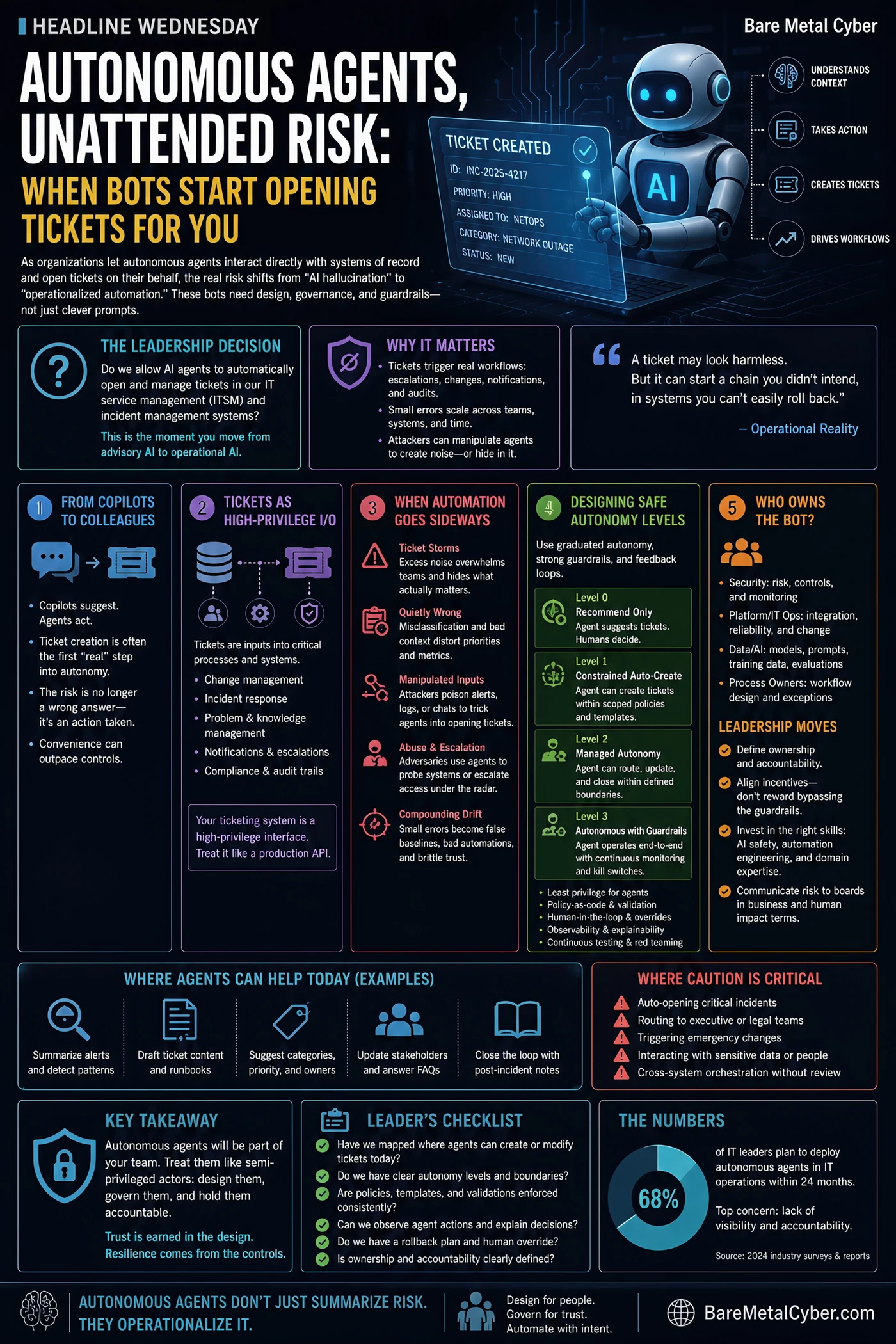
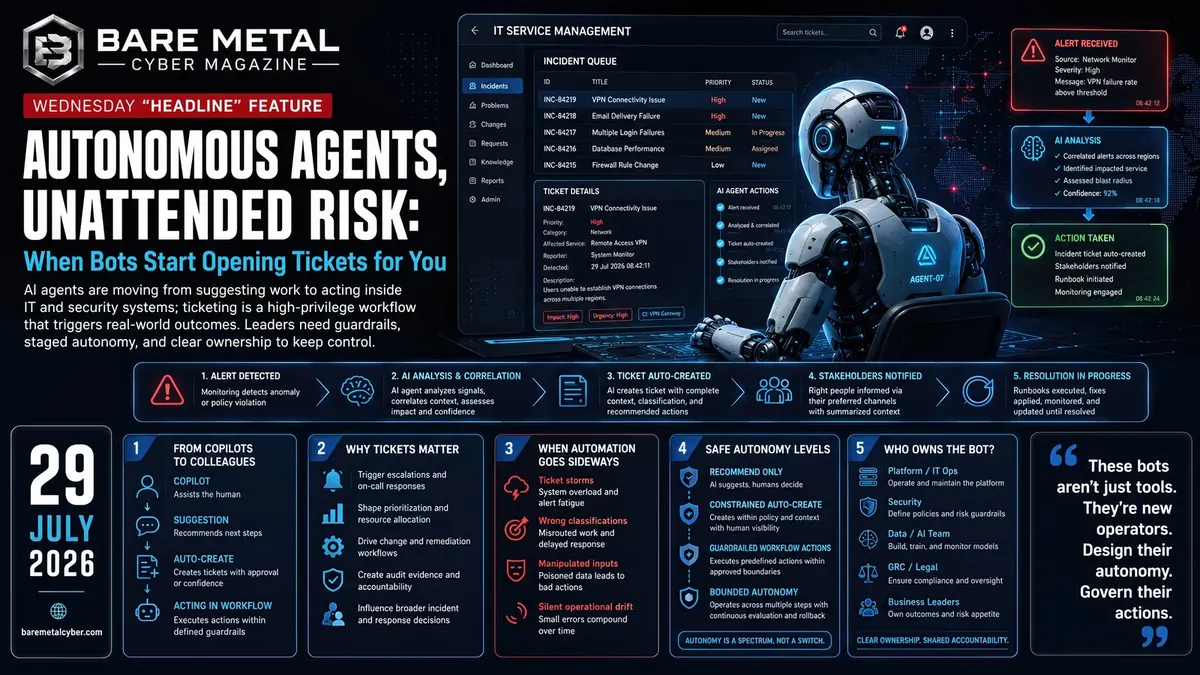
From Copilots to Colleagues
Most teams met AI in the form of copilots: tools that suggest code, summarize alerts, or draft comments while a human still clicks “accept” or “ignore.” In that mode, the AI feels like autocomplete with better branding. The human remains the decision-maker, and the system’s errors are easy to contain. What changes with autonomous agents is not the intelligence but the locus of action. When the bot can open a ticket in your IT service management platform, assign it to a team, and attach evidence, it has crossed the line from suggestion to participation. It has become part of the workflow, not just a voice in the room.
In many organizations, the path to that crossover is incremental and almost invisible. A team starts with an agent that drafts ticket text in chat. Next, someone wires it to an API so the bot can create tickets directly “to save time.” Soon, that capability gets turned on for a few more noisy alert sources. There is rarely a formal decision to grant this agent a defined role with clear permissions. Instead, the agent quietly joins the cast of characters involved in operations, sitting somewhere between an analyst and a low-level automation script, but governed like neither.
Leaders who treat these agents as upgraded copilots rather than as colleagues miss subtle, high-impact dynamics. Colleagues have access scopes, escalation paths, and performance reviews; copilots do not. Colleagues create records that auditors will later inspect; copilots do not. Once an agent can create and shape tickets, it effectively gets a say in how work is perceived and prioritized. The right mental shift is to start asking: if this were a junior analyst making these calls, where would we document their responsibilities, what oversight would we put in place, and who would be accountable for their mistakes? Autonomous agents deserve at least that much structure.
Tickets as High-Privilege I/O
On paper, a ticket looks like a form: title, description, priority, a few fields for category and impact. In practice, that simple object is a command to your organization. Tickets route work, trigger escalations, create audit trails, and sometimes authorize changes. When an autonomous agent begins to populate those fields, it is not just filling out a form on your behalf. It is shaping where people spend their attention, which risks seem urgent, and what history your organization will later read back when it asks, “What happened here?” From a security and governance perspective, tickets are not low-risk text. They are high-privilege input and output.
This becomes obvious when you trace the lifecycle of a bot-created ticket. A performance anomaly in a cloud service leads an observability tool to generate an event. The agent ingests that event, cross-references it with deployment history and error budgets, and creates a “P2” incident ticket with a recommended mitigation. That ticket triggers a Slack channel, pulls in on-call engineers, and may even auto-generate change requests in connected systems. Downstream, audit and compliance teams will rely on that ticket as evidence of detection, response, and remediation. At every step, the initial classification and narrative chosen by the agent constrain how humans think about the problem.
Treating the ticketing system as a high-privilege interface changes the design questions leaders ask. Instead of “Can the bot open tickets?” the questions become “What kinds of tickets is it allowed to open?”, “Which fields are it allowed to set?”, and “What thresholds must be met before a ticket can trigger downstream automation?” It also surfaces the need for controls that mirror identity and access management: strong authentication for agents, scoped permissions for specific queues, and monitoring that can distinguish between healthy automation and a runaway loop. Once you accept that tickets are a powerful control surface rather than administrative noise, giving that surface to an unattended agent without guardrails stops looking like a time-saver and starts looking like granting a new identity semi-privileged access to your operational core.
When Automation Goes Sideways
When agents start opening tickets on their own, the first visible failure mode is usually noise. A well-meaning bot that is slightly too sensitive can flood queues with low-value tickets about transient blips, benign anomalies, or issues already known to humans. At small scale this looks like a minor annoyance; at larger scale it becomes a denial-of-service attack on human attention. Teams become desensitized, rules get added to auto-close or ignore certain patterns, and the very workflows you hoped to strengthen with automation become background hum. Leaders who only measure “tickets processed” or “alerts handled” will miss the fact that the quality of signal has quietly eroded.
The more dangerous failures are subtle distortions rather than obvious floods. An agent that misclassifies a recurring issue as “low impact” can bury genuine risk under a veneer of documentation. Another that consistently routes tickets to the wrong team can create invisible drag, as work bounces around without clear ownership. Because these are system-level effects, they accumulate over weeks and months. Your dashboards look busy, the metrics look green, and yet real problems are handled late or not at all. The organization believes it has become more responsive, while the underlying risk posture has actually weakened.
Then there is the adversarial angle. Once agents act on logs, alerts, and user input, attackers get a new interface to your operations. A threat actor who understands your environment can craft patterns that cause the agent to open distracting tickets, mislabel important ones, or even normalize malicious activity as “expected behavior.” Social engineering does not have to target humans directly if it can target the systems that humans trust. Over time, your autonomous agents can be trained—intentionally or not—into becoming unpaid interns for an attacker, triaging away the clues your defenders most need to see.
In each of these cases, the common pattern is the same: automation moves faster than governance. The organization gains apparent efficiency while losing the ability to reason clearly about what work is being done and why. Recognizing these dynamics early is what allows leaders to design autonomy in layers rather than discovering, after an incident, that the bots quietly helped set the stage.
Designing Safe Autonomy Levels
The easiest mistake to make with autonomous agents is to treat autonomy as a binary: either the bot is “on” and opening tickets, or it is “off” and back to being a passive copilot. In reality, safe use looks more like a set of graduated autonomy levels. At the lowest level, the agent only drafts tickets and humans decide whether to submit them. The next level allows auto-creation in constrained domains, such as low-priority issues in a single queue with no downstream automation. Higher levels allow the agent to create, classify, and even update tickets that feed into change and incident workflows, but only under specific, observable conditions. Thinking in levels forces leaders to decide what kind of authority they are actually delegating.
Designing those levels starts with scoping. Instead of asking what the agent could theoretically do, ask where its decisions are tolerable to be wrong. That might mean limiting it to informational tickets that do not trigger changes, or to specific services where the blast radius of misclassification is low. Guardrails then become explicit: which queues it can write to, what priority bands it is allowed to set, what enrichment sources it may use, and what patterns should always require a human to confirm. These rules can live as policy-as-code around the agent, enforced at the integration point with your ticketing system rather than hidden inside a prompt template.
Feedback loops are the other half of safe autonomy. If humans cannot easily correct or override the agent, you have no way to steer its behavior over time. Leaders should insist on mechanisms for analysts and engineers to flag bad tickets, adjust classifications, and feed those corrections back into training or rules updates. Metrics shift from “tickets created by the bot” to questions like “how often did humans disagree with the bot’s decisions?” and “how quickly do we react when disagreement patterns emerge?” When autonomy levels, scopes, and feedback loops are visible and explainable, you can grant agents meaningful operational roles without pretending they are infallible or leaving their impact to luck.
Who Owns the Bot?
Once an agent can quietly open tickets in your production systems, the question of ownership stops being theoretical. Someone is responsible for its configuration, its permissions, its training data, and the outcomes it produces. In many organizations, that “someone” is a blurry coalition: IT operations owns the service desk, the platform team owns the integrations, security worries about abuse, and the data or AI team owns the models. Without a clear owner, the bot becomes a shared secret, an unaccountable actor whose behavior is everyone’s problem and no one’s job. For leaders, clarifying ownership is a control decision, not a project-management detail.
A useful way to think about ownership is to mirror how you treat any semi-privileged system identity. The team that owns the bot should define its role, set its permissions, and maintain its runbook. They should also be accountable for monitoring its behavior: tracking what tickets it opens, how accurate its classifications are, where it is overstepping its scope, and when its decisions are challenged by humans. This does not mean the owner operates in isolation. Security should shape guardrails and threat models, operations should help define acceptable failure modes, and risk or compliance teams should weigh in on auditability. But there must be a single team that feels responsible when the bot misbehaves.
Culturally, clear ownership helps resist the temptation to bypass guardrails in the name of convenience. If teams can flip the agent into more autonomous modes without talking to the owner, you will eventually get shadow automation: unofficial bots with too much power, no monitoring, and no place in your risk narrative. Leaders can counter this by tying agent usage to existing governance forums—change advisory boards, architecture reviews, or risk committees—so that autonomy levels and scopes are explicit decisions with documented rationale. When everyone knows who owns the bot, how its authority is defined, and where to raise concerns, the agent becomes part of a managed socio-technical system rather than a clever script someone snuck into production.
Where Leaders Go From Here
At its heart, this topic is about treating autonomous agents as semi-privileged actors in your organization, not as harmless helpers. The quiet moment when you let a bot start opening tickets is the moment you delegate real authority into your systems of record. From there, every ticket it creates shapes what work humans see, how they interpret risk, and what story your audit trail tells about how you run the business. Closing the loop between that decision point and the downstream consequences is the core leadership move.
The same way we began with a seemingly simple configuration choice, we end with the recognition that nothing about this is “just” a setting. Tickets turn out to be high-privilege input and output, failure modes turn out to be systemic rather than episodic, and autonomy turns out to be a spectrum, not a switch. When leaders see agents as colleagues with roles, scopes, and performance expectations, instead of as upgraded copilots, they gain leverage: they can design autonomy levels, demand feedback loops, and assign real ownership instead of hoping for good outcomes.
For security and technology leaders, internalizing this argument changes the questions you ask. Rather than “Can we use an agent to save time?” you start asking “What kind of authority are we delegating, who owns it, and how will we know when it goes wrong?” Conversations with boards and regulators shift from AI as a buzzword to AI as part of your control surface. Inside your teams, people understand that pushing for more autonomy comes with responsibilities: clearer guardrails, better monitoring, and a willingness to accept scrutiny.
A practical next step is simple but non-trivial: sit down with the leaders who own your service desk, observability stack, and AI initiatives, and map where agents already touch your systems of record. Ask which bots can open or shape tickets today, what constraints exist around that authority, and how you would detect if automation started to drift. The point is not to halt progress. It is to make sure that, as bots start opening tickets for you, they do so under the same intentional governance you expect from any other actor in your environment.