The CISO had three dashboards open and none of them agreed on what was actually happening. Outside, protests were gathering at the company’s headquarters. Inside, a payment API was flapping in and out of service. On social media, a hashtag accusing the firm of “complicity” was trending, fueled by screenshots, partial logs, and a leaked slide deck from an internal briefing. The board wanted to know if this was “just a DDoS,” a misconfiguration, or part of something bigger—and whether pulling systems offline would calm things down or ignite them.
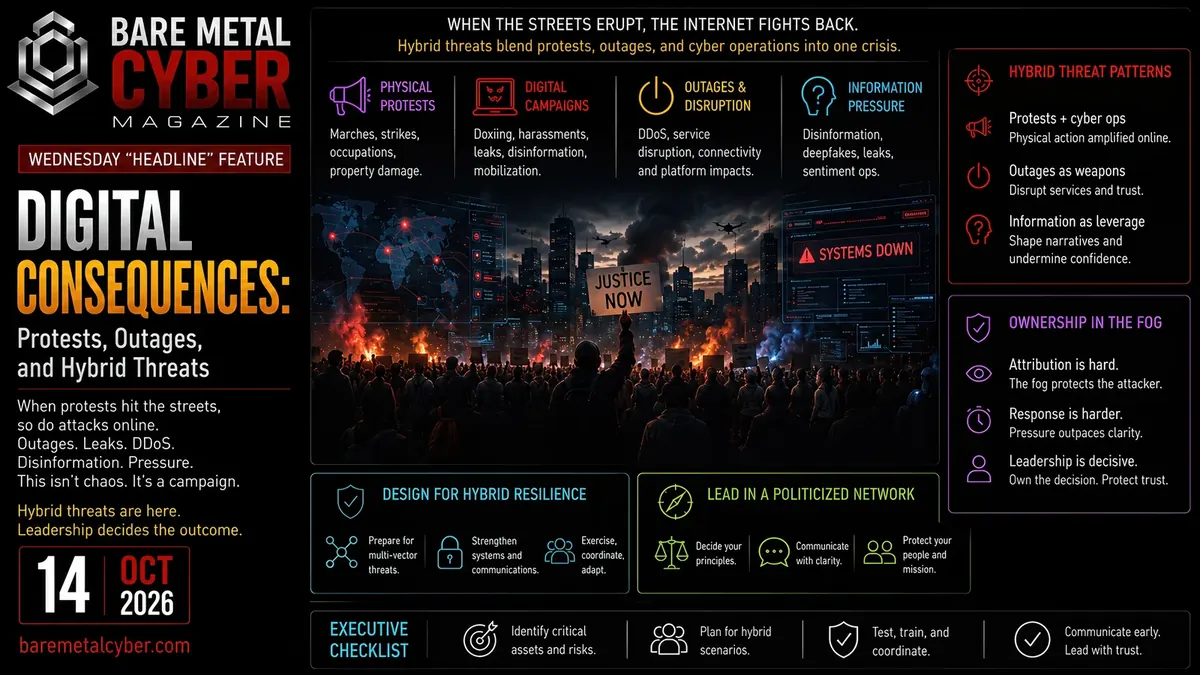
This Wednesday “Headline” feature in Bare Metal Cyber Magazine is about that moment when digital and physical pressure collide and you have to choose what to protect first, knowing every move will be interpreted as a statement. The core concept is hybrid digital-physical threat campaigns: situations where protests, information operations, and technical disruptions reinforce each other rather than happening in isolation. Over the next few years, these will not be edge cases. They will be an expected part of operating in sectors that touch money, mobility, communications, or identity.
For security and technology leaders, the challenge is not “stopping protests” or “preventing outages” in some absolute sense. It is understanding how different actors—activists, criminals, states, and platforms—use outages, leaks, throttling, and pressure on infrastructure as tools in larger campaigns. It is being able to explain to executives and regulators what is a deliberate attack, what is a policy choice, and what is collateral stress on brittle systems. And it is designing architectures, playbooks, and governance that assume hybrid pressure will arrive on your worst operational day, not your best.
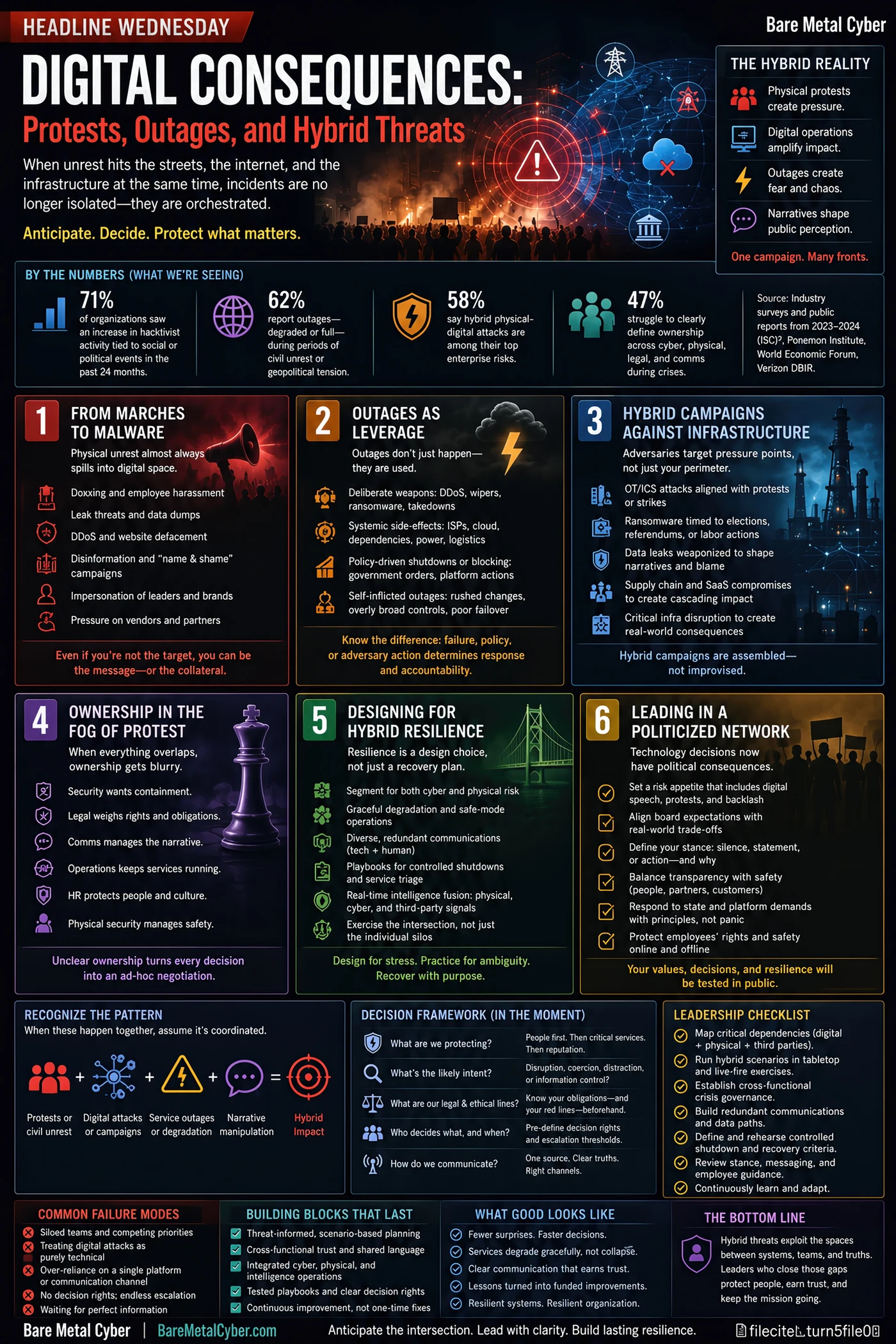
From Marches to Malware
Most organizations still treat street protests and digital attacks as separate categories of risk, managed by different teams with different playbooks. In reality, physical demonstrations now spill into digital space almost by default. A protest outside a headquarters or data center rapidly turns into doxxing of executives, targeted harassment of employees, and campaigns to overwhelm customer-support channels. The same videos that appear on news feeds become raw material for online narratives, and those narratives often come packaged with instructions to “hit” specific systems, brands, or people.
From a security leader’s perspective, the sequence is depressingly familiar. First comes the sudden spike in social-listening alerts and legal inquiries about speech, defamation, and content. Then an unofficial boycott list starts circulating, naming your company alongside others. Within hours, web forms are hammered, login pages see unusual patterns from new geographies, and your marketing site or blog becomes the target of defacement attempts. The actors behind this activity are not always coordinated, and they are not all “attackers” in the traditional sense. But their combined effect is to push your digital estate into a higher-stress regime right when physical and reputational pressure is already high.
The hard leadership problem is to separate signal from noise without dismissing the human context. Some actions will be clearly malicious—credential stuffing, botnets, data-leak threats. Others will be legitimate users trying to express anger, organize boycotts, or demand information. If security treats everything as hostile, the organization risks overreacting, shutting down channels, and feeding the narrative that it is hiding something. If security underreacts, opportunistic actors can slip serious attacks into the chaos. Leaders have to guide their teams toward a framing where protests are not “cyber incidents,” but predictable amplifiers of stress on systems and people. That framing sets the stage for more deliberate decisions about what to protect, what to tolerate, and how to communicate when the noise turns into real damage.
Outages as Leverage
When systems start failing during unrest, everyone wants a simple label: “attack,” “bug,” or “policy decision.” In practice, outages sit at the intersection of all three, and that ambiguity is exactly why they are such powerful leverage. A basic distributed denial-of-service attack can be framed as censorship if it knocks offline a platform used by organizers. A government order to throttle connectivity can be framed as a security measure against “instability.” A rushed internal change to add new controls may unintentionally break critical services at the worst possible moment. To users and the public, the distinction between intent, incompetence, and collateral damage is invisible. They just see that their access has been cut.
For security and technology leaders, the more important distinction is not moral but operational. You need to know whether you are in a world of hostile action against your systems, a self-inflicted failure from stressed teams, or an upstream outage caused by a provider or regulator. Each implies different decision paths. If this is truly an external campaign, upstream providers and law enforcement may matter more than internal root cause analysis. If you triggered the outage through a rushed change, your priority shifts to owning the mistake, restoring confidence, and making sure that “emergency hardening” does not silently undermine core business dependencies. And if the outage is the result of a policy-level decision—by your firm, a platform, or a state actor—then the security team is suddenly pulled into questions of ethics, law, and public positioning.
The leadership trap is treating outages purely as technical incidents when they are being used as symbolic events. Taking a payment system offline might reduce fraud risk, but it can also look like punishment directed at a community. Accepting degraded service at a protest location might protect staff safety, but it can also create long-term distrust in your brand. On the other hand, insisting on keeping everything online “in the name of transparency” may expose employees to doxxing or harassment that you cannot control. Hybrid threats turn uptime decisions into political statements whether you acknowledge it or not. Leaders who understand outages as leverage can start designing for graceful degradation, transparent communication, and clear criteria for when and why to pull plugs—so those choices feel principled, not panicked, when hybrid pressure arrives.
Hybrid Campaigns Against Infrastructure
When hybrid campaigns escalate, they stop targeting just brands and websites and start leaning on infrastructure. Payment rails, logistics platforms, cloud collaboration suites, identity providers, and content-delivery networks all become pressure points. In some cases, these systems are targeted directly with ransomware, denial-of-service attacks, or exploitation of known weaknesses. In others, they are used as choke points: a cloud provider’s abuse process, an app store’s policy enforcement, or an identity provider’s trust relationships become tools for amplifying or dampening the impact of protests. The result is a landscape where a relatively small set of platforms and providers disproportionately shape how disruption feels on the ground.
For leaders, what matters is not just that these infrastructures are “critical,” but that they are shared. A logistics carrier whose drivers are on strike, a payments company facing regulatory pressure, or a communications platform caught in a political controversy can trigger cascading effects across hundreds of customers at once. Adversaries understand this. They time ransomware campaigns to coincide with elections, protests, or industrial actions, knowing that defenders will be distracted and public pressure will be high. They leak data from one entity to tarnish an entire sector. They choose infrastructure nodes that are hard to replace quickly: identity brokers, sector-specific SaaS, and cloud regions bound by data residency rules.
The deeper problem is that many organizations still reason about risk at the level of their own perimeters and applications. They have not mapped how their dependencies behave under hybrid stress. Which cloud regions are politically exposed? Which carriers or payment partners are likely targets of activism or state pressure? Where could a single platform policy change turn into an outage for your customers? Leaders who do not ask these questions are left improvising when a partner’s “business as usual” incident suddenly intersects with social unrest. Those who do build a richer picture of their dependency graph can plan for substitution, graceful degradation, and alternative channels before the campaign reaches their door.
Ownership in the Fog of Protest
Hybrid events expose every unresolved ownership question you have been living with. In ordinary times, the fuzzy overlap between cyber, physical security, legal, HR, and communications is annoying but survivable. During protests and outages, that fuzziness becomes an accelerant. Who decides whether to shut down badge access or move to remote work in a protest zone? Who approves disabling public-facing services in a region where tensions are high? Who signs off on holding or deleting data that could be requested by regulators, law enforcement, or civil litigants? If those answers are not clear before the fog rolls in, they will be rewritten on the fly by whoever happens to be in the room.
From the CISO’s chair, the problem is not just that roles are unclear; it is that the definitions of “harm” and “risk” diverge. Physical security worries about crowd control and staff safety. Legal worries about discovery, regulatory exposure, and contempt of court. Communications worries about reputation and narrative control. Operations worries about keeping core services alive. Security worries about opportunistic attackers and long-term erosion of trust. In a hybrid crisis, all of them are right, but they are not all right at the same time. Without prior agreement on who owns which decisions at which thresholds, every move becomes a negotiation, and those negotiations leak time, attention, and credibility.
The most damaging failures in hybrid events often come not from the first decision, but from the inconsistent ones that follow. An organization might initially commit to keeping certain services online “for transparency,” then quietly limit access when pressure escalates. It might promise employees robust support against harassment, then fail to act when leaders are doxxed. It might claim neutrality, then comply with opaque requests it is not prepared to explain. These contradictions are visible externally and internally, and they are remembered long after the technical outage is resolved. Leaders who treat ownership as a governance problem rather than a crisis improvisation problem can define in advance who makes which calls, what values guide those calls, and how they will be communicated. That clarity does not eliminate controversy, but it dramatically reduces the chaos when protests, outages, and hybrid threats collide.
Designing for Hybrid Resilience
Designing for hybrid resilience starts with admitting that you cannot engineer your way out of politics. You can, however, architect systems and processes so that when political, social, and technical forces collide, the blast radius is smaller and your options are clearer. Practically, that means moving beyond “keep it up at all costs” thinking and embracing controlled, explainable ways for services to degrade. Instead of a binary choice between full availability and total shutdown, leaders should demand modes where certain features are restricted, certain geographies are throttled, or certain identities require stronger assurance—implemented in ways that can be audited and communicated.
At the architectural level, many of the same patterns we talk about for cyber resilience apply, but with an explicitly hybrid lens. Segmentation is not just about stopping lateral movement; it is about being able to isolate functions that may become flashpoints during unrest—payment flows tied to controversial activities, data sets that are likely to be demanded by authorities, public APIs that can be easily abused for harassment or amplification. Alternative communications channels matter as much as redundant data centers: if your primary collaboration platform is blocked or overwhelmed, can leadership and critical teams still coordinate? If your login journey is targeted in a campaign, can customers still authenticate through a backup route that does not expose them to new risks?
Playbooks sit on top of this architecture and turn options into deliberate choices. A hybrid resilience playbook should define what “graceful degradation” looks like for key services, which controls can be tightened temporarily, and which changes require executive or board-level approval. It should spell out how you will log and document those decisions, because in many jurisdictions you will be explaining them later to regulators, courts, or the public. Crucially, it should include scenarios where you decline to take certain actions—even under pressure—because they would undermine your long-term trust position. That is where hybrid resilience crosses from engineering into governance: you are not just building systems that can survive protests and outages, you are designing a stance that employees, customers, and partners can understand even when they disagree.
Leading in a Politicized Network
Hybrid threats are ultimately about power in a networked world, and leaders sit at junctions where many different powers intersect. Boards, regulators, activists, employees, customers, platforms, and states all have expectations about how your organization should behave under pressure. In calm times, those expectations can stay pleasantly vague. In a crisis, you will be asked to pick sides—sometimes explicitly, often implicitly through choices about who gets access, whose data is prioritized, and which narratives your systems enable or constrain. Pretending that these are “purely technical” or “purely legal” decisions is no longer credible.
For security and technology leaders, this means expanding the conversation about risk appetite into a conversation about posture. Are you comfortable being seen as a neutral infrastructure provider, even when that neutrality means facilitating actions some stakeholders oppose? Are you prepared to comply with lawful but controversial orders that conflict with your public commitments? Under what conditions will you accept higher operational risk to protect employees or vulnerable users? These are not decisions you want to improvise while an outage is trending and protests are at your doors. They require the board, executive team, and key functions to agree on a set of principles that will guide actions when hybrid stress arrives.
Culture is where those principles either take root or die. If engineers believe leadership will back them when they push back on unsafe demands, they will raise concerns earlier. If employees believe the company will abandon its stated values at the first sign of pressure, they will leak, resist, or leave. And if external partners see you as opportunistic in your response to unrest—talking about human rights one week and quietly cutting deals the next—they will price that into contracts and alliances. Leading in a politicized network means recognizing that your security, resilience, and trust positions are all the same position, viewed from different angles. It is about building the muscle to act consistently when protests, outages, and hybrid threats test every promise you have made.
Where Leaders Go from Here
At its heart, this topic is about accepting that risk no longer arrives in neat lanes and leading in a world where social pressure, infrastructure fragility, and adversarial behavior reinforce each other. The hybrid events that combine protests, outages, and coordinated digital campaigns are not anomalies. They are what it looks like when our physical, legal, and technical systems are fully entangled. Leaders who cling to a narrow “cyber incident” lens will keep getting surprised, not because the threats are novel, but because their mental models are too small.
The decision point we opened with—a leadership team trying to work out whether a flapping API, a trending hashtag, and a protest at the front gate are connected—is not going away. What changes is how prepared you are when that moment arrives. If you have already mapped how marches turn into malware, how outages are used as leverage, and how infrastructure can be turned into a pressure point, you can see patterns instead of noise. If you have clarified ownership across cyber, physical security, legal, HR, and comms, then the fog of protest does not automatically become a fog of governance. And if your architectures and playbooks are designed for graceful degradation rather than brittle heroics, you can make hard choices without panicking the system.
Internalizing this argument shifts conversations in boardrooms and leadership teams. Instead of asking “Will we be attacked?” the question becomes “When hybrid pressure arrives, what values do we act from, who decides, and what trade-offs have we already accepted?” That shift turns hybrid threats from a purely defensive problem into a test of posture and integrity. The practical next step is simple but uncomfortable: bring these questions to the table before the next protest, outage, or campaign forces them on you, and make sure your answers are strong enough to stand when the network around you starts to shake.