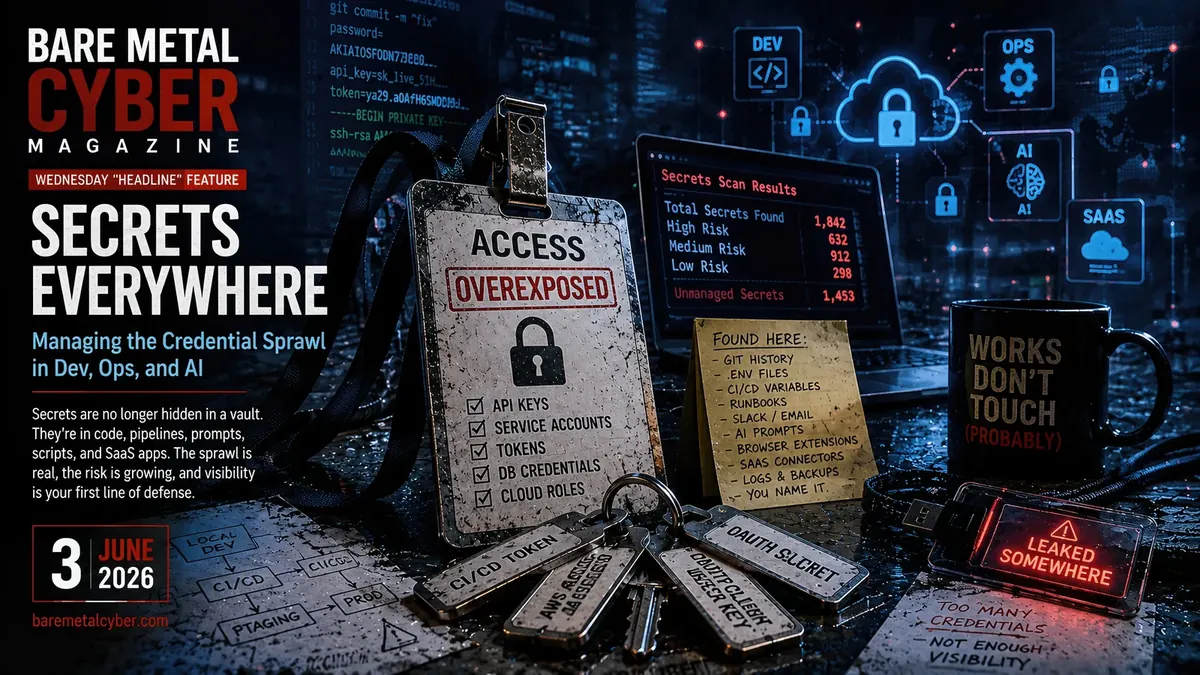
The CISO leans over the table and asks the question everyone’s been dodging: “If we printed every credential our systems rely on today, how big would the stack be?” Around the room, people talk about the secrets manager rollout, cloud-native key services, and the shiny new passwordless strategy. No one mentions the keys parked in Git history, the API tokens living in CI/CD variables, the “temporary” service accounts in production, or the credentials quietly pasted into AI prompts so a chatbot can “just fix it.” This Wednesday “Headline” feature in Bare Metal Cyber Magazine is about that gap between the comforting story and the messy reality.
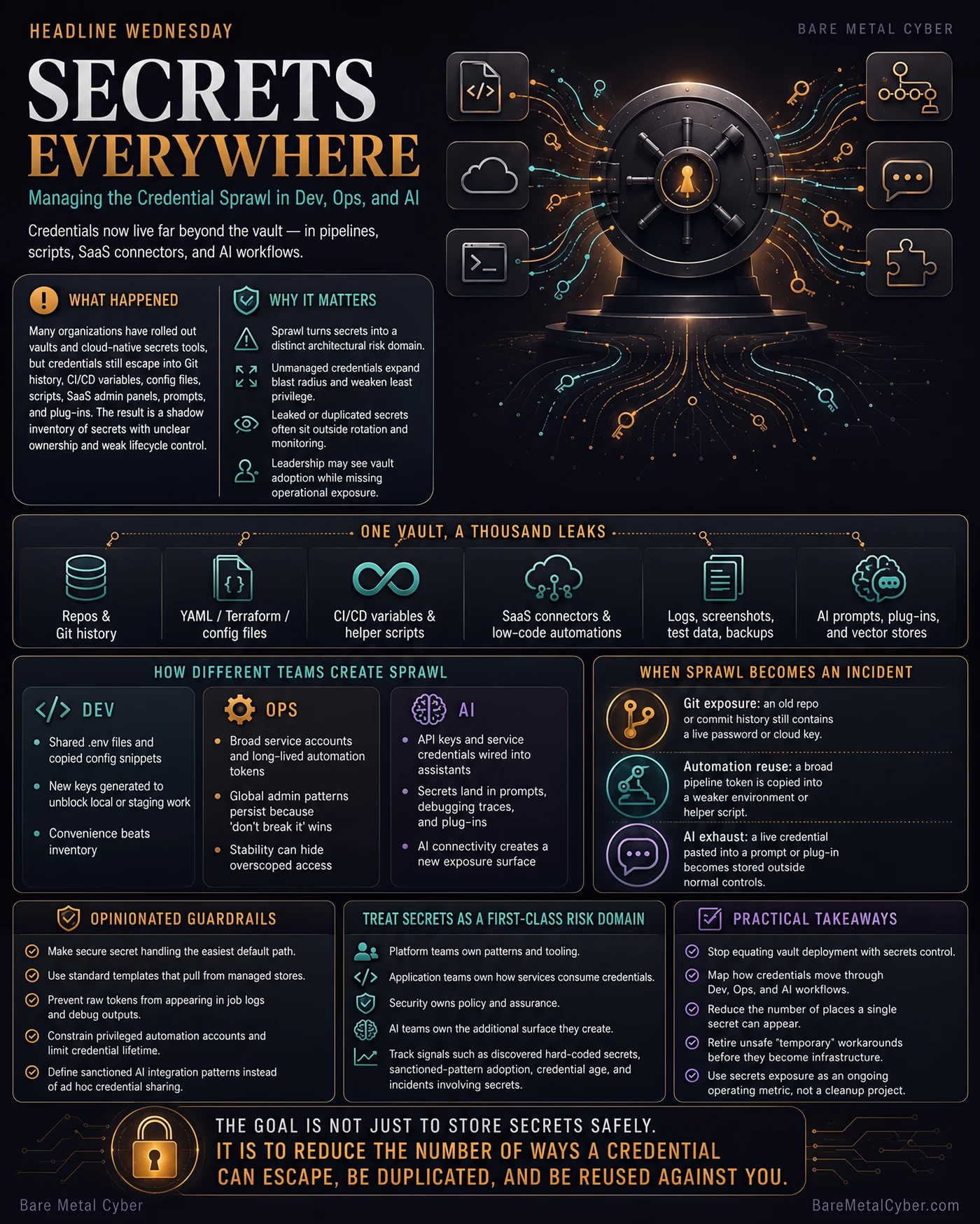
Secrets used to mean a handful of privileged accounts and maybe a shared root password you were slowly phasing out. In today’s environments, secrets are everywhere: in YAML files and Terraform, in SaaS connectors and low-code automations, in feature flags and AI plug-ins. Development teams trade convenience for speed, operations teams wire up infrastructure with broad service identities, and AI teams glue everything together with credentials pushed into prompts, tools, and vector stores. None of this is inherently reckless, but almost all of it is invisible at the leadership level until something goes very wrong.
Over the next 12–24 months, this sprawl becomes an architectural risk domain in its own right. Regulations and frameworks will keep talking about identity, access management, and least privilege, but the hardest problems will sit in the grey space where secrets move faster than your controls and live longer than your designs. The leaders who get ahead of this won’t just buy another vault or scanner. They will make opinionated choices about how Dev, Ops, and AI teams request, issue, rotate, and retire credentials, and they will treat secrets exposure as a first-class metric, not a cleanup project after the next incident.
One Vault, A Thousand Leaks
On paper, the story is simple: you rolled out a secrets manager, integrated it with your cloud provider, and mandated that teams stop hard-coding credentials. The architecture slides show neat flows from apps to vaults to key management services. In practice, the organization lives in a messy middle state where only some services are wired correctly, a few flagship teams follow the pattern, and everyone else is “on the roadmap.” The result is a hybrid reality: one well-governed source of truth surrounded by a ring of ad hoc secrets scattered across repos, config files, and SaaS admin panels.
The problem is not that the vault is bad technology. The problem is that real systems rarely move in lockstep with the reference architecture. A development team racing to ship a feature will drop an access token into a continuous integration and continuous delivery (CI/CD) variable “just for now.” An operations engineer debugging a production issue will temporarily add a static credential into a runbook or script. A vendor integration arrives with a long-lived API key that nobody has time to refactor into your standard pattern. Each of these decisions is rational in isolation, but together they create a shadow inventory of secrets your vault never sees.
Even when teams adopt the vault, the edges leak. Wrapper scripts store cached credentials in local files; environment variables replicate secrets into containers and lambdas; “helper” configuration repos end up with sample files that still contain real tokens. Over time, the number of places a single secret can appear multiplies: in logs, in screenshots, in test data, in backup copies of old configuration. Leaders who only track vault adoption metrics miss the actual risk picture: a growing population of unmanaged secrets whose lifecycle no one owns and whose blast radius no one has measured.
From a leadership perspective, the key shift is recognizing that “we have a vault” is not the same as “we know where our secrets really live.” The question changes from “did we deploy the tool?” to “how many ways can a single credential escape the pattern, and how would we know if it did?” Until that gap is visible, secrets management will remain a slideware success with operationally invisible leaks.
How Dev, Ops, and AI Actually Create Secrets Sprawl
Secrets sprawl is not an abstract flaw in the system; it is the direct outcome of how different groups get work done. Developers live in short feedback loops and automated pipelines. They need databases, queues, and third-party APIs to “just work” in local environments, feature branches, and staging systems. That pressure tends to produce shared environment variables, copied .env files, and “golden” configuration snippets passed around in chat. When a developer is blocked because a key expired, the fastest fix is often to generate a new one and paste it somewhere convenient. Each of those small, local optimizations leaves a trail of credentials nobody tracks.
Operations teams create a different class of sprawl. Their job is to keep infrastructure, SaaS platforms, and legacy systems running across clouds and data centers. To do that, they configure service accounts with broad permissions, long-lived tokens for monitoring and backup tools, and cross-tenant credentials for managed services. The sprawl here is less about one-off tokens and more about overpowered identities that touch many systems and rarely get revisited once they are working. “Don’t break it” becomes the dominant control, and a surprising amount of risk ends up hiding inside automation scripts, orchestration tools, and “global” admin accounts.
AI teams and power users add a third layer that most organizations are only starting to see. To make AI assistants useful, people wire them into ticketing systems, knowledge bases, cloud consoles, and CI/CD platforms, often by handing them API keys and service credentials through plug-ins, browser extensions, or prompt stuffing. Credentials end up embedded in prompts, stored in vector databases, or logged as part of debugging traces. The AI stack was rarely designed with secrets hygiene as a first-class concern, so sensitive tokens can move across boundaries that traditional secrets management never anticipated.
For leaders, the takeaway is that Dev, Ops, and AI each produce their own flavor of secrets sprawl, driven by different incentives and tooling. A single, generic policy or training deck won’t fix this. You need patterns that respect how each group works while constraining how credentials are requested, distributed, and reused, so that “just get it working” does not silently become “we lost control of our blast radius.”
When Sprawl Turns Into Real Incidents
The danger with secrets sprawl is that it stays invisible until an attacker or an unlucky internal user stumbles on the wrong credential. One common pattern starts with a developer’s personal Git repository or a long-forgotten project on an internal Git server. Somewhere in the history, there is a database password, a cloud access key, or a CI/CD token that still works. An attacker who compromises that repo, or a contractor who leaves with a local copy, now holds a key that was never registered in your inventory and never included in your rotation schedules. From their perspective, it’s a golden ticket with no monitoring attached.
Another failure mode lives in automation. A CI/CD pipeline variable stores a broad-scoped API token that can create new infrastructure, push images, and modify secrets. The pipeline itself is locked down, but the token is also reused in a helper script that runs on an engineer’s laptop, or in a debugging job that runs in a less-trusted environment. Compromise the weakest copy of that token and you bypass the strongest controls around the original. When an incident hits, teams often discover that the token in question was “temporary,” created to unblock a project months ago, and never cleaned up or narrowed down.
AI-driven sprawl introduces subtler incidents. A well-meaning engineer pastes a live credential into a model prompt so a chatbot can run a quick API call, or configures an AI plug-in with production access because the staging environment is missing data. That secret may now be stored in logs, conversation history, or a third-party plug-in’s storage. If those systems are breached, or if access scopes change, the attacker does not have to breach your core infrastructure; they just harvest the tokens lying in the AI exhaust. When this kind of exposure comes to light, leaders realize they never treated AI integrations as part of the secrets surface at all.
These incidents share a theme: the business believes secrets are centralized and controlled, while attackers thrive in the spaces where credentials are duplicated, repurposed, and forgotten. Until you assume that any credential can and will leak into the easiest path, you will underestimate how quickly a “local” convenience can turn into an enterprise-wide incident.
Opinionated Guardrails, Not Just Another Tool
Once you accept that secrets sprawl is a product of normal work, not just bad tooling, the response has to move beyond “everyone should use the vault.” Leaders need to make a few opinionated decisions about how credentials are requested, approved, and wired into systems, and then bake those decisions directly into the paths teams actually use. That means shaping developer platforms, infrastructure templates, and AI integration patterns so that the easiest way to get work done is also the least dangerous way to handle secrets. If the safe path is slower, more brittle, or poorly documented, people will keep inventing side doors.
One useful lens is to treat secrets the way you treat production changes. You do not rely on policy alone to stop people from pushing code straight to main; you provide a well-supported pipeline and guardrails that make bypassing controls rare and visible. The same logic applies here. For developers, that could mean standard templates that automatically pull secrets from managed stores, CI/CD patterns that never expose raw tokens to job logs, and self-service flows where requesting a new credential automatically enforces least privilege and rotation. For operations teams, it means privileged automation accounts with sharply constrained scopes, time-bounded access elevation, and clear playbooks for rotating or revoking credentials without breaking everything.
AI integrations need their own opinionated patterns too. Instead of allowing ad hoc plug-ins and browser extensions to hold production credentials, you define a small number of sanctioned ways for AI systems to act on behalf of users or services. Those patterns should minimize how often raw secrets are exposed to models or third parties, and they should keep auditability high: who granted what scope, when, and through which integration. This may feel like friction for early adopters, but it is the only way to stop AI from becoming a blind spot where secrets leak without anyone noticing.
At the leadership level, the critical move is to accept that not every pattern can survive. Some “working but unsafe” workflows will have to be retired or significantly reshaped. That requires backing platform and security teams when they simplify options, remove unsafe toggles, and insist on just one or two viable ways to connect systems. The organizations that win here are not the ones with the most tools. They are the ones with a small, enforceable set of guardrails that actually match how Dev, Ops, and AI teams ship real work.
Treating Secrets as a First-Class Risk Domain
When you treat secrets as a side effect of identity or DevSecOps, they will always compete for attention with more visible priorities. Elevating secrets to a first-class risk domain means giving them the same clarity you give to vulnerabilities, outages, or fraud: defined ownership, a shared vocabulary, and a small set of measures you review regularly. The question is no longer “are we using a secrets manager?” but “who is accountable for how secrets are created, used, and retired across Dev, Ops, and AI, and how do we know if we’re getting better or worse?”
Start by defining where the boundaries sit. Platform teams may own the patterns and tooling; application teams own how individual services consume credentials; security owns the overarching policy and assurance; AI teams own the additional surface they create. That division only works if you connect it to metrics that leaders actually see. Useful examples include the number of discovered hard-coded secrets, the percentage of critical systems using sanctioned patterns, the age distribution of sensitive credentials, and the count of incidents where secrets contributed to impact. These are not vanity dashboards; they become the way you argue for investment, simplification, and cleanup.
Over time, secrets should show up in your risk register, incident reviews, and strategic planning. Major incidents ought to ask not only “why was this credential exposed?” but “what pattern allowed it to be reused, overscoped, or forgotten?” Board discussions about AI adoption should include questions about how credentials flow into prompts, plug-ins, and orchestration layers. Regulatory responses will increasingly expect you to demonstrate not just that you have tools, but that you understand and are actively managing the way secrets move through your environment.
When leaders frame secrets in this way, teams stop seeing them as an implementation detail and start recognizing them as a shared, structural risk. That shift is what keeps secrets sprawl from quietly accumulating until the next breach forces everyone to care at the worst possible moment.
Where Leaders Go From Here
At its heart, this topic is about owning the reality that secrets are not a side note to identity; they are the connective tissue of how your business actually runs. The imagined stack of printed credentials in that leadership meeting is not a scare tactic, it is a mental model. Every token in that pile represents a decision someone made under pressure: to ship faster, to unblock an integration, to make an AI assistant useful. When you view secrets sprawl as the accumulated output of those decisions, it becomes clear that this is not a tooling problem you can delegate away. It is a strategic risk domain that demands clear choices about how much blast radius you will tolerate in exchange for speed.
Closing the loop means tying the story back to how work really happens in your organization. The Dev, Ops, and AI workflows described here will not disappear; if anything, they will grow more complex. Your leverage comes from shaping the defaults: tightening the guardrails around how credentials are issued and used, pruning unsafe patterns even when they are popular, and insisting that AI integrations meet the same bar as any other production change. When secrets show up in your metrics, incident narratives, and AI roadmaps with the same prominence as vulnerabilities or outages, you change the conversation from “do we have a vault?” to “are we reducing the number of ways a secret can hurt us?”
The next move is not a giant program but a sharper set of questions. Who truly owns secrets risk across Dev, Ops, and AI, and what signals tell you they are winning? Where are you still relying on “temporary” workarounds that have quietly become permanent infrastructure? And what one or two opinionated patterns are you prepared to enforce, even when they add friction, because they keep that stack of credentials from becoming the kindling for your next major incident?