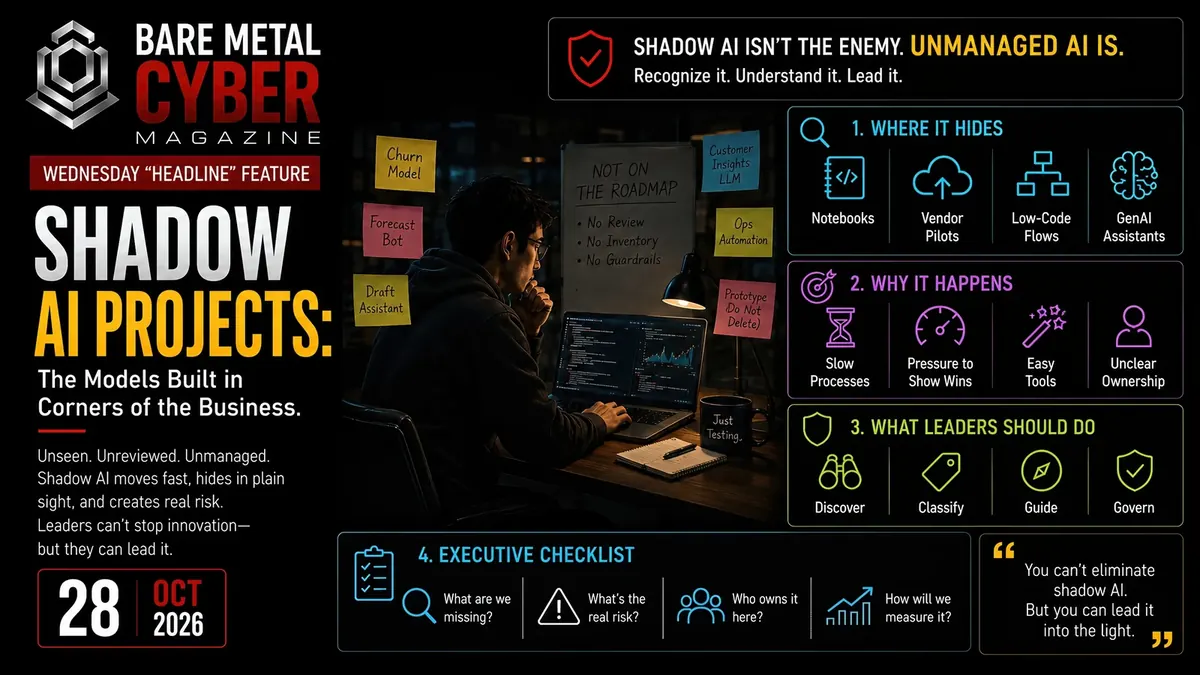
The first time you hear about it is not from your security tools. It is in a meeting where a marketing lead casually mentions “our churn model,” or a finance manager drops a reference to “the bot that drafts our forecasts.” A few questions later, you realize these are not initiatives run through your data science team or aligned to your official artificial intelligence (AI) roadmap. They are shadow AI projects: models, scripts, and automations built in the corners of the business, living in notebooks, vendor dashboards, and improvised pipelines that never touched a formal review. This Wednesday “Headline” feature in Bare Metal Cyber Magazine is about what you do once you realize that this is not an exception—it is the default.
Over the next few years, the presence of shadow AI will say less about your control and more about your operating model. When central platforms move slowly, governance feels opaque, and external pressure to “show AI wins” grows, smart people will build what they need with whatever tools they can reach. The result is a spectrum that runs from a harmless prototype in a sandbox to a model quietly influencing credit decisions or incident response. Treating all of that as a single policy violation is a good way to get lied to, sidelined, or bypassed. Leaders need a more granular mental model: where shadow AI actually lives, why it emerges, how its risks cluster, and which projects should be shut down versus shepherded into the light.
This is not a story about catching offenders. It is a story about recognizing that unmanaged machine learning (ML) and generative AI experiments are already part of how your organization works, and deciding whether you will be surprised by them or deliberately shape them. In the pages that follow, we will map the real habitats of shadow AI, unpack the incentives that drive teams into the shadows, and build a playbook for discovery, guardrails, and narrative control. The goal is to leave you with a stance you can explain to your own leaders: not “we stopped shadow AI,” but “we know where it is, which of it we tolerate, and how we turn the best of it into an advantage.”
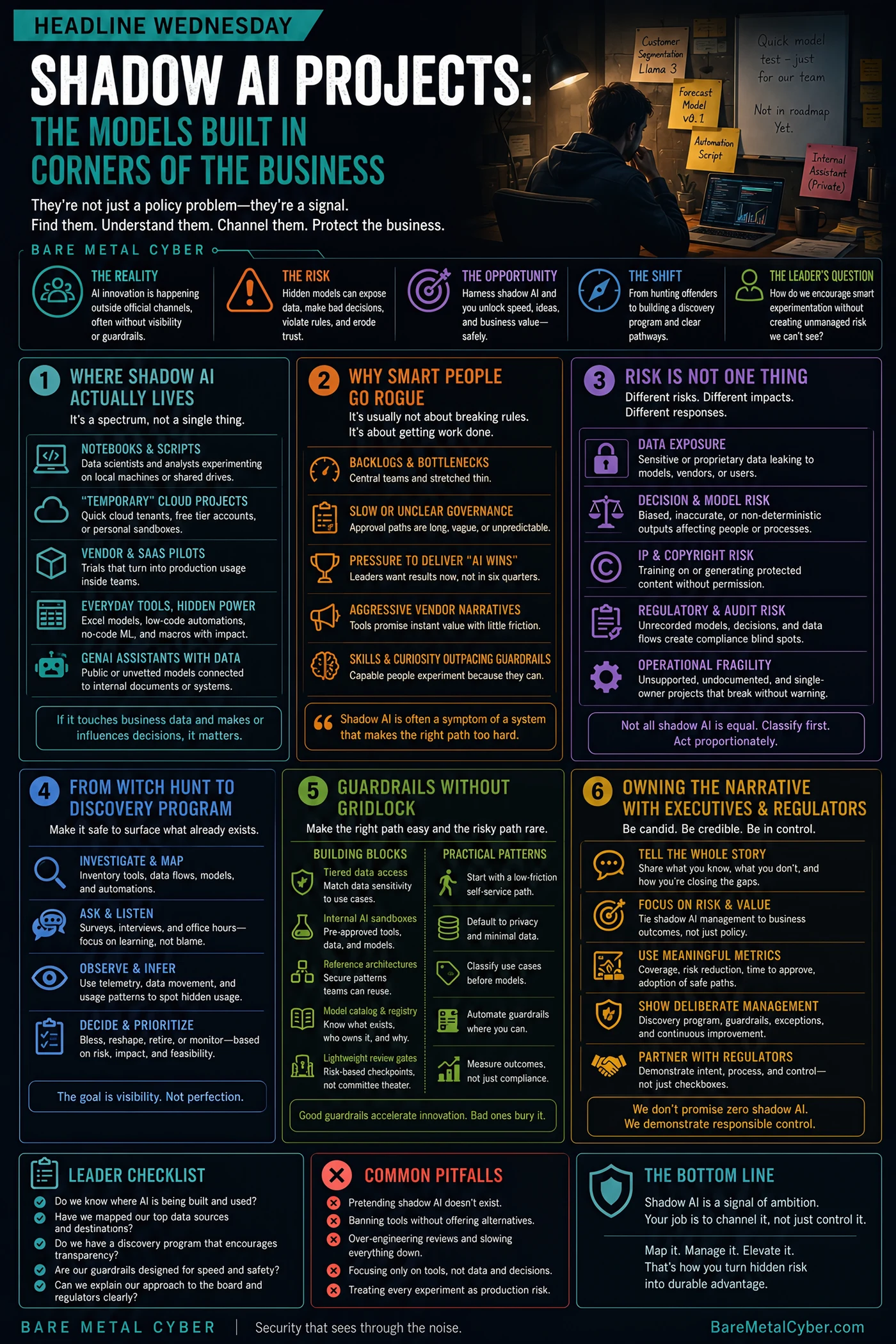
Where Shadow AI Actually Lives
If you only look for shadow AI in official “AI platforms,” you will miss most of it. The real habitats are ordinary tools stretched just far enough to count as models. A marketing analyst has a Python notebook in a shared drive that pulls export files from your customer relationship management system and fits a basic churn classifier. A finance team has a “temporary” workspace in a cloud provider, spun up on someone’s personal credit card, where a forecasting model runs once a week. An operations engineer has wired a generative AI assistant into ticket data, asking it to draft remediation steps and customer updates. None of these look like capital “Projects.” All of them are models built in corners.
You also see shadow AI hiding inside vendor dashboards and “pilot” features. A customer support platform quietly rolls out an “AI reply assist” that uses your historical tickets for fine-tuning, and a product manager toggles it on for a subset of agents. A sales enablement tool adds “AI deal scoring” trained on vague “industry data,” and the field team begins to rely on its rankings to prioritize calls. From a governance standpoint, these are models making decisions with your data, yet they can appear as a checkbox in an admin panel rather than a formal implementation. If your inventory only includes the things the central AI team built, these features never exist on paper.
Then there are the low-code and spreadsheet layers, where automation bleeds into modeling. A planner creates a macro that calls an external application programming interface (API) for “AI-driven optimization.” A business unit experiments with a low-code platform that promises “predictive routing” or “anomaly detection” as drag-and-drop components. Shadow AI in these spaces looks like configuration, not code, and the people using it think of it as just another formula or flow. Leaders who want to see the real picture must widen their lens: shadow AI is not just rogue models in custom stacks; it is any place where a system is learning from your data and influencing decisions without explicit, accountable sponsorship.
Why Smart People Go Rogue
Most shadow AI does not start with someone trying to break the rules. It starts with someone trying to do their job in an environment where the official paths are slow, opaque, or misaligned with what the frontline needs. A marketing team is told to “show AI impact this quarter” but the central data science group is booked for the next six months. A risk leader approves an “AI initiative” budget, yet the intake process feels like a compliance audit, not a partnership. In that gap, a product manager or analyst reasons that a small model in a notebook or a vendor’s built-in AI feature is the only realistic way to move. They do not experience themselves as going rogue; they experience themselves as solving a problem the organization has not made room to solve.
Incentives amplify this pattern. Vendors promise that you can “turn on AI” in a platform with a few clicks, bypassing the need for deep internal expertise. Executives talk about staying competitive in artificial intelligence but rarely talk as clearly about guardrails, ownership, or how much risk they are willing to accept for the sake of speed. Business unit leaders hear the first part and respond rationally: if the scoreboard is “demonstrate AI wins,” then every shortcut that appears safe enough becomes attractive. When security and governance functions show up late in that story with a simple “no,” they are not correcting a mistake—they are cutting across weeks of effort and political promises. That is how you breed secrecy.
Underneath it all is a trust problem between central functions and the rest of the organization. If teams believe that raising their hand early will trigger delay, scrutiny, and loss of control, they will not raise their hand. If they believe that sharing half-baked ideas will earn them a collaborative design conversation and a path to “yes,” they will surface work sooner. Leaders have to own this dynamic. Shadow AI is less a reflection of individual recklessness and more a mirror held up to your operating model: how you fund, prioritize, and govern new technology, and whether ambitious people see you as an accelerator or an obstacle.
Risk Is Not One Thing
When leaders first confront shadow AI, the instinct is often to ban it outright. Everything unsanctioned gets framed as the same generic risk: “we do not know what this model is doing.” That is emotionally understandable but operationally useless. The reality is that shadow AI spans very different risk types and severities, and treating them as one blob prevents good decisions. A small prototype using synthetic or fully anonymized data is not in the same league as a model that quietly influences loan approvals or production changes. A vendor feature using narrow metadata is not equivalent to a custom generative model with access to sensitive logs and contracts. If your response cannot distinguish between those, it will either be ignored or weaponized selectively.
A more useful view starts by segmenting risk into distinct buckets. There is data risk: what datasets the model touches, whether personal or regulated information is involved, and how that data is moved and stored. There is decision risk: what business actions the model influences, from cosmetic recommendations to credit decisions or security responses. There is model and IP risk: how the model is trained, whether you are leaking proprietary patterns into a shared service, or exposing yourself to copyright and licensing claims. Then there is operational risk: who maintains the thing, how changes are deployed, and what happens when it fails at two in the morning. Shadow AI projects land very differently across these axes.
Once you are thinking in buckets rather than slogans, you can sort shadow projects into categories: tolerate, tame, or terminate. Some experiments may be relatively low-risk and can be allowed to continue in a safer environment with modest adjustments. Others are salvageable if you change their data sources, wrap them in monitoring, or move them to a managed platform. A smaller subset will be non-negotiable shutdowns because they sit in the high-impact, high-uncertainty quadrant. The leadership move is to be explicit about these distinctions. That clarity is what lets you tell teams, “We are not against all experimentation, but here is where the line really is—and why.”
From Witch Hunt to Discovery Program
If your first visible move on shadow AI is a crackdown, you will drive it deeper underground. Rumors of “AI police” audits travel faster than any official communication, and before long, teams will quietly rename projects, strip “AI” from slide titles, or move work off corporate systems. You will feel briefly in control because fewer questionable initiatives cross your desk. In reality, you have traded visibility for false comfort. To do better, you have to recast the entire effort: not as a search for culprits, but as a discovery program that assumes smart people have already built things worth understanding. The language, posture, and mechanics of that program matter more than any single control.
A discovery program starts with clear intent. You tell the organization that you expect AI experimentation to exist, that you want to find it, and that the goal is to reduce risk and amplify value—not to hand out penalties. Then you give people multiple safe ways to surface work: structured surveys that ask about models and automations, “office hours” where teams can walk through their projects, and targeted outreach in domains where you know experimentation is likely. You back this up with behavior. When a team comes forward, the first conversation is diagnostic and collaborative: what problem are they solving, what data are they using, what decisions does their model touch, and how fragile is the plumbing.
Behind the scenes, you pair that human discovery with observability. Cloud logs, data platform usage, and vendor admin panels often contain strong signals of where models and AI features are active. Instead of using those signals to spring traps, use them as prompts for conversation: “We see you are using this vendor’s AI scoring feature—can we sit down and understand how it fits into your process?” Over time, you build a catalogue of shadow AI projects and their risk profiles. That catalogue is not just a control artifact; it is also a strategic asset that shows you where the business is already trying to innovate faster than your official roadmap.
Guardrails Without Gridlock
Once you start surfacing shadow AI, the natural question from executives and risk partners is, “What are our guardrails?” The temptation is to write a policy so broad and restrictive that it effectively outlaws anything not run through a central team. On paper, that sounds safe. In practice, it recreates the same bottlenecks that drove people into the shadows in the first place. A better approach is to design for “guardrails without gridlock”: giving people clear, opinionated lanes where experimentation is easy and safe enough, and reserving heavy governance for the comparatively small set of AI uses that genuinely warrant it. That structure is what allows you to be permissive in the right places without losing sleep.
One useful pattern is to define tiers of AI usage with corresponding requirements. At the bottom, you might have low-risk experimentation on non-sensitive or synthetic data inside approved sandboxes. Here, the bar is basic: use the sanctioned environments, tag your projects, document owners. In the middle tier, where real customer or operational data is involved but decisions are reversible, you start to require design reviews, monitoring hooks, and explicit sign-off from a data or risk owner. At the top tier—models that influence money movement, safety, legal exposure, or critical operations—you mandate full lifecycle governance: formal validation, robust change control, and clear accountability at the executive level. The important part is not the specific tiers; it is that people can see where their idea fits and what it takes to move up.
To make those guardrails real, you need enabling infrastructure, not just rules. Internal AI sandboxes and reference architectures give teams a starting point that already bakes in better defaults for identity, logging, and data access. Model and feature catalogs turn ad hoc projects into visible assets with owners, lineage, and basic documentation. Lightweight review forums give business teams a predictable path to get eyes on a proposal without waiting months. None of this eliminates shadow AI entirely, and it should not. The goal is to ensure that the easiest way to do AI work is also the safest way, so that the path of least resistance and the path of least regret finally start to converge.
Owning the Narrative With Executives and Regulators
Sooner or later, shadow AI stops being an internal curiosity and becomes a board, auditor, or regulator question. When that happens, you do not want your story to be, “We just discovered a bunch of unsanctioned models yesterday.” You want to be able to say, with a straight face, that you understand how AI is used across the organization, that you have a program to surface and manage unofficial initiatives, and that you are deliberately steering experimentation into safer lanes. That narrative does not require perfection. It does require that you move beyond vague assurances and show how you are turning a messy reality into a managed one.
With executives and boards, the emphasis should be on posture, patterns, and progress. You describe the landscape: where AI is officially deployed, where experimentation is concentrated, and what categories of use you consider high, medium, or low concern. You walk through your discovery program and guardrail tiers, using a handful of anonymized examples to illustrate how a shadow AI project moves from “found in a corner” to “formally owned.” You are candid about gaps—areas where you expect hidden activity still exists—and explicit about what you are doing to shrink those gaps over time. That mix of honesty and structure is far more credible than pretending you have perfect inventory in a fast-moving space.
Regulators and auditors, meanwhile, will care both about controls and about evidence that your story is real. Here, your catalogue of projects, tier definitions, and review artifacts become part of the proof. You can show that when a rogue model is discovered, there is a repeatable path: risk assessment, decisions, remediation where needed, and documentation of outcomes. You frame shadow AI not as a failure of discipline but as a known phenomenon you have integrated into your risk management. The leaders who come out of these conversations in the strongest position are not the ones who claim to have stamped out shadow AI; they are the ones who can show that they saw it early and built a system to live with it on purpose.
Where Leaders Go From Here
At its heart, this topic is about choosing whether shadow AI happens to you or with you. The models built in corners of the business are not an anomaly to be erased; they are a signal about how your organization actually solves problems under pressure. When you first hear about a “little model” in a meeting that never crossed the official roadmap, you can treat it as a disciplinary issue or as an invitation to understand what your systems, processes, and incentives are really optimizing for. One path creates quieter shadows. The other creates a more accurate map.
Bringing shadow AI into the light does not mean blessing every experiment. It means seeing the landscape clearly enough to sort activity into tolerate, tame, or terminate—and being able to explain those decisions in terms of data, decision, IP, and operational risk. It means replacing witch hunts with a discovery program that assumes smart people have already done interesting things, and pairing that with guardrails and infrastructure that make good behavior the easy default. When you do that, your relationship with the business changes. You stop being the team that shows up only to say no, and start being the team that helps convert scrappy experiments into sustainable capabilities.
For leaders, the shift is as much cultural as technical. The organizations that navigate the next few years well will be the ones whose executives can talk about shadow AI without flinching, whose boards hear a coherent story about posture and progress, and whose engineers and analysts trust that raising their hand early will lead to a better outcome, not a punishment. The practical next step is simple: ask your teams where they are already using AI or automation in ways that are not on any official slide. Then ask yourself two questions: what does that usage say about how your organization really works, and what would it look like to manage it on purpose instead of by surprise.