The conversation usually starts as a throwaway line in a leadership review. Someone asks why the “old mainframe” or that creaking line-of-business app is still around, and the room chuckles before moving on to shinier topics. But if you stay in that room long enough, you notice something: year after year, wave after wave of modernization, one or two systems never move. They survive org charts, budget cycles, and CIO rotations. This Wednesday “Headline” feature in Bare Metal Cyber Magazine is about that stubborn survivor and the day you finally commit to turning it off.
For security and technology leaders, the last legacy system is not just a nuisance. It is often a quiet concentration of operational, security, and regulatory risk wrapped in business lore. It is the only place certain workflows truly live, the system auditors barely understand but always ask about, and the dependency nobody wants to own on the record. As new platforms, SaaS products, and automation layers pile up around it, your overall architecture may look more modern, but your risk story still has an old gravitational center. Over the next few years, more boards, regulators, and insurers will start asking why.
This piece does not argue that every legacy system must disappear tomorrow. Instead, it treats the decision to retire the last one as a serious strategic act. We will explore why one system always seems to outlive the others, how hidden dependencies and hero culture keep it alive, what it takes to model the true blast radius of shutting it down, and how to design a controlled exit instead of a heroic cutover. The goal is to give you a mental model and a practical language for moving the “someday we’ll turn that off” conversation into a real plan, with a real date, that your organization can execute without crossing its fingers.
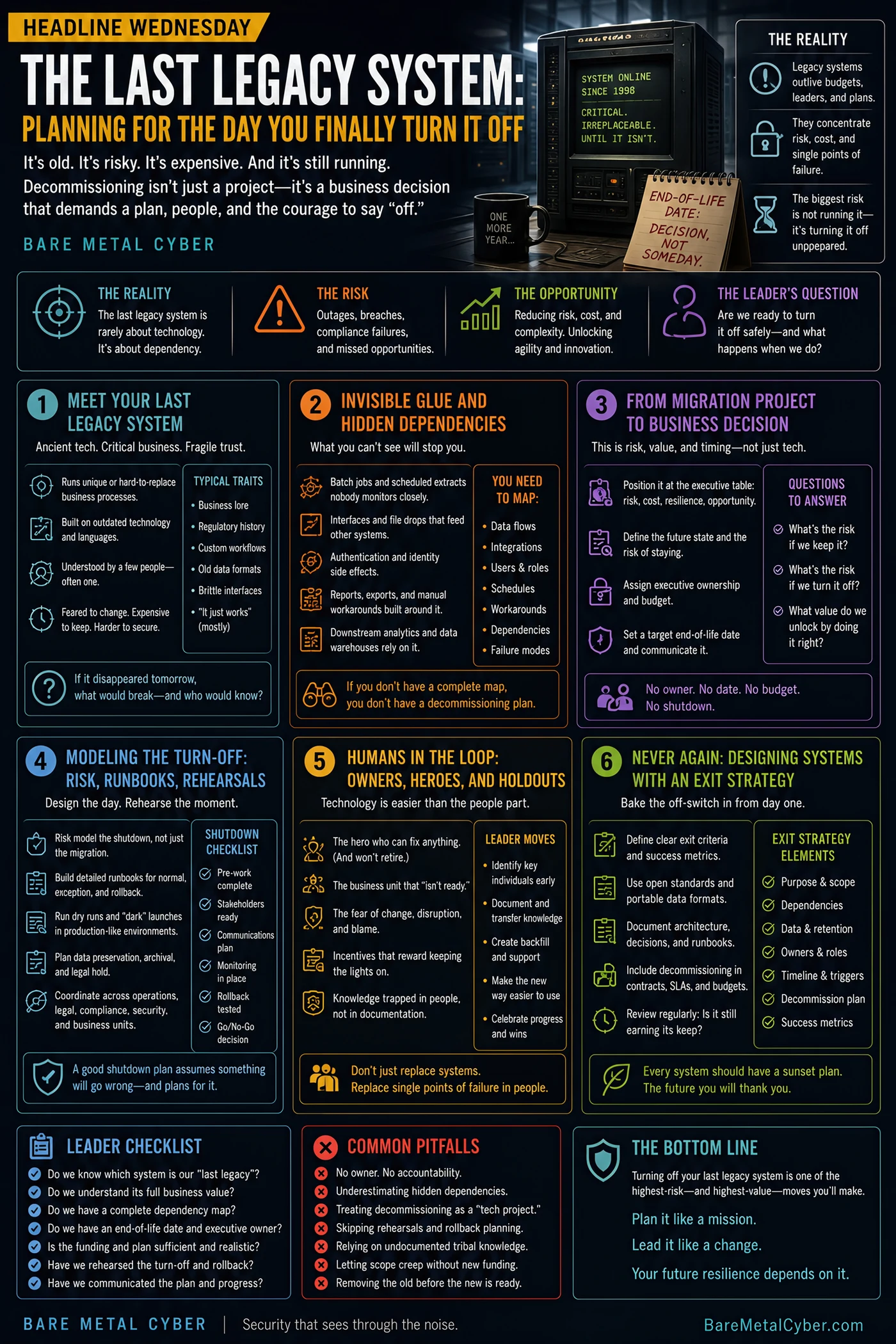
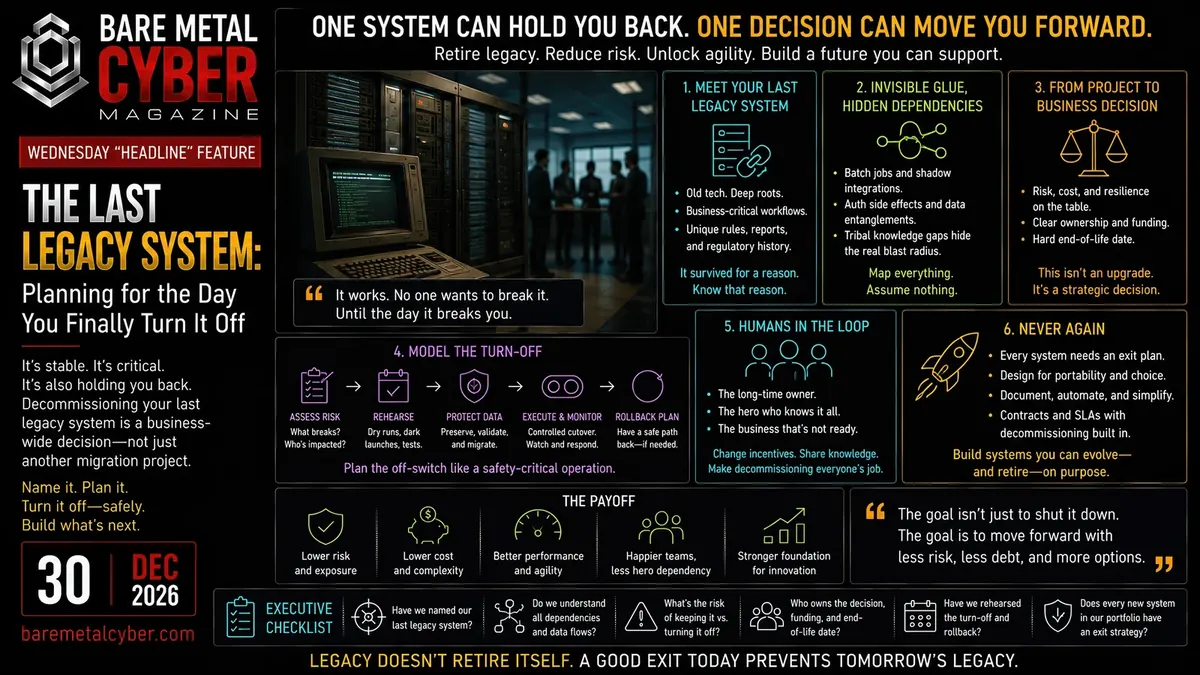
Meet Your Last Legacy System
If you walk through a typical estate with your architecture or operations leads, they can usually point to the system everyone secretly knows is “the last one.” It might be a mainframe that still clears a nontrivial portion of revenue, a bespoke client-server app built in the late nineties, or a vendor package that has been so heavily customized no upgrade path is realistic. Whatever the technology, the pattern is the same: this system is old, oddly shaped, and yet somehow critical to how the organization actually works. It sits in a corner of the architecture diagrams, but in reality it anchors entire business processes, from billing cycles to regulatory reporting.
What makes that last legacy system different from all the other old platforms you’ve already retired is not just age or technical debt. It is the density of business meaning packed into it. Over time, the organization has encoded policy choices, exception paths, and edge cases directly into the system’s logic and data model. Things that should live in updated procedures or standard operating documents only exist as behavior in that code. For many teams, the “truth” about how a product is priced, how a claim is processed, or how a customer is grandfathered lives only inside this box. When you ask why it is still running, stakeholders often describe it in human terms: “It just knows how we work.”
There is also a narrative dimension. The last legacy system usually has stories attached to it: the project that saved the business in a crisis, the release that made a regulator happy, the heroic fix during an outage that everyone still remembers. Those stories create emotional and political weight that newer systems do not yet have. For leaders, this matters because transitioning away from that system is not just a technical migration; it is a change to how the organization remembers itself. You are asking people to let go of an artifact that has been part of their professional identity. That is why the system keeps surviving modernization waves even when everyone acknowledges its flaws.
Over the next few sections, we will keep this picture in mind: a single, stubborn system that carries both technical and cultural weight, sitting in the middle of critical processes. To plan for the day you turn it off, you first need to name it explicitly and accept that it is different. Only then can you start to see the less visible forces that keep it alive, from hidden integrations to unrecorded business rules, and build a plan that respects its history without letting it dictate your future.
Invisible Glue and Hidden Dependencies
Once you acknowledge that one system is likely to be the last legacy standing, the next realization is more uncomfortable: you probably do not fully understand what it touches. Over the years, teams have wired it into new platforms through batch jobs, messaging buses, shared databases, and one-off scripts that live on forgotten servers. Reporting teams may pull data from it directly because the warehouse never quite caught up. Identity and access flows may depend on it in indirect ways, such as a nightly job that populates entitlements for downstream systems. Individually, none of these connections look decisive. Taken together, they turn the legacy system into invisible glue holding your estate together.
This is where standard architecture diagrams and CMDB entries start to fail you. They often capture the official picture: declared APIs, documented interfaces, supported data feeds. But the dependencies that stop you from turning off a legacy system are just as likely to live in “shadow” places: a long-running cron job, a custom report embedded in finance workflow, a third-party reconciliation tool that expects a specific file format. Those dependencies may have been created by contractors who have since left, or by teams that no longer exist. When you ask for impact analysis, you get confident answers based on incomplete maps. As a leader, that is the dangerous middle ground: enough information to feel like you are making a rational decision, but not enough to see the real blast radius.
To move beyond guesswork, you need more than a one-time discovery exercise. The most effective organizations treat legacy decommissioning as an opportunity to raise the bar on observability and data lineage. They instrument the legacy system and its surroundings to see who calls it, what data flows through it, and which downstream processes depend on that data, over weeks and months, not days. They combine technical mapping with human interviews, asking business teams where they “get that number” or “pull that file” rather than starting with system names. The result is a more honest view of how deeply the last legacy system is woven into daily operations. That honest view is what enables you to have a real conversation about risk, because you are no longer pretending the decision is just about replacing one application with another.
From Migration Project to Business Decision
When leaders talk about turning off a legacy system, the conversation often starts in project language: timelines, milestones, feature parity, data migration. That framing is comfortable because it fits existing delivery machinery. But the last legacy system is not just another application upgrade. It sits at the intersection of risk, revenue, compliance, and reputation. Treating its retirement purely as a migration project understates the stakes and leaves critical decisions buried in technical workstreams. The real move is to elevate it to an explicit business decision: are we willing to keep absorbing the risk and opportunity cost of this system, or are we making a conscious choice to exit, with all that entails?
Reframing it this way changes the questions you ask at the executive table. Instead of “Can we finish the migration by Q4?” the focus becomes “What does it cost us, in risk and agility, every year we keep this system running?” and “What is the impact on our strategy if we cannot change these core workflows quickly?” It also makes clear that ownership cannot sit solely with IT or even with security. The business unit that depends on the system, the finance function that funds it, the risk and compliance teams that explain it to regulators, and the technology organization that keeps it alive all share the decision. Without that shared ownership, the project quietly slips down the priority list whenever something louder appears.
This business framing also opens the door to more honest trade-offs. Maybe you decide that you will accept certain technical risks for a defined period because the cost of replacement is genuinely prohibitive right now, but you pair that with targeted mitigations and an explicit end-of-life date. Maybe you choose a staged approach: ring-fence the most sensitive data and workflows first, then tackle the rest as capacity allows. What matters is that the choice is deliberate, documented, and revisited, not the accidental outcome of never quite finding time for the migration. When leaders see decommissioning as a strategic lever rather than a back-office chore, the last legacy system stops being an embarrassing relic and becomes a managed, time-bound risk.
Modeling the Turn-Off: Risk, Runbooks, and Rehearsals
Once you accept that retiring the last legacy system is a business decision, the next challenge is to make “turning it off” something you can model and rehearse, not a cliff-edge moment. Leaders often underestimate how much uncertainty surrounds the shutdown itself. You may know roughly which processes depend on the system, but you rarely know in detail how they will behave without it. That is why the right mindset is closer to planned risk events in safety-critical industries: you assume you do not know everything, you design for surprises, and you practice the response before the real day. The goal is not a perfect plan; it is a plan that fails safely.
Risk modeling for decommissioning should go beyond a generic impact matrix. You want a storyline: if we turn this off on a given day, what happens to revenue flows, customer commitments, regulatory timelines, and incident response capacity over the following hours and days? Which metrics will tell us early that something is wrong, and who will be watching them? This is where security, operations, and business continuity teams can add real value. They can help define leading indicators, such as queue backlogs, error rates in downstream systems, unusual customer contact volumes, or missing reports. They can also identify worst-case scenarios and pre-plan specific mitigations rather than relying on generic “rollback if needed” language.
Rehearsals are where this becomes real. Dry runs that shadow the turn-off—running new paths in parallel while the legacy system is still live, turning off non-critical functions first, or executing “dark” cutovers in a test environment that mirrors production constraints—teach you where your assumptions break. They also expose gaps in runbooks and communication plans. On the actual day, your teams should feel like they are executing a script they have practiced, with clear roles, decision thresholds, and escalation paths. When you treat decommissioning as a series of rehearsed, observable steps rather than a single heroic switch flip, you give the organization permission to learn its way into the shutdown instead of gambling on a one-time leap.
Humans in the Loop: Owners, Heroes, and Holdouts
Behind every last legacy system there is a small cast of characters who keep it alive. There is the long-time business owner who knows every exception path and whose reputation is tied to the system’s reliability. There is the hero engineer who can fix anything in it at three in the morning and who quietly enjoys that status. There are middle managers who fear that moving off the system will expose fragile processes or spark new scrutiny from auditors. Together, they form a kind of informal guardianship. They are not malicious; in many cases, they have saved the organization from real pain. But their incentives are rarely aligned with making the system disappear. For leaders, understanding these human dynamics is as important as understanding any data flow.
When you announce a plan to retire the system, you are not just changing technology; you are changing role definitions, power structures, and personal narratives. The hero engineer may feel they are being asked to dismantle their own job security. The business owner may worry that a new system will not honor the edge cases they fought to embed years ago. If these concerns are not surfaced and addressed, they show up as passive resistance: “We are not ready,” “The replacement is not mature enough,” or “Regulators will not like it.” You see endless scope expansion, requirement churn, and acceptance criteria that no new system could realistically meet. Technically, the project is blocked by “open issues.” In reality, it is blocked by unresolved fears.
Effective leaders treat these humans in the loop as critical stakeholders in the decommissioning, not as obstacles to be overridden. That means creating explicit paths for them to transfer knowledge, shape acceptance criteria, and gain new forms of status in the future state. It also means removing unhealthy hero dependencies by institutionalizing knowledge: documenting workflows, cross-training teams, and making sure no single person holds the keys to understanding how the system really works. When you shift from a culture where one or two people are “the system” to one where the organization owns the process, the conversation about turning it off becomes less about personal risk and more about shared responsibility for managing legacy.
Never Again: Designing Systems With an Exit Strategy
If the last legacy system teaches anything, it is that “modern” is a temporary status. Today’s flagship platforms and cloud-native architectures will eventually become tomorrow’s awkward relics. The difference is whether they age into that role by accident or by design. An organization that has lived through one painful decommissioning has a chance to institutionalize the lessons. That starts with a simple but powerful idea: every significant system should be born with a retirement plan. Not a vague aspiration to “sunset it someday,” but concrete exit criteria, data portability expectations, and ownership for the decision to turn it off.
Designing with an exit strategy means treating decommissioning as a first-class architectural concern. Data models should assume they will be read elsewhere in the future, not trapped in proprietary formats. Integrations should flow through well-defined interfaces rather than deep coupling to internal schemas. Documentation and operational runbooks should describe not only how to keep the system healthy, but how to unwind its dependencies safely. When you negotiate with vendors, you build exit provisions into contracts and service level agreements: commitments around data export formats, assistance with transition, and notice periods that match the real lead time of complex migrations. None of this guarantees an easy shutdown, but it makes it a managed engineering problem rather than an act of archaeology.
At the governance level, exit strategies become part of how you evaluate both risk and investment. Architecture and risk councils can require that major initiatives clearly describe not just the benefits and implementation plan, but also how the organization would eventually move on. Portfolio reviews can look for systems that have exceeded their expected lifespan without a revised case for continued operation. Boards and executive committees can ask explicitly whether new strategic platforms are being designed to avoid becoming the next untouchable legacy. Over time, this shifts the culture. Instead of measuring success only by how quickly you stand new systems up, you also measure how gracefully you can stand them down. That is how you ensure that when you finally turn off the last legacy system, you are not quietly building its replacement in the same shape.
Where Leaders Go From Here
At its heart, this topic is about treating the last legacy system as a deliberate, time-bound risk choice rather than a background inconvenience. The stubborn platform that has outlived modernization waves is not just old technology; it is a dense knot of business logic, history, and human incentives that will not untangle itself. When you name it explicitly, map its invisible glue, and recognize the people whose identities are tied to it, you move from wishful talk about “modernization” to a concrete question: what will it take, in this organization, to turn this off safely and on purpose?
Bringing that question into the open changes how you lead. You stop accepting vague assurances that “we will get to it after the next project” and instead ask for real risk narratives, real dependency evidence, and real rehearsals for the day you switch it off. You treat decommissioning as a cross-functional decision that belongs at the same table as strategy and capital allocation, not as a side quest for infrastructure teams. And as you work through the shutdown, you build new habits into how you design and govern systems so that today’s strategic platforms arrive with an exit strategy baked in.
The organizations that do this well do not boast about having no legacy. They are honest about what must stay for now, clear about what will leave when, and intentional about never again creating a system that only one hero can explain. As you look at your own estate, you might start with two simple questions for your leadership team: which system would hurt us most if it failed tomorrow, and why have we never set a real date to replace it? The conversations that follow will tell you whether your last legacy system is still driving you, or whether you are finally ready to drive how and when it ends.