
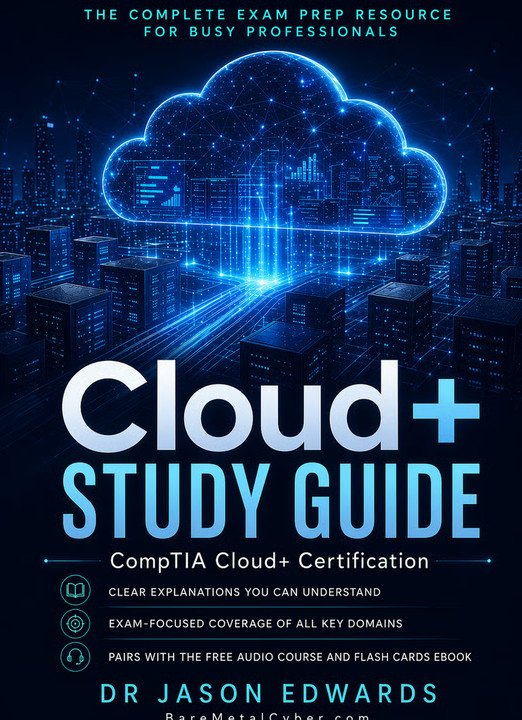
Study Guide
CompTIA Cloud+ Study Guide
Use the companion study guide to organize the material, compare important concepts, annotate key ideas, and build a written reference for review.
CompTIA · Free, ad-free audio course
A structured, audio-first learning route for CompTIA Cloud+, designed for focused review and practical understanding.
Companion Books
The study guide helps you organize and revisit the material. The flashcards book adds active recall and rapid review across the course objectives.
Study Guide
Use the companion study guide to organize the material, compare important concepts, annotate key ideas, and build a written reference for review.
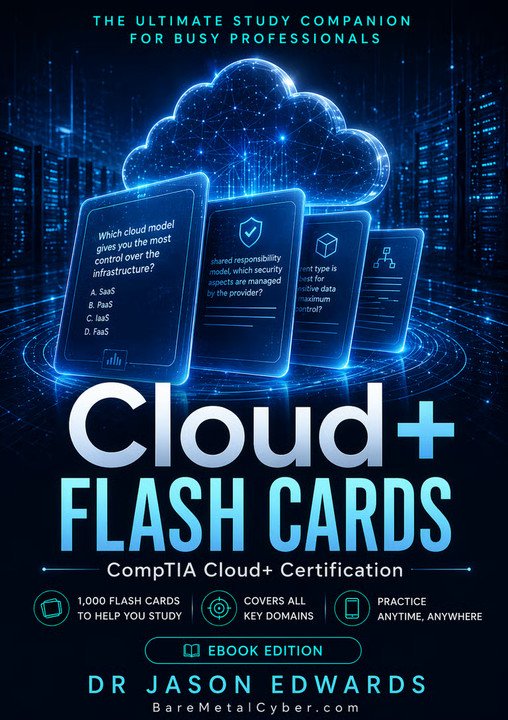
Flashcards Book
Use the flashcards book for active recall, terminology checks, rapid review, and repeated practice across the course objectives.
PUT IT INTO PRACTICE
Try 50 original BMC questions, review every explanation, and return to the lessons behind the answer. No login is required. Earn Challenge achievements and share your progress as you go.
Independent BMC learning practice—not official exam items, a full mock exam, or an exam-readiness score.
Complete Lesson Directory
Search by topic or narrow the directory by exam domain. Courses with multiple editions are organized below so every season remains easy to find. Each lesson includes its own audio player, full description, transcript when available, and previous-or-next navigation.
164 lessons available
Getting Started
This first episode is your orientation to the CompTIA Cloud+ PrepCast and the journey ahead toward earning the CV0-003 certification.…
Getting Started
In this episode, we define the purpose and scope of the CompTIA Cloud+ certification and explain why it’s an important credential for cloud professionals.…
Getting Started
Here, we walk you through the structure of the CV0-003 exam so you know exactly what to expect on test day. You’ll learn about the maximum number of questions, the 90-minute time limit, and the difference between multiple-choice and performance-based question types.…
Getting Started
This episode provides a detailed study framework tailored for the Cloud+ certification. We guide you through breaking down the objectives into manageable sections, setting a realistic timeline, and choosing study methods that improve both understanding and retention.…
Getting Started
In this episode, we examine the official CompTIA Cloud+ exam objectives in depth, showing how they serve as both a blueprint for the test and a practical checklist for your preparation.…
Getting Started
This episode focuses on how to evaluate and select the most effective study materials for your Cloud+ preparation.…
Getting Started
In this episode, we compare CompTIA Cloud+ to both vendor-specific certifications such as AWS Certified Solutions Architect, Microsoft Azure Administrator, and Google Cloud Associate Engineer, as well as vendor-neutral credentials like CompTIA Network+ and Server+.…
Getting Started
This glossary episode delivers detailed explanations of key terms from the Cloud Architecture and Design domain, ensuring you understand both the definitions and the practical applications.…
Getting Started
In this episode, we unpack the critical security and compliance vocabulary found throughout the Cloud+ objectives.…
Getting Started
This episode focuses on the operational and diagnostic terms that appear in the later domains of the Cloud+ exam.…
Domain 1 · Cloud Architecture and Design
This episode introduces Domain 1 of the Cloud+ CV0-003 exam, which focuses on understanding and applying cloud architecture and design principles.…
Domain 1 · Cloud Architecture and Design
In this episode, we break down the core deployment models that form the backbone of cloud computing strategies.…
Domain 1 · Cloud Architecture and Design
Here, we examine specialized deployment strategies that go beyond the standard models.…
Domain 1 · Cloud Architecture and Design
This episode explores the concept of multitenancy, a core element in cloud architecture where multiple customers share the same physical infrastructure while maintaining logical isolation.…
Domain 1 · Cloud Architecture and Design
This episode compares the three primary cloud service models—Infrastructure as a Service (IaaS), Platform as a Service (PaaS), and Software as a Service (SaaS)—detailing their unique capabilities, responsibilities, and use cases.…
Domain 1 · Cloud Architecture and Design
In this episode, we focus on Function as a Service (FaaS), a serverless computing model that executes code in response to specific events.…
Domain 1 · Cloud Architecture and Design
This episode covers emerging technologies that are increasingly shaping cloud environments and exam content. We start with the Internet of Things (IoT), explaining how connected devices generate, transmit, and process massive data streams in cloud platforms.…
Domain 1 · Cloud Architecture and Design
In this episode, we break down the shared responsibility model, a foundational concept in cloud security and operations. You’ll learn how responsibilities are divided between cloud service providers and customers across different service models like IaaS, PaaS, and SaaS.…
Domain 1 · Cloud Architecture and Design
This episode explores the fundamentals of capacity planning in cloud environments, starting with hardware considerations like compute, memory, storage, and network bandwidth.…
Domain 1 · Cloud Architecture and Design
In this episode, we focus on the tools and techniques used to create repeatable, effective capacity planning processes. You’ll learn how to use templates to standardize data collection, resource forecasting, and scaling strategies.…
Domain 1 · Cloud Architecture and Design
In this episode, we examine the most common licensing models encountered in cloud deployments and how they impact cost management and scalability.…
Domain 1 · Cloud Architecture and Design
This episode builds on licensing fundamentals by exploring strategies that can optimize cost and operational flexibility. We discuss volume licensing agreements, which allow organizations to purchase large quantities of licenses at discounted rates while simplifying administration.…
Domain 1 · Cloud Architecture and Design
In this episode, we explore the concept of planning for density, which involves anticipating the maximum number of users or workloads a system can support while maintaining performance and reliability.…
Domain 1 · Cloud Architecture and Design
This episode examines how different workload patterns influence cloud resource planning.…
Domain 1 · Cloud Architecture and Design
In this episode, we focus on using trend analysis to inform capacity planning decisions. We explain how to establish performance baselines that reflect normal operating conditions, and how to monitor for deviations that may indicate growth or potential issues.…
Domain 1 · Cloud Architecture and Design
This episode examines how pattern recognition and anomaly detection can enhance capacity planning and operational stability. We explain how pattern recognition identifies recurring workload behaviors, such as traffic spikes during specific times or predictable storage growth.…
Domain 1 · Cloud Architecture and Design
In this episode, we focus on the performance metrics that drive effective capacity planning. We cover CPU utilization, memory allocation, storage IOPS, and network throughput, explaining how each affects overall system performance.…
Domain 1 · Cloud Architecture and Design
This episode explores the architectural principles that support high availability in cloud environments.…
Domain 1 · Cloud Architecture and Design
In this episode, we dive into hypervisor-level strategies that influence workload placement and performance.…
Domain 1 · Cloud Architecture and Design
This episode focuses on identifying and eliminating single points of failure in cloud architectures. We discuss how to design redundant network paths, distribute workloads across multiple compute nodes, and ensure failover capabilities for critical services.…
Domain 1 · Cloud Architecture and Design
In this episode, we break down the three main scaling strategies used in cloud environments and how they relate to Cloud+ exam objectives.…
Domain 1 · Cloud Architecture and Design
This episode explains the concept of cloud bursting, where workloads temporarily overflow from on-premises infrastructure into the cloud to handle demand spikes.…
Domain 1 · Cloud Architecture and Design
In this episode, we look at how to align cloud design decisions with business goals, service-level agreements (SLAs), and integration requirements. We explain how to capture stakeholder priorities, regulatory obligations, and cost constraints in the initial design phase.…
Domain 2 · Security
This episode introduces Domain 2 of the Cloud+ exam, which covers securing cloud environments across identity management, network protection, application hardening, and compliance measures.…
Domain 2 · Security
This episode focuses on the fundamentals of identity and access management (IAM) in cloud environments. We explain how identification verifies user identity, while authentication confirms it through credentials, and authorization determines what resources the user can access.…
Domain 2 · Security
In this episode, we explore privileged access in cloud environments and how it differs from standard user access.…
Domain 2 · Security
This episode focuses on the processes for securely creating, managing, and removing user accounts in cloud systems. We break down provisioning, which involves granting new users the correct access rights, applying security policies, and enabling required services.…
Domain 2 · Security
In this episode, we break down Role-Based Access Control (RBAC) and how it enforces consistent permissions across cloud resources. We explain how roles group permissions together, simplifying management and reducing the chance of misconfiguration.…
Domain 2 · Security
This episode covers three primary access control models and their application in cloud security. Discretionary Access Control (DAC) allows resource owners to determine access, offering flexibility but requiring careful oversight.…
Domain 2 · Security
In this episode, we explain how directory services function in cloud environments and the role they play in identity management.…
Domain 2 · Security
In this episode, we examine how federation enables users from one domain to access resources in another without needing separate authentication credentials.…
Domain 2 · Security
This episode focuses on the role of digital certificates in securing cloud communications and verifying system identities. We cover the components of a certificate, including public and private keys, certificate authorities (CAs), and trust chains.…
Domain 2 · Security
In this episode, we explore multifactor authentication (MFA) as a core security control in cloud environments. We define the three common factor types—something you know, something you have, and something you are—and explain how combining them strengthens identity verification.…
Domain 2 · Security
This episode explains how single sign-on (SSO) reduces friction for users by enabling access to multiple applications with a single authentication event.…
Domain 2 · Security
In this episode, we explore the architecture and functions of Public Key Infrastructure (PKI), which supports secure communications through encryption, authentication, and digital signatures.…
Domain 2 · Security
In this episode, we cover the essential practices for managing sensitive information such as API keys, encryption keys, passwords, and tokens in cloud environments.…
Domain 2 · Security
This episode explains how network segmentation improves performance, security, and manageability in cloud architectures.…
Domain 2 · Security
In this episode, we explore how securing the Domain Name System (DNS) protects against spoofing, cache poisoning, and man-in-the-middle attacks.…
Domain 2 · Security
This episode discusses the importance of accurate timekeeping for authentication, logging, and system coordination in cloud environments.…
Domain 2 · Security
In this episode, we detail the protocols that protect data in transit across cloud networks. IPSec is covered as a suite for securing IP communications, including its modes, encryption methods, and authentication options.…
Domain 2 · Security
In this episode, we cover the tunneling protocols that enable secure or encapsulated communications in cloud and hybrid network architectures. Secure Shell (SSH) is explained as both a remote access protocol and a secure tunneling mechanism for other traffic.…
Domain 2 · Security
This episode explains how network security appliances and services operate in cloud environments.…
Domain 2 · Security
In this episode, we look at intrusion prevention systems (IPS), intrusion detection systems (IDS), and network access control (NAC) as part of a broader cloud security architecture.…
Domain 2 · Security
This episode explains how packet brokers and data loss prevention (DLP) tools enhance visibility and control in cloud environments. Packet brokers aggregate and filter traffic from multiple sources, optimizing monitoring tool performance.…
Domain 2 · Security
In this episode, we cover the role of log and event monitoring in detecting and responding to security incidents. We explain the types of logs generated by firewalls, IDS/IPS, and network devices, and how to centralize them for analysis.…
Domain 2 · Security
In this episode, we explore how network flow analysis provides valuable insights into traffic patterns, bandwidth utilization, and potential security threats in cloud environments.…
Domain 2 · Security
This episode focuses on reducing attack surfaces by hardening network device configurations. We explain the process of closing unused ports, disabling insecure or unnecessary protocols, and applying firmware updates to address vulnerabilities.…
Domain 2 · Security
In this episode, we explain the methods used to control and secure inbound (ingress) and outbound (egress) traffic in cloud environments.…
Domain 2 · Security
This episode explores how to design cloud environments to withstand Distributed Denial of Service (DDoS) attacks. We discuss layered defense strategies, including upstream filtering by cloud providers, traffic scrubbing services, and auto-scaling to absorb surges.…
Domain 2 · Security
In this episode, we focus on the security policies that protect operating systems and applications in cloud environments. We cover password complexity and expiration requirements, account lockout thresholds, and application whitelisting to prevent unauthorized software execution.…
Domain 2 · Security
In this episode, we look at three critical layers of endpoint and application security in cloud environments. User permissions define the specific resources and actions a user can access, enforcing the principle of least privilege.…
Domain 2 · Security
This episode covers Host-based Intrusion Detection Systems (HIDS) and Host-based Intrusion Prevention Systems (HIPS) as part of a layered cloud security approach.…
Domain 2 · Security
In this episode, we explain how hardened baselines create secure, standardized configurations for operating systems and applications. We cover the process of removing unnecessary services, disabling unused accounts, applying security patches, and configuring system-level protections.…
Domain 2 · Security
This episode looks at how configuration management and event monitoring work together to maintain cloud security. Configuration management ensures systems are deployed and maintained according to predefined policies, reducing drift and misconfigurations.…
Domain 2 · Security
In this episode, we explore encryption practices across multiple layers of a cloud environment.…
Domain 2 · Security
In this episode, we examine the Mandatory Access Control (MAC) model and its role in enforcing strict, label-based security policies in cloud systems.…
Domain 3 · Deployment
This episode introduces Domain 3 of the Cloud+ exam, which focuses on deploying cloud solutions effectively and securely. We outline the major topic areas, from provisioning compute, storage, and network resources to integrating subscription services and containerized applications.…
Domain 3 · Deployment
In this episode, we explain the different types of subscription-based services available in cloud environments. File services include storage and synchronization platforms that support remote work and data sharing.…
Domain 3 · Deployment
This episode covers Virtual Desktop Infrastructure (VDI), which delivers desktop environments from centralized servers to user devices, improving security and manageability.…
Domain 3 · Deployment
In this episode, we explain how to provision the three core resource types in cloud environments: compute instances, storage volumes, and network components.…
Domain 3 · Deployment
In this episode, we explore how application integration in cloud environments leverages serverless computing and event-driven architectures.…
Domain 3 · Deployment
This episode covers the deployment of virtual machines (VMs) in cloud platforms, starting from provider base images and extending to fully customized builds.…
Domain 3 · Deployment
In this episode, we examine how templates accelerate cloud deployment by providing predefined configurations for operating systems and entire solution stacks.…
Domain 3 · Deployment
This episode focuses on deploying cloud-based identity management systems that centralize authentication and authorization for users and applications.…
Domain 3 · Deployment
In this episode, we explain how containers package applications and dependencies into portable, consistent units for cloud deployment. We detail how environment variables configure container behavior dynamically, allowing for easy adaptation across environments.…
Domain 3 · Deployment
In this episode, we explore how persistent storage supports containerized applications that need to retain data beyond the container lifecycle.…
Domain 3 · Deployment
This episode examines how auto-scaling mechanisms adjust cloud resources to match demand in real time. Horizontal scaling adds or removes instances to distribute workloads, while vertical scaling adjusts the resources—such as CPU or memory—allocated to a single instance.…
Domain 3 · Deployment
In this episode, we cover the steps needed to confirm a cloud deployment is functioning as intended.…
Domain 3 · Deployment
This episode breaks down the three main types of cloud storage. Block storage is discussed as a high-performance option for databases and transactional workloads. File storage offers shared access through protocols like NFS or SMB, ideal for collaborative work or legacy applications.…
Domain 3 · Deployment
In this episode, we examine Storage Area Networks (SANs) and how they deliver block-level storage to cloud and hybrid infrastructures.…
Domain 3 · Deployment
In this episode, we explore Network Attached Storage (NAS) and its role in delivering shared file-based storage across cloud and hybrid environments.…
Domain 3 · Deployment
This episode focuses on object storage, a highly scalable and flexible method for storing unstructured data.…
Domain 3 · Deployment
In this episode, we cover the different tiers of storage available in cloud environments and how they align with performance and cost objectives. Flash storage offers high-speed, low-latency access for mission-critical workloads.…
Domain 3 · Deployment
This episode explains Input/Output Operations Per Second (IOPS) and how it measures the performance capability of storage systems. We detail how read and write operations differ in performance characteristics, and how workload types influence the IOPS requirement.…
Domain 3 · Deployment
In this episode, we break down the protocols used to access and manage cloud storage. Network File System (NFS) and Common Internet File System (CIFS) are file-level protocols, while Internet Small Computer System Interface (iSCSI) and Fibre Channel (FC) provide block-level access.…
Domain 3 · Deployment
In this episode, we detail Redundant Array of Independent Disks (RAID) configurations and their impact on storage performance, redundancy, and capacity. RAID 0 offers striping for speed but no fault tolerance, while RAID 1 mirrors data for redundancy at the cost of usable capacity.…
Domain 3 · Deployment
This episode examines advanced features that improve storage efficiency and data protection. Compression reduces the size of stored data to save space and potentially improve performance.…
Domain 3 · Deployment
In this episode, we compare thin provisioning—allocating storage space on demand—to thick provisioning, which reserves the entire capacity upfront.…
Domain 3 · Deployment
This episode focuses on managing storage consumption and securing data access in cloud environments. User quotas enforce limits on the amount of storage each user or group can consume, preventing resource hogging and ensuring fair allocation.…
Domain 3 · Deployment
In this episode, we explain how hyperconverged storage integrates compute, storage, and networking into a single software-driven platform, simplifying deployment and scaling.…
Domain 3 · Deployment
In this episode, we cover the key networking services that support cloud deployments. Dynamic Host Configuration Protocol (DHCP) automates IP address assignment and network configuration for devices, ensuring consistency and reducing administrative effort.…
Domain 3 · Deployment
This episode explains the role of IP Address Management (IPAM) systems in organizing, tracking, and automating IP address allocation across cloud and hybrid networks.…
Domain 3 · Deployment
In this episode, we examine the primary Virtual Private Network (VPN) types used in cloud connectivity. Site-to-site VPNs link entire networks securely, often for branch-to-headquarters or cloud-to-on-premises connections.…
Domain 3 · Deployment
This episode focuses on two widely used VPN protocols. IPSec secures IP communications through encryption and authentication, operating in tunnel or transport modes for flexibility.…
Domain 3 · Deployment
In this episode, we explore virtual routing in cloud environments, starting with static routing, where administrators manually define network paths, and dynamic routing, where protocols like BGP or OSPF adjust routes automatically based on network changes.…
Domain 3 · Deployment
In this episode, we cover two critical categories of cloud network appliances. Load balancers distribute incoming network traffic across multiple servers to optimize performance, improve redundancy, and ensure availability.…
Domain 3 · Deployment
This episode examines common Virtual Private Cloud (VPC) design models. The hub-and-spoke model centralizes resources and security services in a main hub network, with connected spoke networks for workloads or departments.…
Domain 3 · Deployment
In this episode, we explore network segmentation technologies starting with Virtual LANs (VLANs), which divide a physical network into logical segments for better security and performance.…
Domain 3 · Deployment
This episode explains Single Root I/O Virtualization (SR-IOV), a technology that allows a physical network interface card to be shared directly with multiple virtual machines, bypassing the hypervisor for improved performance.…
Domain 3 · Deployment
In this episode, we detail how Software-Defined Networking (SDN) separates the control plane, which makes traffic management decisions, from the data plane, which forwards traffic.…
Domain 3 · Deployment
In this episode, we discuss how to select virtual machine specifications that match workload requirements. Compute sizing involves balancing CPU cores, clock speed, memory, storage performance, and network bandwidth to ensure applications run efficiently.…
Domain 3 · Deployment
This episode examines the two main hypervisor types used in virtualization. Type 1 hypervisors, or bare-metal hypervisors, run directly on host hardware and provide superior performance and resource efficiency.…
Domain 3 · Deployment
In this episode, we define Simultaneous Multi-Threading (SMT) and how it allows a single CPU core to execute multiple threads concurrently, improving utilization and throughput.…
Domain 3 · Deployment
This episode explains how physical CPUs, virtual CPUs (vCPUs), and Graphics Processing Units (GPUs) are allocated in cloud environments.…
Domain 3 · Deployment
In this episode, we compare clock speed, measured in gigahertz, with Instructions Per Cycle (IPC) as two key determinants of processor performance. Clock speed dictates how many cycles a CPU can execute per second, while IPC measures how much work is completed in each cycle.…
Domain 3 · Deployment
In this episode, we explore hyperconverged compute architectures that integrate compute, storage, and networking into a single, software-driven platform.…
Domain 3 · Deployment
This episode focuses on dynamic memory allocation techniques that adjust RAM assignments to virtual machines based on workload demand. Ballooning is covered in detail, explaining how hypervisors reclaim unused memory from one VM and allocate it to another without downtime.…
Domain 3 · Deployment
In this episode, we examine cloud migration workflows starting with Physical-to-Virtual (P2V), which converts physical systems into virtual machines for cloud hosting. We also cover Virtual-to-Virtual (V2V) migrations, moving workloads between hypervisors or cloud platforms.…
Domain 3 · Deployment
This episode addresses migrations between cloud providers, often driven by cost optimization, service availability, or strategic alignment. We explain how to assess compatibility, data transfer methods, and service mapping when moving workloads between platforms.…
Domain 3 · Deployment
In this episode, we focus on the unique challenges of migrating Platform as a Service (PaaS) and Software as a Service (SaaS) applications. Access Control Lists (ACLs) must be reviewed and adjusted to ensure correct user permissions post-migration.…
Domain 3 · Deployment
In this episode, we cover the processes and considerations for migrating storage within cloud environments. Block storage migrations often involve moving high-performance workloads like databases, requiring minimal downtime and careful synchronization.…
Domain 3 · Deployment
This episode examines database migration strategies for both relational and non-relational systems. Relational database migrations require schema transfer, data validation, and potentially complex query rewrites if moving between engines.…
Domain 3 · Deployment
In this episode, we explain how to move databases across services or environments while preserving functionality. This includes adapting configuration settings, modifying access controls, and ensuring compatibility with new infrastructure.…
Domain 4 · Operations and Support
This episode introduces Domain 4 of the Cloud+ exam, which covers operational tasks, monitoring, and lifecycle management for cloud environments. We outline key areas including logging and alerting, performance monitoring, patch management, and backup/restore operations.…
Domain 4 · Operations and Support
In this episode, we break down the fundamentals of logging in cloud environments. We explain how to collect logs from diverse sources including applications, operating systems, and network devices.…
Domain 4 · Operations and Support
In this episode, we explore how Simple Network Management Protocol (SNMP) and Syslog operate as essential monitoring and diagnostic tools in cloud deployments.…
Domain 4 · Operations and Support
This episode examines the value of audit logging and authentication logs in maintaining a secure and compliant cloud environment. Audit logs record changes to configurations, permissions, and critical resources, helping administrators detect unauthorized or erroneous actions.…
Domain 4 · Operations and Support
In this episode, we focus on automating log collection and analysis to reduce manual workload and improve responsiveness. Automation tools aggregate logs, normalize data formats, and apply rules to identify anomalies or threshold breaches.…
Domain 4 · Operations and Support
This episode covers how to create baselines representing normal system performance and set thresholds to detect deviations.…
Domain 4 · Operations and Support
In this episode, we explain how to monitor both application and infrastructure performance in cloud environments. Application monitoring involves tracking response times, transaction success rates, and error frequencies to ensure optimal user experience.…
Domain 4 · Operations and Support
In this episode, we discuss how to monitor and verify that cloud resources are being utilized efficiently while meeting uptime targets.…
Domain 4 · Operations and Support
This episode examines how to measure and ensure compliance with Service Level Agreements (SLAs) in cloud environments. Availability tracking involves monitoring system uptime, performance consistency, and responsiveness against contractual targets.…
Domain 4 · Operations and Support
In this episode, we explore how integrating monitoring tools across infrastructure, applications, and security layers creates a unified visibility framework.…
Domain 4 · Operations and Support
This episode covers techniques for improving the quality and relevance of log data. Log scrubbing removes sensitive or irrelevant information before storage or analysis, supporting compliance and reducing storage costs.…
Domain 4 · Operations and Support
In this episode, we explain how alerting systems notify administrators of events that require attention.…
Domain 4 · Operations and Support
In this episode, we discuss how maintenance mode and alert suppression policies help prevent unnecessary or false-positive alerts during planned system updates.…
Domain 4 · Operations and Support
This episode explains how categorizing alerts by severity, impact, and urgency supports a more efficient incident response process. Categories might range from informational events that require logging only, to critical alerts that demand immediate escalation and resolution.…
Domain 4 · Operations and Support
In this episode, we explore the importance of verifying backups to ensure they are complete, uncorrupted, and restorable. Backup verification includes automated checksum validation, test restores, and scheduled audits to confirm that recovery objectives can be met.…
Domain 4 · Operations and Support
This episode covers life-cycle management as it applies to cloud services and applications. Version control tracks changes to configurations and code, ensuring rollback capability and documentation.…
Domain 4 · Operations and Support
In this episode, we explain structured change management processes for cloud deployments. This includes evaluating risks, obtaining approvals, scheduling changes during low-impact windows, and documenting the entire process.…
Domain 4 · Operations and Support
In this episode, we examine how asset management and Configuration Management Databases (CMDB) work together to provide visibility and control over cloud resources. Asset management tracks hardware, software, licenses, and virtual resources, ensuring accountability and compliance.…
Domain 4 · Operations and Support
This episode focuses on patching strategies to keep cloud environments secure and stable. We explain the types of patches—security updates, bug fixes, and feature enhancements—and how to prioritize them based on severity and exposure.…
Domain 4 · Operations and Support
In this episode, we cover rollback procedures for reversing patches or updates that cause instability or security issues. Effective rollback planning includes keeping backups, maintaining version histories, and ensuring minimal downtime during reversions.…
Domain 4 · Operations and Support
This episode explores upgrade deployment strategies that reduce risk and downtime. Blue-green deployments run two identical environments, switching traffic to the updated one once validated.…
Domain 4 · Operations and Support
In this episode, we explain how dashboards consolidate key operational metrics for real-time visibility.…
Domain 5 · Troubleshooting
In this episode, we introduce Domain 5 of the Cloud+ exam, which focuses on identifying, diagnosing, and resolving issues in cloud environments.…
Domain 5 · Troubleshooting
This episode focuses on the first and most critical step in troubleshooting: identifying the problem. We discuss methods for collecting detailed information, including user reports, log analysis, monitoring data, and environmental checks.…
Domain 5 · Troubleshooting
In this episode, we explain how to formulate a theory of probable cause based on collected evidence. This involves reviewing system documentation, researching known issues, and comparing current symptoms to baseline performance data.…
Domain 5 · Troubleshooting
This episode covers the process of testing your theory to confirm the root cause of a problem. We explain how to perform controlled changes or simulations to verify whether the suspected cause produces or resolves the observed symptoms.…
Domain 5 · Troubleshooting
In this episode, we outline how to develop and execute an action plan that resolves the confirmed issue. Planning includes defining the specific changes, scheduling them to minimize impact, and ensuring all required resources and approvals are in place.…
Domain 5 · Troubleshooting
In this episode, we cover the critical step of verifying that the implemented fix has fully resolved the issue. Verification involves functional testing, monitoring affected systems, and confirming with end users that normal operations have been restored.…
Domain 5 · Troubleshooting
This episode emphasizes the importance of documenting every phase of the troubleshooting process. Detailed records should include the problem description, investigation steps, theories tested, actions taken, and final resolution.…
Domain 5 · Troubleshooting
In this episode, we explore troubleshooting issues caused by missing or incomplete privileges in a cloud environment. These problems can prevent users or services from accessing necessary resources, executing commands, or integrating with other systems.…
Domain 5 · Troubleshooting
This episode focuses on diagnosing and resolving issues with authentication and authorization systems. Authentication failures can stem from incorrect credentials, expired certificates, or mismatched authentication methods.…
Domain 5 · Troubleshooting
In this episode, we explain how security group misconfigurations can cause connectivity or access problems. Directory security groups manage access to identity resources, while network security groups control traffic to and from specific subnets or instances.…
Domain 5 · Troubleshooting
In this episode, we examine common certificate-related issues and how they impact cloud services. Expired certificates can cause service outages, prevent secure connections, and disrupt authentication flows.…
Domain 5 · Troubleshooting
This episode addresses problems that arise when security or operational policies are misconfigured or incorrectly applied. Examples include overly restrictive firewall rules, improper access control settings, or conflicting automation policies.…
Domain 5 · Troubleshooting
In this episode, we explore how encryption failures, incorrect data classification, and accidental exposure can create serious security incidents. Encryption problems may involve weak ciphers, improper key management, or unencrypted channels.…
Domain 5 · Troubleshooting
This episode focuses on identifying and resolving issues where endpoints or interfaces are unintentionally exposed to the public internet. Common causes include overly permissive firewall rules, default configurations, or lack of authentication.…
Domain 5 · Troubleshooting
In this episode, we examine problems related to security appliances such as Web Application Firewalls (WAFs), Intrusion Prevention Systems (IPS), Intrusion Detection Systems (IDS), and Network Access Control (NAC) solutions.…
Domain 5 · Troubleshooting
In this episode, we address issues that arise when legacy or insecure protocols and ciphers are still in use within a cloud environment.…
Domain 5 · Troubleshooting
This episode examines how to identify signs of both internal and external threats within cloud environments. Internal attack indicators may include unusual access patterns, privilege escalation, or unauthorized data transfers.…
Domain 5 · Troubleshooting
In this episode, we explore the causes of connectivity failures and outages during cloud deployments. Problems can occur due to misconfigured routing tables, incorrect IP assignments, firewall restrictions, or DNS resolution errors.…
Domain 5 · Troubleshooting
This episode focuses on performance degradation that can occur after deployment. Latency may result from suboptimal network routing, overloaded servers, or insufficient bandwidth. Resource lag can be caused by under-provisioned compute, storage bottlenecks, or poor load balancing.
Domain 5 · Troubleshooting
In this episode, we examine how misconfigured templates, incorrect tags, faulty automation scripts, or improperly built containers can lead to deployment failures or inconsistencies.…
Domain 5 · Troubleshooting
In this episode, we focus on diagnosing issues where scaling configurations fail to meet demand or capacity is exceeded. Compute-related problems may arise when auto-scaling rules are misconfigured, instance limits are reached, or workloads are not properly balanced.…
Domain 5 · Troubleshooting
This episode examines issues that arise when licensing or subscription entitlements are not aligned with deployed resources. These conflicts can result in service interruptions, feature limitations, or compliance violations.…
Domain 5 · Troubleshooting
In this episode, we explore problems that stem from vendor-imposed limitations or platform-specific behaviors. API rate limits can cause integration failures, while migration errors may result from incompatible configurations or unsupported features.…
Domain 5 · Troubleshooting
This episode focuses on resolving connectivity problems caused by incorrect network configurations.…
Domain 5 · Troubleshooting
In this episode, we discuss how routing errors and Network Address Translation (NAT) misconfigurations can impact connectivity and data flow.…
Domain 5 · Troubleshooting
In this episode, we cover diagnosing issues with load balancers in cloud environments. Problems can arise when the load balancer is configured with the wrong protocol, causing mismatches between client and server communication methods.…
Domain 5 · Troubleshooting
This episode looks at multi-layered networking issues that can disrupt cloud services. DNS errors may involve incorrect records, propagation delays, or misapplied DNSSEC settings.…
Domain 5 · Troubleshooting
In this episode, we explain how to use essential network troubleshooting tools effectively. Ping verifies connectivity and measures latency, while Tracert or Traceroute maps the path packets take through the network.…
Domain 5 · Troubleshooting
This episode addresses problems in automation and orchestration workflows. Mismatches can occur when scripts or templates are out of sync with infrastructure changes, causing failed deployments or inconsistent configurations.…
Try another term or clear one of the filters.
A Practical Study Routine
Use the free audio course during a commute, walk, workout, or focused study session.
Use the study guide to organize the material, annotate key ideas, and build a reference you can return to.
Use the flashcards book to practice active recall and quickly revisit weak areas.
Related Magazine Features
Related Cyber Wiki
An AI agent selects actions and invokes tools, services, or workflows to pursue a goal across multiple steps.
AI change assuranceAn AI change evidence package assembles the artifacts needed to understand, approve, reproduce, and later audit a model, data, prompt, configuration, or integration change.
AI engineering assuranceAI configuration reproducibility means an authorized team can recreate the relevant model build or runtime behavior from recorded code, data references, parameters, dependencies, prompts, and infrastructure settings.
Agentic AI securityAI connector and plugin security governs integrations that let models read data or act through external applications and services.
AI safety engineeringAI guardrail engineering implements enforceable limits around model inputs, outputs, tools, data, and operating conditions.
Generative AI application securityAI output validation treats generated text, code, commands, queries, and structured data as untrusted until the consuming system verifies it.