
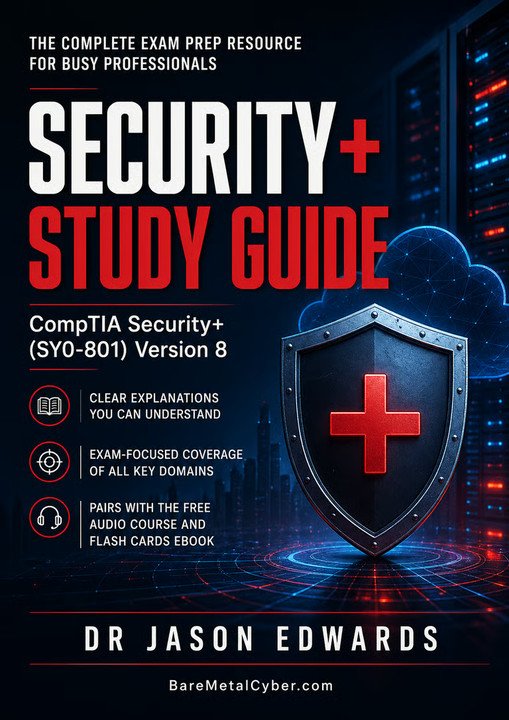
Study Guide
CompTIA Security+ Study Guide
Use the companion study guide to organize the material, compare important concepts, annotate key ideas, and build a written reference for review.
CompTIA · Free, ad-free audio course
A complete, audio-first Security+ study system with focused lessons, companion learning resources, and an episode-by-episode directory.
Companion Books
The study guide helps you organize and revisit the material. The flashcards book adds active recall and rapid review across the course objectives.
Study Guide
Use the companion study guide to organize the material, compare important concepts, annotate key ideas, and build a written reference for review.
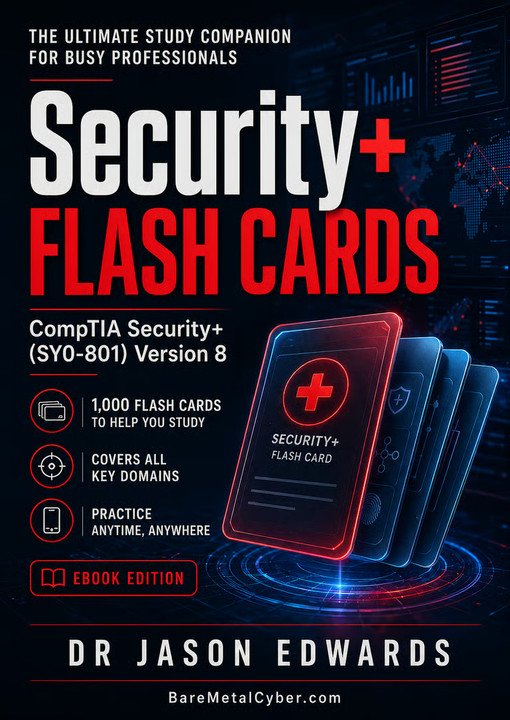
Flashcards Book
Use the flashcards book for active recall, terminology checks, rapid review, and repeated practice across the course objectives.
PUT IT INTO PRACTICE
Try 50 original BMC questions, review every explanation, and return to the lessons behind the answer. No login is required. Earn Challenge achievements and share your progress as you go.
Independent BMC learning practice—not official exam items, a full mock exam, or an exam-readiness score.

Complete Lesson Directory
Search by topic or narrow the directory by exam domain. Courses with multiple editions are organized below so every season remains easy to find. Each lesson includes its own audio player, full description, transcript when available, and previous-or-next navigation.
339 lessons available
Getting Started
Listen to SY0-801 at a Glance: What Changed from Security+ 701 (Intro) in the CompTIA Security+ audio course.
Getting Started
Listen to How to Study with an Audio-First Security+ Plan (Intro) in the CompTIA Security+ audio course.
Domain 1 · General Security Concepts
Listen to Defense in Depth: Layering Controls So One Failure Doesn’t Sink You (1.1) in the CompTIA Security+ audio course.
Domain 1 · General Security Concepts
Listen to CIA and AAA: The Core Security Models (1.1) in the CompTIA Security+ audio course.
Domain 1 · General Security Concepts
Listen to Non-Repudiation, Least Privilege, and Trust Decisions (1.1) in the CompTIA Security+ audio course.
Domain 1 · General Security Concepts
Listen to Zero Trust Principles: Never Trust, Always Verify (1.1) in the CompTIA Security+ audio course.
Domain 1 · General Security Concepts
Listen to Control Categories and Control Types (1.1) in the CompTIA Security+ audio course.
Domain 1 · General Security Concepts
Listen to Change Management: Why Security Breaks During Normal Updates (1.2) in the CompTIA Security+ audio course.
Domain 1 · General Security Concepts
Listen to CABs, Approvals, Ownership, and Stakeholders (1.2) in the CompTIA Security+ audio course.
Domain 1 · General Security Concepts
Listen to Impact Analysis, Test Results, and Maintenance Windows (1.2) in the CompTIA Security+ audio course.
Domain 1 · General Security Concepts
Listen to Backout Plans vs. Fail Forward: Recovering from Bad Changes (1.2) in the CompTIA Security+ audio course.
Domain 1 · General Security Concepts
Listen to Technical and Documentation Impacts of Change (1.2) in the CompTIA Security+ audio course.
Domain 1 · General Security Concepts
Listen to PKI Foundations: Public Keys, Private Keys, and Trust (1.3) in the CompTIA Security+ audio course.
Domain 1 · General Security Concepts
Listen to Certificates and Certificate Authorities (1.3) in the CompTIA Security+ audio course.
Domain 1 · General Security Concepts
Listen to Revocation and Validation: CRLs, OCSP, and Trust Problems (1.3) in the CompTIA Security+ audio course.
Domain 1 · General Security Concepts
Listen to CSRs, Wildcards, Root of Trust, and Key Escrow (1.3) in the CompTIA Security+ audio course.
Domain 1 · General Security Concepts
Listen to Symmetric vs. Asymmetric Encryption (1.3) in the CompTIA Security+ audio course.
Domain 1 · General Security Concepts
Listen to Encryption Levels: Disk, File, Volume, Database, and Record (1.3) in the CompTIA Security+ audio course.
Domain 1 · General Security Concepts
Listen to Key Exchange, Algorithms, Key Length, and Protocol Selection (1.3) in the CompTIA Security+ audio course.
Domain 1 · General Security Concepts
Listen to Hashing, Salting, Digital Signatures, Obfuscation, and Crypto Tools (1.3) in the CompTIA Security+ audio course.
Domain 2 · Threats, Vulnerabilities, and Mitigations
Listen to Threats vs. Vulnerabilities: Likelihood, Impact, and Life Cycle (2.1) in the CompTIA Security+ audio course.
Domain 2 · Threats, Vulnerabilities, and Mitigations
Listen to Threat Feeds and Intelligence Sources (2.1) in the CompTIA Security+ audio course.
Domain 2 · Threats, Vulnerabilities, and Mitigations
Listen to Vulnerability Scoring: CVSS, CVEs, and Prioritization (2.1) in the CompTIA Security+ audio course.
Domain 2 · Threats, Vulnerabilities, and Mitigations
Listen to Vulnerability Types and Risk-Based Decisions (2.1) in the CompTIA Security+ audio course.
Domain 2 · Threats, Vulnerabilities, and Mitigations
Listen to Threat Actors: Organized Crime, Terrorists, Hacktivists, and Insiders (2.2) in the CompTIA Security+ audio course.
Domain 2 · Threats, Vulnerabilities, and Mitigations
Listen to State-Sponsored, Competitors, Accidental, and Unskilled Attackers (2.2) in the CompTIA Security+ audio course.
Domain 2 · Threats, Vulnerabilities, and Mitigations
Listen to Motivations and Capabilities: Money, Espionage, Ideology, and Extortion (2.2) in the CompTIA Security+ audio course.
Domain 2 · Threats, Vulnerabilities, and Mitigations
Listen to APTs and the Modern Threat Vector Map (2.3) in the CompTIA Security+ audio course.
Domain 2 · Threats, Vulnerabilities, and Mitigations
Listen to Message-Based Attacks: Email, SMS, RCS, IM, and Collaboration Tools (2.3) in the CompTIA Security+ audio course.
Domain 2 · Threats, Vulnerabilities, and Mitigations
Listen to Image and Attachment Attacks: QR Codes, CAPTCHA Abuse, Macros, PDFs, and RTF (2.3) in the CompTIA Security+ audio course.
Domain 2 · Threats, Vulnerabilities, and Mitigations
Listen to Browser-Based Attacks: Extensions, JavaScript, Cookies, Password Managers, and Session Tokens (2.3) in the CompTIA Security+ audio course.
Domain 2 · Threats, Vulnerabilities, and Mitigations
Listen to Network, Remote Access, and Endpoint Threat Sources (2.3) in the CompTIA Security+ audio course.
Domain 2 · Threats, Vulnerabilities, and Mitigations
Listen to Supply Chain, SaaS, USB, Human, IoT, OT, Physical, Bluetooth, RF, and NFC Threats (2.3) in the CompTIA Security+ audio course.
Domain 2 · Threats, Vulnerabilities, and Mitigations
Listen to Unsupported, Unpatched, Obsolete, and Unmanaged Systems (2.4) in the CompTIA Security+ audio course.
Domain 2 · Threats, Vulnerabilities, and Mitigations
Listen to Ports, Services, Applications, Race Conditions, and Malicious Updates (2.4) in the CompTIA Security+ audio course.
Domain 2 · Threats, Vulnerabilities, and Mitigations
Listen to Code Weaknesses: Hardcoded Secrets and Unsafe Exception Handling (2.4) in the CompTIA Security+ audio course.
Domain 2 · Threats, Vulnerabilities, and Mitigations
Listen to Stale Credentials, Rogue Devices, Shadow IT, Wireless, Mobile, and Identity Provider Risks (2.4) in the CompTIA Security+ audio course.
Domain 2 · Threats, Vulnerabilities, and Mitigations
Listen to LLMs, Misconfigurations, Public Repositories, and Public Object Storage (2.4) in the CompTIA Security+ audio course.
Domain 2 · Threats, Vulnerabilities, and Mitigations
Listen to Malware Indicators: Ransomware, Trojans, Worms, Spyware, and Fileless Malware (2.5) in the CompTIA Security+ audio course.
Domain 2 · Threats, Vulnerabilities, and Mitigations
Listen to Physical and Network Attack Indicators (2.5) in the CompTIA Security+ audio course.
Domain 2 · Threats, Vulnerabilities, and Mitigations
Listen to Social Engineering Indicators: Smishing, Vishing, Whaling, Quishing, and Deepfakes (2.5) in the CompTIA Security+ audio course.
Domain 2 · Threats, Vulnerabilities, and Mitigations
Listen to Indicators of Compromise: Hashes, Domains, Timestamps, Log Manipulation, and Impossible Travel (2.5) in the CompTIA Security+ audio course.
Domain 2 · Threats, Vulnerabilities, and Mitigations
Listen to Application Attacks: Injection, Buffer Overflow, Replay, Privilege Escalation, Forgery, and Traversal (2.5) in the CompTIA Security+ audio course.
Domain 2 · Threats, Vulnerabilities, and Mitigations
Listen to Credential Attacks: Password Spraying, Brute Force, User Enumeration, and MFA Bypass (2.5) in the CompTIA Security+ audio course.
Domain 2 · Threats, Vulnerabilities, and Mitigations
Listen to AI Threats: Model Manipulation, Poisoning, and Prompt Injection (2.6) in the CompTIA Security+ audio course.
Domain 2 · Threats, Vulnerabilities, and Mitigations
Listen to AI Failure Risks: Data Loss, Bias, Explainability, Hallucinations, and Ethics (2.6) in the CompTIA Security+ audio course.
Domain 2 · Threats, Vulnerabilities, and Mitigations
Listen to AI Abuse: Jailbreaking, Evasion, Privacy, Session Hijacking, and Code Execution (2.6) in the CompTIA Security+ audio course.
Domain 3 · Security Architecture
Listen to Architecture Models: Cloud, On-Premises, Hybrid, Private, Public, and Community Cloud (3.1) in the CompTIA Security+ audio course.
Domain 3 · Security Architecture
Listen to Serverless, Multicloud, and Infrastructure as Code (3.1) in the CompTIA Security+ audio course.
Domain 3 · Security Architecture
Listen to OT, Air-Gapped Networks, Microservices, and Segmentation (3.1) in the CompTIA Security+ audio course.
Domain 3 · Security Architecture
Listen to Technical Architecture Tradeoffs: Availability, Resilience, Open Source, and Usability (3.1) in the CompTIA Security+ audio course.
Domain 3 · Security Architecture
Listen to Business Architecture Tradeoffs: Data Sovereignty, Classification, Cost, and Ownership (3.1) in the CompTIA Security+ audio course.
Domain 3 · Security Architecture
Listen to Scalability, Environmental Requirements, Risk, and Recovery Decisions (3.1) in the CompTIA Security+ audio course.
Domain 3 · Security Architecture
Listen to Infrastructure Protection: Device Placement, Security Zones, Attack Surface, and Diversity (3.2) in the CompTIA Security+ audio course.
Domain 3 · Security Architecture
Listen to Zero Trust Architecture: User, Device, and Application Decisions (3.2) in the CompTIA Security+ audio course.
Domain 3 · Security Architecture
Listen to Secure Access: VPNs, Remote Access, Tunneling, and Encrypted Messaging (3.2) in the CompTIA Security+ audio course.
Domain 3 · Security Architecture
Listen to Out-of-Band Management, File Transfer, and Security Service Edge (3.2) in the CompTIA Security+ audio course.
Domain 3 · Security Architecture
Listen to Identity Architecture: gMSAs, Least Privilege Accounts, Privilege Creep, and Failure Modes (3.2) in the CompTIA Security+ audio course.
Domain 3 · Security Architecture
Listen to Data Types and States: Structured, Unstructured, At Rest, In Use, and In Transit (3.3) in the CompTIA Security+ audio course.
Domain 3 · Security Architecture
Listen to Data Classification: Public to Top Secret, Sensitive to Restricted (3.3) in the CompTIA Security+ audio course.
Domain 3 · Security Architecture
Listen to Securing Data: Masking, Hashing, Filtering, Tokenization, Encryption, and Obfuscation (3.3) in the CompTIA Security+ audio course.
Domain 3 · Security Architecture
Listen to Data Protection Roles: Owner, Custodian, Steward, Operator, Controller, and Subprocessor (3.3) in the CompTIA Security+ audio course.
Domain 3 · Security Architecture
Listen to Data Handling, Geofencing, Lifecycle, Retention, Disposal, and Compliance (3.3) in the CompTIA Security+ audio course.
Domain 3 · Security Architecture
Listen to Resilience Sites: Hot, Warm, Cold, and Environmental Planning (3.4) in the CompTIA Security+ audio course.
Domain 3 · Security Architecture
Listen to Platform Diversity, Load Balancing, Clustering, Autoscaling, and High Availability (3.4) in the CompTIA Security+ audio course.
Domain 3 · Security Architecture
Listen to Power, Storage, Backups, Immutability, and Restoration Testing (3.4) in the CompTIA Security+ audio course.
Domain 3 · Security Architecture
Listen to Disaster Recovery and Business Continuity: Failover, Simulation, Parallel Processing, and Capacity Planning (3.4) in the CompTIA Security+ audio course.
Domain 3 · Security Architecture
Listen to Recovery Metrics: RTO, RPO, MTTR, and MTBF (3.4) in the CompTIA Security+ audio course.
Domain 4 · Security Operations
Listen to Mitigating Controls Overview: Segmentation, Access Control, Hardening, and Sandboxing (4.1) in the CompTIA Security+ audio course.
Domain 4 · Security Operations
Listen to Deception and Disruption: Honeypots, Honeynets, Honeyfiles, Honeytokens, and Canary Accounts (4.1) in the CompTIA Security+ audio course.
Domain 4 · Security Operations
Listen to Monitoring, MDM, Allow Lists, Block Lists, IDS, IPS, and WIPS (4.1) in the CompTIA Security+ audio course.
Domain 4 · Security Operations
Listen to Firewalls and Filtering: WAF, UTM, Layer 4/Layer 7, Rate Limiting, and DLP (4.1) in the CompTIA Security+ audio course.
Domain 4 · Security Operations
Listen to Endpoint and Network Access Control: EDR, XDR, Antivirus, Captive Portals, 802.1X, and Posture (4.1) in the CompTIA Security+ audio course.
Domain 4 · Security Operations
Listen to Repository, Application, and Code Security: Secrets Scanning, Input Validation, Secure Cookies, Static Analysis, and Code Signing (4.1) in the CompTIA Security+ audio course.
Domain 4 · Security Operations
Listen to Email and OS Security: DMARC, SPF, DKIM, BIMI, Group Policy, and SELinux (4.1) in the CompTIA Security+ audio course.
Domain 4 · Security Operations
Listen to Asset Management: Hardware, Software, and Data Life Cycle (4.2) in the CompTIA Security+ audio course.
Domain 4 · Security Operations
Listen to Planning, Procurement, Assignment, Tracking, Disposal, and Decommissioning (4.2) in the CompTIA Security+ audio course.
Domain 4 · Security Operations
Listen to Vulnerability Management Overview: Scanning, IPAM, CSPM, and Source Code Review (4.3) in the CompTIA Security+ audio course.
Domain 4 · Security Operations
Listen to Prioritization: Severity, Business Impact, and Pen Test Report Review (4.3) in the CompTIA Security+ audio course.
Domain 4 · Security Operations
Listen to Remediation, Verification, and Internal Reporting (4.3) in the CompTIA Security+ audio course.
Domain 4 · Security Operations
Listen to External Reporting: Bug Bounties and Responsible Disclosure (4.3) in the CompTIA Security+ audio course.
Domain 4 · Security Operations
Listen to Monitoring Resources: Systems, Applications, Infrastructure, and Log Aggregation (4.4) in the CompTIA Security+ audio course.
Domain 4 · Security Operations
Listen to Alerting Operations: Scanning, Archiving, Reporting, and Alert Tuning (4.4) in the CompTIA Security+ audio course.
Domain 4 · Security Operations
Listen to Monitoring Tools: SIEM, DLP, Vulnerability Scanners, Orchestration, and Packet Analyzers (4.4) in the CompTIA Security+ audio course.
Domain 4 · Security Operations
Listen to Monitoring Protocols and Data Flow: NetFlow, SNMP, Syslog, SCAP, Port Mirroring, and Dashboards (4.4) in the CompTIA Security+ audio course.
Domain 4 · Security Operations
Listen to IAM Lifecycle: Provisioning, Deprovisioning, Permissions, and Identity Proofing (4.5) in the CompTIA Security+ audio course.
Domain 4 · Security Operations
Listen to Federation and SSO: SAML, LDAP, and OAuth (4.5) in the CompTIA Security+ audio course.
Domain 4 · Security Operations
Listen to Account Types and Privilege Models: User, Privileged, Service, Third-Party, and Emergency Access (4.5) in the CompTIA Security+ audio course.
Domain 4 · Security Operations
Listen to MFA: Tokens, Biometrics, OTPs, Backup Codes, and Bypass Risks (4.5) in the CompTIA Security+ audio course.
Domain 4 · Security Operations
Listen to Access Models and Modern Authentication: JIT Access, Passkeys, Passwordless, and Credential Monitoring (4.5) in the CompTIA Security+ audio course.
Domain 4 · Security Operations
Listen to Automation Use Cases: Provisioning, Desired State, Anomaly Detection, and Ticketing (4.6) in the CompTIA Security+ audio course.
Domain 4 · Security Operations
Listen to Automation Risks and Guardrails: Logic, Complexity, Financial Risk, and Process Risk (4.6) in the CompTIA Security+ audio course.
Domain 4 · Security Operations
Listen to AI in SecOps: Agentic AI, Chatbots, Predictive Analysis, AI-Augmented Baselines, and CI/CD (4.6) in the CompTIA Security+ audio course.
Domain 4 · Security Operations
Listen to Incident Response Preparation: Training, Tabletop Exercises, Playbooks, Simulations, and Roles (4.7) in the CompTIA Security+ audio course.
Domain 4 · Security Operations
Listen to Identification and Investigation: Detection, Advisories, Threat Hunting, Forensics, and Chain of Custody (4.7) in the CompTIA Security+ audio course.
Domain 4 · Security Operations
Listen to Containment Through Post-Incident: Isolation, Negotiation, Recovery, Reporting, Lessons Learned, and RCA (4.7) in the CompTIA Security+ audio course.
Domain 4 · Security Operations
Listen to Investigation Data Types: Access, Device, Server, Application, Authentication, Communication, and Audit Logs (4.8) in the CompTIA Security+ audio course.
Domain 4 · Security Operations
Listen to Investigation Sources: Vulnerability Scans, Automated Reports, NetFlow/IPFIX, Surveillance, and Packet Captures (4.8) in the CompTIA Security+ audio course.
Domain 4 · Security Operations
Listen to Evidence and Stakeholders: File Integrity, Memory Dumps, Bit Copies, Snapshots, HR, Legal, and Log Parsing (4.8) in the CompTIA Security+ audio course.
Domain 5 · Security Program Management and Oversight
Listen to GRC Artifacts: Guidelines, Benchmarks, Advisories, Implementation Guides, and Reference Architectures (5.1) in the CompTIA Security+ audio course.
Domain 5 · Security Program Management and Oversight
Listen to Standards and Procedures: Baselines, Passwords, Physical Security, RFCs, Encryption, SOPs, and Runbooks (5.1) in the CompTIA Security+ audio course.
Domain 5 · Security Program Management and Oversight
Listen to Plans and Policies: BCP, DRP, BYOD, AUP, Clean Desk, Incident Response, Data Retention, Access Control, and Privacy (5.1) in the CompTIA Security+ audio course.
Domain 5 · Security Program Management and Oversight
Listen to Risk Identification and Assessment: Assets, Stakeholders, Scoring, and Categorization (5.2) in the CompTIA Security+ audio course.
Domain 5 · Security Program Management and Oversight
Listen to Risk Analysis and Registers: Impact, Likelihood, Owners, Current Mitigations, and Qualitative vs. Quantitative Risk (5.2) in the CompTIA Security+ audio course.
Domain 5 · Security Program Management and Oversight
Listen to Risk Treatment and Business Impact: Transfer, Accept, Avoid, Mitigate, BIA, Appetite, Residual Risk, SLE, ALE, and ARO (5.2) in the CompTIA Security+ audio course.
Domain 5 · Security Program Management and Oversight
Listen to Third-Party Risk: Vendor Selection, RFP, RFI, RFQ, EOI, Due Diligence, and Conflicts (5.3) in the CompTIA Security+ audio course.
Domain 5 · Security Program Management and Oversight
Listen to Agreements and Monitoring: SLA, SLO, MOU, MOA, NDA, MSA, SOW, and Right to Audit (5.3) in the CompTIA Security+ audio course.
Domain 5 · Security Program Management and Oversight
Listen to Vendor Constraints and Rules of Engagement: Jurisdiction, ROI, Lock-In, and Assurance Mechanisms (5.3) in the CompTIA Security+ audio course.
Domain 5 · Security Program Management and Oversight
Listen to Compliance Training and Monitoring: Data Handling, AML/CTF, Anti-Bribery, and Attestations (5.4) in the CompTIA Security+ audio course.
Domain 5 · Security Program Management and Oversight
Listen to Non-Compliance, Privacy Rights, Legal Holds, Legal Orders, and Retention (5.4) in the CompTIA Security+ audio course.
Domain 5 · Security Program Management and Oversight
Listen to Audit Data Gathering: Sampling, Questionnaires, Interviews, Assertions, and Reference Sources (5.5) in the CompTIA Security+ audio course.
Domain 5 · Security Program Management and Oversight
Listen to Audit Scope and Engagements: Charters, Gap Analysis, Internal Reviews, External Reviews, and Benchmarking (5.5) in the CompTIA Security+ audio course.
Domain 5 · Security Program Management and Oversight
Listen to Penetration Testing, Reconnaissance, Frameworks, Functional Testing, and Behavioral Testing (5.5) in the CompTIA Security+ audio course.
Domain 5 · Security Program Management and Oversight
Listen to Security Awareness Training: Onboarding, Ongoing, Targeted, and Corrective Training (5.6) in the CompTIA Security+ audio course.
Domain 5 · Security Program Management and Oversight
Listen to Awareness Delivery and Effectiveness: LMS, Self-Service, Metrics, Behavior Risk Scoring, BEC, BYOD, and Remote Work (5.6) in the CompTIA Security+ audio course.
Course Review and Updates
Listen to PBQ Strategy: Turning Objectives into Scenario Decisions (Review) in the CompTIA Security+ audio course.
Course Review and Updates
Listen to Full-Course Review: The SY0-801 Memory Map (Review) in the CompTIA Security+ audio course.
Course Review and Updates
Listen to Final Objectives Update: What Changed When CompTIA Finalized SY0-801 (Update) in the CompTIA Security+ audio course.
Getting Started
This episode kicks off the Certify – Security Plus podcast series by introducing the CompTIA Security+ certification. You’ll learn what this credential is, why it's such a popular choice for cybersecurity beginners, and what makes it a foundational part of many career paths.…
Getting Started
Understanding the structure of the SY0-701 exam is crucial before you dive into study mode. This episode provides a domain-by-domain walkthrough of the Security+ certification exam layout.…
Getting Started
In this episode, we tackle the biggest early challenge: how to study for the Security+ exam effectively. We'll guide you through building a realistic, sustainable study plan that adapts to your personal schedule and learning style.…
Getting Started
Exam day can be nerve-wracking, but this episode prepares you for everything you’ll face—from check-in to the final click of the mouse.…
Course Lessons
Domain One sets the tone for the entire Security+ exam, introducing key cybersecurity principles like confidentiality, integrity, and availability. This episode breaks down control types, the CIA triad, authentication models, and concepts like Zero Trust and AAA.…
Domain 1 · General Security Concepts
Security controls are the foundation of every cybersecurity strategy, providing the rules, tools, and enforcement mechanisms that protect data, systems, and operations from internal and external threats.…
Domain 1 · General Security Concepts
Security controls can be grouped into several major categories—technical, managerial, and operational—each playing a distinct but complementary role in securing modern enterprise environments.…
Domain 1 · General Security Concepts
While cybersecurity often emphasizes digital threats, physical security controls are just as vital, forming the first line of defense against unauthorized access to systems, data centers, and critical infrastructure.…
Domain 1 · General Security Concepts
Security controls are not only categorized by function, but also by the role they play in the security lifecycle—specifically, whether they are preventive, deterrent, detective, corrective, compensating, or directive.…
Domain 1 · General Security Concepts
In the second half of our discussion on control types, we explore detective, corrective, compensating, and directive controls—each of which plays a crucial role in identifying and responding to security incidents.…
Domain 1 · General Security Concepts
Compensating and directive controls often serve as the bridge between policy and practice, offering essential flexibility and guidance in environments where standard controls may not be viable.…
Domain 1 · General Security Concepts
The CIA Triad—Confidentiality, Integrity, and Availability—forms the foundational model upon which nearly all cybersecurity principles and practices are built.…
Domain 1 · General Security Concepts
Cybersecurity is not only about prevention—it’s also about proof, accountability, and enforcement. In this episode, we examine non-repudiation and the AAA model—Authentication, Authorization, and Accounting—as cornerstones of digital trust.…
Domain 1 · General Security Concepts
Security programs are only as strong as their weakest uncovered areas—and that’s where gap analysis and Zero Trust come into play.…
Domain 1 · General Security Concepts
Physical security remains a vital—if sometimes overlooked—component of cybersecurity, especially when protecting facilities, data centers, and physical access points.…
Domain 1 · General Security Concepts
Deception technologies play a unique and powerful role in cybersecurity by proactively misleading, confusing, or delaying attackers while providing valuable insight into their methods and intentions.…
Domain 1 · General Security Concepts
Change is inevitable in IT environments, but without structure, even small adjustments can introduce security gaps or operational disruptions.…
Domain 1 · General Security Concepts
Security is not just a technical concern—it’s deeply intertwined with business processes, especially when it comes to change management. In this episode, we examine key business elements that drive secure change: the approval process, stakeholder roles, ownership, and impact analysis.…
Domain 1 · General Security Concepts
A successful change doesn’t end with approval—it must be implemented carefully and maintained with consistency.…
Domain 1 · General Security Concepts
Change at the technical level affects more than just configurations—it can ripple through applications, dependencies, and user experiences in complex and unexpected ways.…
Domain 1 · General Security Concepts
Documentation is the connective tissue that holds a secure environment together, enabling repeatability, accountability, and informed decision-making across teams and time.…
Domain 1 · General Security Concepts
Cryptography is the bedrock of secure communication, and understanding its principles is essential for every cybersecurity professional.…
Domain 1 · General Security Concepts
Encryption is the most widely used method for ensuring data confidentiality, but its implementation must be tailored to the context in which data exists.…
Domain 1 · General Security Concepts
Software-based encryption can be effective, but for high-assurance environments, hardware-based cryptography adds critical layers of tamper resistance and performance optimization.…
Domain 1 · General Security Concepts
While encryption is the gold standard for confidentiality, it’s not the only method for protecting sensitive information—especially in use cases like software development, privacy regulation, or fraud prevention.…
Domain 1 · General Security Concepts
Data integrity and authenticity are two foundational pillars of cybersecurity, and in this episode, we explore how hashing, salting, and digital signatures help uphold both.…
Domain 1 · General Security Concepts
Modern threats require advanced cryptographic responses, and in this episode, we explore the techniques that strengthen authentication, protect weak credentials, and secure transactional data at scale.…
Domain 1 · General Security Concepts
Digital certificates are the backbone of online trust, providing the mechanism for authenticating websites, users, devices, and software in a secure, scalable manner.…
Course Lessons
If Domain One is the foundation of cybersecurity—built on core principles and frameworks—then Domain Two is where we start applying that knowledge to real-world threats. This is the domain where you learn what we’re actually defending against.…
Domain 2 · Threats, Vulnerabilities, and Mitigations
Cyber threats come in many forms, and to defend effectively, you must understand the adversaries behind the attacks.…
Domain 2 · Threats, Vulnerabilities, and Mitigations
Some of the most damaging cybersecurity incidents originate not from unknown hackers, but from within—through employees, vendors, or unmanaged systems operating outside official channels.…
Domain 2 · Threats, Vulnerabilities, and Mitigations
To effectively model risk and defend systems, cybersecurity professionals must understand not just who the attackers are, but what they are capable of.…
Domain 2 · Threats, Vulnerabilities, and Mitigations
Behind every cyberattack is a motive, and understanding why attackers do what they do is essential for predicting and preventing their behavior.…
Domain 2 · Threats, Vulnerabilities, and Mitigations
Cyber threats aren’t always driven by stealth or sophistication—sometimes they are fueled by money, ideology, or ethics.…
Domain 2 · Threats, Vulnerabilities, and Mitigations
Not all cyberattacks are launched for money or politics—some are driven by emotion, chaos, or war. In this episode, we examine three additional motivations: revenge, disruption, and warfare.…
Domain 2 · Threats, Vulnerabilities, and Mitigations
Cybersecurity is not just about knowing your enemy—it’s about understanding the paths they take to reach you. This episode introduces threat vectors and attack surfaces, two essential concepts for identifying exposure and hardening defenses.…
Domain 2 · Threats, Vulnerabilities, and Mitigations
Attackers frequently exploit messaging channels—email, SMS, and instant messaging—to deliver payloads, harvest credentials, or manipulate users into making harmful decisions.…
Domain 2 · Threats, Vulnerabilities, and Mitigations
While emails and text messages are well-known vectors, attackers also exploit images, file attachments, and voice communication to bypass traditional security controls.…
Domain 2 · Threats, Vulnerabilities, and Mitigations
Many attacks succeed not because of advanced hacking techniques, but because of outdated, misconfigured, or unsupported systems that haven’t been properly maintained.…
Domain 2 · Threats, Vulnerabilities, and Mitigations
Your network is the digital highway that connects everything in your organization—and if not properly secured, it becomes the perfect path for attackers.…
Domain 2 · Threats, Vulnerabilities, and Mitigations
Even the best-configured systems can fall victim to the most basic security oversights—like open ports and unchanged default passwords.…
Domain 2 · Threats, Vulnerabilities, and Mitigations
People are often the weakest link in cybersecurity, and attackers exploit this through carefully crafted manipulation tactics known as social engineering.…
Domain 2 · Threats, Vulnerabilities, and Mitigations
While basic social engineering relies on message-based deception, more advanced techniques target identity, credibility, and digital presence through impersonation, pretexting, and domain spoofing.…
Domain 2 · Threats, Vulnerabilities, and Mitigations
Applications serve as the user-facing layer of most digital environments, and they are frequently targeted by attackers exploiting poor coding practices and flawed design.…
Domain 2 · Threats, Vulnerabilities, and Mitigations
Operating systems and web applications form the backbone of IT infrastructure, and when left unpatched or misconfigured, they present rich targets for exploitation.…
Domain 2 · Threats, Vulnerabilities, and Mitigations
Cybersecurity doesn’t stop at software—hardware and firmware vulnerabilities can offer attackers deep, long-term access to systems in ways that are difficult to detect and even harder to fix.…
Domain 2 · Threats, Vulnerabilities, and Mitigations
Virtualization and cloud computing introduce powerful efficiencies—but they also open up new categories of vulnerabilities that traditional security models often fail to address.…
Domain 2 · Threats, Vulnerabilities, and Mitigations
Modern cybersecurity is deeply interconnected, and vulnerabilities in your vendors, partners, or third-party software can easily become vulnerabilities in your own environment.…
Domain 2 · Threats, Vulnerabilities, and Mitigations
Misconfiguration is one of the most common and preventable causes of security breaches, and mobile devices amplify this risk due to their ubiquity and inconsistent management.…
Domain 2 · Threats, Vulnerabilities, and Mitigations
Zero-day vulnerabilities are software flaws that are unknown to the vendor and, critically, to defenders—giving attackers a window of opportunity to exploit systems with no available patch or signature-based detection.…
Domain 2 · Threats, Vulnerabilities, and Mitigations
Malware comes in many forms—ransomware, spyware, trojans, worms—and each leaves behind unique indicators that can help defenders detect infections early and respond effectively.…
Domain 2 · Threats, Vulnerabilities, and Mitigations
While cybersecurity often focuses on virtual threats, physical attacks on facilities, hardware, and access points remain a serious and sometimes overlooked risk.…
Domain 2 · Threats, Vulnerabilities, and Mitigations
The network is often where the first signs of an attack emerge—if you know what to look for.…
Domain 2 · Threats, Vulnerabilities, and Mitigations
Continuing our focus on network-based threats, this episode explores wireless-specific attacks and credential replay tactics that compromise network integrity and user accounts.…
Domain 2 · Threats, Vulnerabilities, and Mitigations
Applications are often targeted because they represent the gateway to sensitive data and services, and attackers leave behind subtle but detectable signs when they exploit them.…
Domain 2 · Threats, Vulnerabilities, and Mitigations
Even strong encryption systems can be undermined by poor implementation, weak configurations, or direct cryptographic attacks—and recognizing the signs is vital.…
Domain 2 · Threats, Vulnerabilities, and Mitigations
Password attacks are among the most common initial access vectors, and recognizing their early indicators is key to stopping intrusions before they escalate.…
Domain 2 · Threats, Vulnerabilities, and Mitigations
Not every security breach begins with a smoking gun—many start with subtle shifts in system behavior that point to something being off.…
Domain 2 · Threats, Vulnerabilities, and Mitigations
Network segmentation and access control are two of the most powerful tools for limiting the scope and impact of an attack, especially once a threat actor gains initial access.…
Domain 2 · Threats, Vulnerabilities, and Mitigations
Controlling what software is allowed to run—and isolating it when needed—is a fundamental principle of endpoint security. In this episode, we examine application allow lists, which explicitly define which executables, scripts, and libraries are permitted to run in a given environment.…
Domain 2 · Threats, Vulnerabilities, and Mitigations
Patching and encryption are two of the most basic yet essential components of any security strategy—one protects against known vulnerabilities, the other safeguards data from unauthorized access.…
Domain 2 · Threats, Vulnerabilities, and Mitigations
Monitoring and the principle of least privilege are two complementary pillars of proactive cybersecurity, enabling both visibility and access limitation.…
Domain 2 · Threats, Vulnerabilities, and Mitigations
Keeping systems secure isn’t just about building them right—it’s about making sure they stay that way, and knowing how to shut them down properly when they’re no longer needed.…
Domain 2 · Threats, Vulnerabilities, and Mitigations
System hardening is about reducing the attack surface by eliminating unnecessary features, closing open ports, and enforcing strict policies across endpoints, servers, and network devices.…
Domain 2 · Threats, Vulnerabilities, and Mitigations
Continuing our exploration of system hardening, this episode focuses on host-based firewalls and intrusion prevention systems (HIPS), which defend individual devices by monitoring and controlling inbound and outbound network traffic.…
Domain 2 · Threats, Vulnerabilities, and Mitigations
In the final part of our system hardening series, we tackle some of the most overlooked but impactful practices: disabling unnecessary ports and services, replacing default credentials, and removing unused software.…
Course Lessons
Cybersecurity isn’t just about stopping threats as they happen—it’s also about designing systems that are harder to attack in the first place. And that’s the focus of Domain Three: Security Architecture.…
Domain 3 · Security Architecture
Cloud computing changes the game for infrastructure design and security responsibility, requiring organizations to understand not just how services work—but who is accountable for securing them.…
Domain 3 · Security Architecture
Modern networks are no longer simple, flat environments—they are segmented, layered, and increasingly software-defined.…
Domain 3 · Security Architecture
Security must adapt to the architecture of the environment it protects, and that starts with understanding how infrastructure is organized. In this episode, we compare on-premises, centralized, and decentralized architectures, explaining the security implications of each.…
Domain 3 · Security Architecture
Some systems require specialized architectural models due to their operational roles, legacy constraints, or real-time performance needs.…
Domain 3 · Security Architecture
Availability is one of the core tenets of cybersecurity, and in mission-critical environments, downtime is simply not an option. In this episode, we focus on high availability (HA) architectures—design strategies that ensure systems remain operational even when components fail.…
Domain 3 · Security Architecture
Designing secure systems means weighing a variety of architectural considerations, and in this episode, we begin by focusing on availability, resilience, and cost.…
Domain 3 · Security Architecture
Responsiveness, scalability, and ease of deployment are three more pillars that heavily influence secure architecture decisions, especially in environments where adaptability is key.…
Domain 3 · Security Architecture
In this final installment on architectural considerations, we focus on risk transference, ease of recovery, and the practical realities of patch availability and compute resources.…
Domain 3 · Security Architecture
Securing infrastructure starts with design decisions about where and how devices are placed, how data flows, and where trust boundaries begin and end.…
Domain 3 · Security Architecture
Connectivity powers modern organizations, but with it comes risk—especially when failure modes are not considered in the security design. In this episode, we explore what happens when devices or services fail, and how the design of fail-open vs.…
Domain 3 · Security Architecture
Security isn’t just about policies and firewalls—it’s also about the capabilities and placement of the physical and virtual devices enforcing them. In this episode, we explore key device attributes such as active vs.…
Domain 3 · Security Architecture
Load balancers and network sensors are often associated with performance and visibility—but they are just as critical to your security architecture.…
Domain 3 · Security Architecture
Every port on your network is a potential doorway, and port security ensures those doors stay locked unless explicitly authorized.…
Domain 3 · Security Architecture
Firewalls are one of the oldest and most trusted tools in network defense, but today’s environments require more than just simple packet filtering.…
Domain 3 · Security Architecture
As remote work and distributed systems become the norm, securing communication across potentially hostile networks is more important than ever. In this episode, we explore secure communication methods including Virtual Private Networks (VPNs), TLS encryption, and IPSec tunneling.…
Domain 3 · Security Architecture
Traditional perimeter security isn’t enough in a world of mobile users, cloud resources, and third-party integrations.…
Domain 3 · Security Architecture
Choosing the right security controls is not about applying everything—it’s about applying the right things, in the right places, at the right time.…
Domain 3 · Security Architecture
Data is not monolithic—its classification and context determine how it should be secured.…
Domain 3 · Security Architecture
Not all data is meant for human eyes, and in cybersecurity, understanding the distinction between human-readable and non-human-readable data formats is vital for applying the right protection.…
Domain 3 · Security Architecture
Data classification provides the foundation for applying security controls based on risk and sensitivity, and in this episode, we examine the first part of a two-part discussion on classification strategy.…
Domain 3 · Security Architecture
Building on the foundation from part one, this episode explores public and private data categories, the importance of policy-driven classification, and how to implement classification effectively across diverse environments.…
Domain 3 · Security Architecture
Data security isn’t just about what kind of data you’re protecting—it’s also about when and where that data is at any given time. In this episode, we explore the three states of data: at rest, in transit, and in use.…
Domain 3 · Security Architecture
Where data physically resides has become a legal and operational priority for organizations operating in an increasingly globalized and regulated world.…
Domain 3 · Security Architecture
Protecting data effectively starts with strong core methods that control access and visibility, and in this episode, we focus on geographic restrictions and encryption as frontline tools.…
Domain 3 · Security Architecture
Beyond encryption, organizations have additional tools to secure data in contexts where usability, compliance, or performance requirements call for alternatives.…
Domain 3 · Security Architecture
Beyond encryption, organizations have additional tools to secure data in contexts where usability, compliance, or performance requirements call for alternatives.…
Domain 3 · Security Architecture
In this final installment on data protection methods, we focus on segmentation and permission restrictions—two strategic approaches that limit both exposure and access.…
Domain 3 · Security Architecture
Security isn’t just about keeping attackers out—it’s also about keeping services running when they try to bring you down.…
Domain 3 · Security Architecture
Disaster recovery planning ensures that when critical infrastructure goes offline—whether due to cyberattack, natural disaster, or hardware failure—business operations can resume with minimal disruption.…
Domain 3 · Security Architecture
Relying on a single technology stack or vendor can introduce systemic risk, and in this episode, we explore how platform diversity and multi-cloud strategies enhance both security and resilience.…
Domain 3 · Security Architecture
Even the most secure systems are useless if they can’t operate under pressure, and this episode explores the intersection of cybersecurity with business resilience through Continuity of Operations Planning (COOP) and capacity planning.…
Domain 3 · Security Architecture
Preparation is only as good as its ability to withstand the unexpected, and resilience testing is how you find out whether your systems, processes, and people are truly ready.…
Domain 3 · Security Architecture
Backups form the last line of defense when everything else fails, and a good strategy turns potential disaster into a recoverable event.…
Domain 3 · Security Architecture
Continuing our discussion on backups, this episode explores encryption, snapshots, and backup lifecycle management—three critical components of a secure, efficient, and resilient backup system.…
Domain 3 · Security Architecture
Backups are only half of the story—the other half is how effectively you can recover from them.…
Domain 3 · Security Architecture
Without reliable power, even the most secure systems are at risk of failure—and in many environments, loss of power is both a security and safety issue.…
Course Lessons
If Domains One through Three are about understanding the principles and design of cybersecurity, then Domain Four is about the actual day-to-day work that keeps systems secure.…
Domain 4 · Security Operations
Establishing a secure baseline is one of the most fundamental—and often overlooked—steps in managing system security.…
Domain 4 · Security Operations
Hardening is the practice of stripping down systems to only what they need to function securely, and this episode focuses on doing just that for mobile devices, workstations, switches, and routers.…
Domain 4 · Security Operations
Continuing our discussion on hardening, this episode shifts focus to cloud infrastructure, servers, and industrial systems—each of which requires a tailored approach based on operational roles, architecture, and threat exposure.…
Domain 4 · Security Operations
Embedded systems and IoT devices often operate in environments where security is either underprioritized or extremely difficult to implement, making them prime targets for persistent threats.…
Domain 4 · Security Operations
Wireless networks offer convenience, but they also expand the attack surface by broadcasting connectivity beyond physical boundaries, making them inherently riskier than wired alternatives.…
Domain 4 · Security Operations
Mobile devices have become indispensable for productivity, but they also introduce unique security challenges due to their portability, connectivity, and often personal ownership.…
Domain 4 · Security Operations
Mobile devices connect through a variety of channels—cellular networks, Wi-Fi, and Bluetooth—each with its own risks and requirements for secure operation.…
Domain 4 · Security Operations
As wireless threats become more sophisticated, organizations must move beyond basic security measures and implement advanced techniques to protect access points and users.…
Domain 4 · Security Operations
Applications are often the most exposed layer of an organization’s attack surface, and defending them requires both proactive development practices and reactive protection mechanisms.…
Domain 4 · Security Operations
Isolation and monitoring form a defensive pairing that not only limits the spread of threats but enables rapid detection and response.…
Domain 4 · Security Operations
Security doesn’t start when a system is installed—it begins during the procurement process.…
Domain 4 · Security Operations
To manage risk effectively, organizations must know what they own, who is responsible for it, and how critical it is—this is the basis of asset assignment, ownership, and classification.…
Domain 4 · Security Operations
Security begins with visibility, and that means knowing what devices, systems, and software exist within your environment at all times.…
Domain 4 · Security Operations
When assets reach the end of their lifecycle, they don’t just disappear—they become potential liabilities if not securely decommissioned.…
Domain 4 · Security Operations
Data retention policies define what data must be kept, for how long, and under what security controls—and when they’re done right, they strike a balance between legal obligations, operational needs, and security.…
Domain 4 · Security Operations
Finding vulnerabilities before attackers do is a core function of modern cybersecurity, and this episode explores the technical methods used to identify them early and accurately.…
Domain 4 · Security Operations
Continuing our exploration of how vulnerabilities are identified, this episode focuses on external and community-driven methods, including penetration testing, bug bounty programs, responsible disclosure, and open-source intelligence (OSINT).…
Domain 4 · Security Operations
Auditing is how security teams verify that controls are working, policies are being followed, and no one is operating outside expected behavior—and in this episode, we explore both system and process auditing in depth.…
Domain 4 · Security Operations
Once vulnerabilities are identified, the next challenge is determining which ones require immediate action—and that’s where vulnerability analysis and prioritization come in.…
Domain 4 · Security Operations
Expanding on the concepts of vulnerability prioritization, this episode introduces industry-standard scoring and classification systems like CVSS (Common Vulnerability Scoring System) and CVE (Common Vulnerabilities and Exposures), which provide a structured way to quantify and compare risks.…
Domain 4 · Security Operations
Finding vulnerabilities is only useful if you have a plan to fix them—and this episode dives into the critical processes of response and remediation. We begin with patching, one of the most effective and often underutilized defenses in cybersecurity.…
Domain 4 · Security Operations
Not all vulnerabilities can be patched right away, and in these cases, compensating controls, segmentation, and exceptions become essential components of a realistic remediation strategy.…
Domain 4 · Security Operations
Fixing a vulnerability doesn’t mean it’s gone—it means it needs to be verified.…
Domain 4 · Security Operations
Clear, actionable reporting is the bridge between technical discovery and organizational response, and in this episode, we explore what makes vulnerability reports useful and credible.…
Domain 4 · Security Operations
Monitoring is the heartbeat of any modern security operation, providing real-time visibility into systems, applications, and infrastructure.…
Domain 4 · Security Operations
Monitoring is most valuable when it drives action, and in this episode, we explore foundational activities that turn data into defense—starting with log aggregation, alerting, and scanning.…
Domain 4 · Security Operations
Beyond real-time alerting, monitoring supports long-term visibility, compliance, and forensics through disciplined reporting and archiving practices.…
Domain 4 · Security Operations
Alerts are only effective when they result in meaningful, timely responses—and this episode explores how organizations structure alert triage, validation, and remediation workflows.…
Domain 4 · Security Operations
Choosing the right tools shapes how effectively you can detect, understand, and respond to threats.…
Domain 4 · Security Operations
Building on our previous discussion, this episode explores more advanced and specialized monitoring tools—starting with Security Information and Event Management (SIEM) systems.…
Domain 4 · Security Operations
Endpoints—laptops, desktops, mobile devices—are where most cyberattacks begin, making endpoint security monitoring a frontline defense.…
Domain 4 · Security Operations
The network is where everything intersects—making it one of the most important vantage points for threat detection.…
Domain 4 · Security Operations
Proactive security means finding and fixing weaknesses before attackers do, and vulnerability scanning is the tool that makes that possible at scale.…
Domain 4 · Security Operations
Firewalls are often the first line of defense—but they’re only as effective as the rules, architecture, and tuning behind them.…
Domain 4 · Security Operations
Intrusion Detection and Prevention Systems (IDS/IPS) are powerful tools—but their effectiveness depends entirely on tuning, context, and visibility.…
Domain 4 · Security Operations
Web filtering and content security are essential for managing user behavior and blocking malicious or inappropriate content before it ever reaches the endpoint.…
Domain 4 · Security Operations
The operating system is the beating heart of any computing device—and securing it properly lays the groundwork for all other defenses.…
Domain 4 · Security Operations
Not all protocols are created equal—and using the wrong one can open a serious security hole in your environment. In this episode, we examine the implementation of secure communication protocols like TLS, SSH, and IPSec, which provide confidentiality and integrity for data in transit.…
Domain 4 · Security Operations
DNS and email are two of the most commonly exploited services in cyberattacks—and securing them requires layered, policy-driven controls.…
Domain 4 · Security Operations
File Integrity Monitoring (FIM) and Data Loss Prevention (DLP) tools are essential for detecting tampering and protecting sensitive data from unauthorized exfiltration.…
Domain 4 · Security Operations
Controlling access at the point of connection is one of the most effective ways to prevent unauthorized entry, and in this episode, we explore the implementation of Network Access Control (NAC) and endpoint protection systems.…
Domain 4 · Security Operations
User Behavior Analytics (UBA) shifts the security paradigm from rules-based alerts to behavioral baselines, allowing defenders to spot anomalies that signal potential insider threats, account compromise, or malicious misuse.…
Domain 4 · Security Operations
Creating, modifying, and revoking user accounts may sound like routine IT work—but it’s a fundamental part of security control.…
Domain 4 · Security Operations
Before you can secure access, you have to know who’s requesting it—and identity proofing ensures that the person behind a login is who they claim to be.…
Domain 4 · Security Operations
Single Sign-On (SSO) allows users to access multiple systems with a single set of credentials, enhancing both convenience and security when implemented with care.…
Domain 4 · Security Operations
As organizations adopt more diverse platforms, cloud services, and third-party integrations, the ability for systems to work together securely—known as interoperability—becomes mission-critical.…
Domain 4 · Security Operations
Access control models define who can access what, under which conditions—and in this episode, we begin our exploration with Mandatory Access Control (MAC) and Discretionary Access Control (DAC).…
Domain 4 · Security Operations
In this second installment on access control models, we focus on more adaptive and scalable approaches: Role-Based Access Control (RBAC), Rule-Based Access Control, and Attribute-Based Access Control (ABAC).…
Domain 4 · Security Operations
Access controls must go beyond static roles to enforce the principle of least privilege in real time, and this episode explores how to implement more advanced models that do just that.…
Domain 4 · Security Operations
Multifactor Authentication (MFA) is one of the most effective ways to prevent unauthorized access, and in this episode, we break down how to implement it effectively across different environments.…
Domain 4 · Security Operations
Multifactor authentication is only as strong as the diversity and reliability of the factors it uses.…
Domain 4 · Security Operations
Passwords continue to serve as a primary access method for many systems, and in this episode, we examine what secure password management really looks like—from user behavior to backend storage.…
Domain 4 · Security Operations
Privileged accounts are the crown jewels of any IT environment, and their misuse—whether accidental or malicious—can lead to devastating breaches.…
Domain 4 · Security Operations
In modern cybersecurity, manual processes can’t keep up with the scale and speed of threats—making automation and scripting essential for operational success.…
Domain 4 · Security Operations
As security teams automate more of their operations, they often accumulate technical debt—shortcuts, fragile code, or undocumented scripts that create long-term risk.…
Domain 4 · Security Operations
Security needs to move at the speed of development, and that’s where continuous integration (CI) and API-driven automation come in.…
Domain 4 · Security Operations
Security automation offers more than just saved time—it fundamentally transforms how teams operate by embedding consistency, speed, and scalability into their daily processes.…
Domain 4 · Security Operations
Building on the first part of our automation series, this episode explores how security automation improves scalability, incident reaction time, and team productivity.…
Domain 4 · Security Operations
As powerful as automation is, it’s not without challenges—and in this episode, we dive into the complexity and cost considerations that come with security automation projects.…
Domain 4 · Security Operations
Continuing our discussion on automation pitfalls, this episode focuses on the risk of single points of failure, technical debt, and long-term support challenges.…
Domain 4 · Security Operations
A strong incident response process can mean the difference between a contained event and a catastrophic breach—and in this episode, we break down the first half of the response lifecycle: preparation, detection, and analysis.…
Domain 4 · Security Operations
Following detection and analysis, the next phases in an incident response plan are containment, eradication, and recovery—critical steps that stop the spread of an attack and restore operations.…
Domain 4 · Security Operations
Every incident is a learning opportunity, and the final step of the response lifecycle—lessons learned—ensures that your team emerges stronger, smarter, and better prepared.…
Domain 4 · Security Operations
A well-written incident response plan is only useful if your team knows how to execute it—and the best way to build that confidence is through training and testing.…
Domain 4 · Security Operations
Stopping an incident isn’t enough—you have to understand how it happened and whether something deeper is still lurking. This episode explores root cause analysis and threat hunting as advanced investigative tools that move teams from reaction to prevention.…
Domain 4 · Security Operations
When a security incident occurs, understanding what happened—and proving it—requires digital forensics. In this episode, we cover foundational concepts of digital forensics, including data acquisition, chain of custody, preservation, and documentation.…
Domain 4 · Security Operations
Capturing and reporting digital evidence is a delicate process that must be repeatable, verifiable, and legally defensible.…
Domain 4 · Security Operations
Once digital evidence is collected, preserving it and producing it responsibly are the next critical steps—and in this episode, we focus on maintaining evidentiary integrity through preservation and e-discovery.…
Domain 4 · Security Operations
Logs are the record books of your infrastructure, capturing who did what, when, and where—and in this episode, we explore how to extract value from them.…
Domain 4 · Security Operations
In this continuation of our log analysis discussion, we shift from collection to interpretation—examining how different data sources support threat detection, forensic investigation, and compliance reporting.…
Domain 4 · Security Operations
Vulnerability scan data is only useful when it’s collected, organized, and presented in a way that drives action—and this episode explains how automated reporting transforms raw scan results into operational intelligence.…
Domain 4 · Security Operations
A well-designed dashboard can turn complex security data into fast, actionable insight—and in this episode, we explore how visualization tools help analysts, engineers, and executives understand the health of their security environments at a glance.…
Domain 4 · Security Operations
Packet captures are the most detailed and revealing form of network data available to defenders—showing not just what happened, but exactly how it happened, byte by byte.…
Course Lessons
Cybersecurity isn’t just about blocking attacks and managing firewalls. It’s also about building policies, assessing risk, managing vendors, and aligning security with the overall goals of the business.…
Domain 5 · Security Program Management and Oversight
Security governance is the blueprint for how an organization manages its security strategy, aligns it with business goals, and ensures accountability across all levels of operation.…
Domain 5 · Security Program Management and Oversight
Policies and standards are the written expression of an organization’s security expectations—and in this episode, we explore how they’re developed, communicated, and enforced.…
Domain 5 · Security Program Management and Oversight
An effective incident response program starts with well-defined policies and procedures that guide every action, role, and escalation during a security event.…
Domain 5 · Security Program Management and Oversight
Standards and controls turn high-level policy into actionable, enforceable security, and in this episode, we explore how physical controls and documented standards create consistent, measurable protection.…
Domain 5 · Security Program Management and Oversight
Procedures and playbooks are the operational backbone of a mature security program—translating policy into detailed, repeatable steps for responding to specific threats or performing security tasks.…
Domain 5 · Security Program Management and Oversight
Security doesn't operate in a vacuum—organizations must navigate a complex web of external considerations that shape how security is governed.…
Domain 5 · Security Program Management and Oversight
Security policies must evolve with technology, threat landscapes, and business goals—and that’s why continuous monitoring and revision are essential.…
Domain 5 · Security Program Management and Oversight
Security governance relies on a clear structure that defines how decisions are made, who enforces them, and how oversight is maintained.…
Domain 5 · Security Program Management and Oversight
Having a governance structure is only the beginning—the real value comes from clearly defining roles and responsibilities within that structure.…
Domain 5 · Security Program Management and Oversight
Risk management is the engine that drives strategic decision-making in security, helping organizations focus their efforts on what matters most.…
Domain 5 · Security Program Management and Oversight
Risk assessments provide the data organizations need to make informed security decisions, and in this episode, we explore the different types of assessments and how they’re conducted.…
Domain 5 · Security Program Management and Oversight
After risks are identified, they need to be analyzed and prioritized—and that’s where risk scoring comes in.…
Domain 5 · Security Program Management and Oversight
Managing risk at scale requires tools that provide structure and visibility, and in this episode, we examine two of the most important: risk registers and key risk indicators (KRIs).…
Domain 5 · Security Program Management and Oversight
Every organization must decide how much risk it is willing to accept in pursuit of its goals—and this decision informs every security investment, policy, and control.…
Domain 5 · Security Program Management and Oversight
Once risks are identified and analyzed, organizations must decide how to respond—and in this episode, we examine the five primary risk management strategies: mitigate, transfer, accept, avoid, and exempt.…
Domain 5 · Security Program Management and Oversight
Risk is meaningless if it isn’t communicated effectively—and in this episode, we focus on how risk reporting bridges the gap between technical findings and business leadership.…
Domain 5 · Security Program Management and Oversight
Business Impact Analysis (BIA) is the foundation of business continuity and disaster recovery planning, helping organizations understand which processes matter most and how downtime affects operations.…
Domain 5 · Security Program Management and Oversight
Recovery objectives define how quickly and how completely a system must return to functionality after a disruption—and in this episode, we explore two of the most critical metrics: Recovery Time Objective (RTO) and Recovery Point Objective (RPO).…
Domain 5 · Security Program Management and Oversight
System resilience depends not only on planning but on measurable performance—and in this episode, we explore four key metrics that define how systems behave under failure: Mean Time to Repair (MTTR), Mean Time Between Failures (MTBF), Mean Time to Detect (MTTD), and Mean Time to Respond (MTTR—the other one).…
Domain 5 · Security Program Management and Oversight
A growing portion of cybersecurity risk now comes from outside the organization—specifically, through third-party vendors, suppliers, and service providers.…
Domain 5 · Security Program Management and Oversight
Contracts are one of the most powerful tools in managing cybersecurity obligations, and in this episode, we break down the types of agreements that define roles, responsibilities, and expectations with external parties.…
Domain 5 · Security Program Management and Oversight
Vendor risk doesn’t stop after the contract is signed—ongoing monitoring and relationship management are critical for maintaining visibility and accountability.…
Domain 5 · Security Program Management and Oversight
Compliance reporting ensures that an organization can demonstrate adherence to regulatory, contractual, and internal security requirements—and in this episode, we explore how to make it both accurate and efficient.…
Domain 5 · Security Program Management and Oversight
Failing to meet regulatory or contractual obligations can carry severe consequences, both financially and reputationally.…
Domain 5 · Security Program Management and Oversight
Attestation and acknowledgement are critical for ensuring that individuals and third parties formally understand and accept their roles in maintaining security and compliance.…
Domain 5 · Security Program Management and Oversight
Data privacy is no longer just a legal issue—it’s a global business imperative, and this episode explores the complex and evolving landscape of privacy laws.…
Domain 5 · Security Program Management and Oversight
Managing personal data effectively starts with knowing exactly what you have, where it lives, how long you keep it, and what rights users have over it.…
Domain 5 · Security Program Management and Oversight
Privacy and compliance are deeply intertwined, especially as global regulations push organizations to safeguard personal data across jurisdictions.…
Domain 5 · Security Program Management and Oversight
Effective data management is critical for both operational success and regulatory compliance, and in this episode, we explore how organizations maintain control over what they collect, where it’s stored, and how long it’s retained.…
Domain 5 · Security Program Management and Oversight
Attestation and internal audits are two of the most powerful tools for ensuring your security program is functioning as intended. In this episode, we start by exploring attestation—formal declarations that certify compliance with policies, procedures, or external frameworks.…
Domain 5 · Security Program Management and Oversight
The effectiveness of internal audits depends not just on what’s reviewed, but on how the audit function is structured within the organization.…
Domain 5 · Security Program Management and Oversight
External audits provide an independent review of an organization’s security and compliance posture, often driven by regulatory mandates, certification requirements, or contractual obligations.…
Domain 5 · Security Program Management and Oversight
Penetration testing goes beyond identifying vulnerabilities—it simulates real-world attacks to see how systems, defenses, and teams hold up under pressure.…
Domain 5 · Security Program Management and Oversight
The value of a penetration test is closely tied to how realistic the environment is—and in this episode, we examine the types of environments in which pen tests are conducted: known, partially known, and unknown.…
Domain 5 · Security Program Management and Oversight
Reconnaissance is the first phase of any attack—and the first opportunity for defenders to detect malicious intent. In this episode, we break down both passive and active reconnaissance techniques used by ethical hackers and adversaries alike.…
Domain 5 · Security Program Management and Oversight
Phishing remains one of the most effective—and dangerous—forms of cyberattack because it targets people, not systems.…
Domain 5 · Security Program Management and Oversight
Cyber threats often hide in plain sight, masquerading as normal user activity until they trigger something unexpected—and that’s why recognizing anomalous behavior is such a valuable skill.…
Domain 5 · Security Program Management and Oversight
Users are often the first and last line of defense in cybersecurity, and their success depends on clear guidance and ongoing training.…
Domain 5 · Security Program Management and Oversight
Beyond basic policy understanding, users need targeted training in key risk areas that attackers frequently exploit—especially insiders, passwords, and privileged access.…
Domain 5 · Security Program Management and Oversight
Security training must evolve with the threat landscape—and that means addressing common but high-risk topics like removable media, social engineering, and operational security (OPSEC).…
Domain 5 · Security Program Management and Oversight
Remote and hybrid work models create new layers of security complexity—blending corporate environments with home networks, personal devices, and cloud-first workflows.…
Domain 5 · Security Program Management and Oversight
A well-informed workforce should be empowered not just to avoid risk—but to report it.…
Domain 5 · Security Program Management and Oversight
Security awareness programs don’t happen by accident—they’re built with intent, tested with feedback, and refined over time.…
Try another term or clear one of the filters.
A Practical Study Routine
Use the free audio course during a commute, walk, workout, or focused study session.
Use the study guide to organize the material, annotate key ideas, and build a reference you can return to.
Use the flashcards book to practice active recall and quickly revisit weak areas.
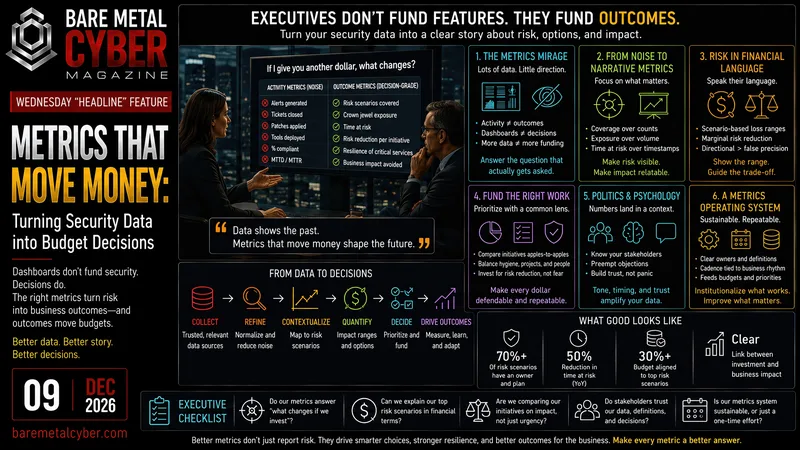
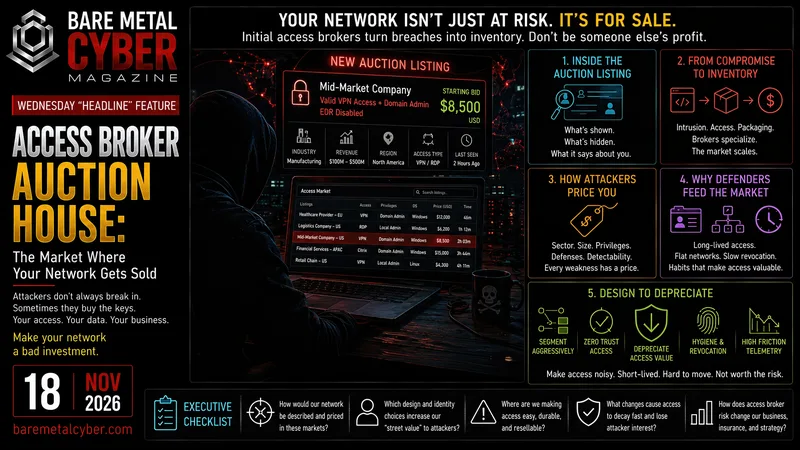
Related Magazine Features
Related Cyber Wiki
802.1X Network Access Control is part of the process used to establish identity, make access decisions, control privileges, or maintain trusted sessions.
ATT&CK Software AnalysisA defensive guide to the Enterprise ATT&CK software record S0677, including identification, dual-use context, behavior analytics, and investigation. The official record summarizes public reporting describing a PowerShell framework used to administer, enumerate, and test Azure Active Directory environments.
ATT&CK Software AnalysisA defensive guide to the Enterprise ATT&CK software record S1000, including identification, dual-use context, behavior analytics, and investigation. The official record summarizes public reporting describing a worm that collects AutoCAD drawings and can expose operational or engineering information.
AI policyAn AI acceptable use policy defines approved, restricted, and prohibited uses of AI services, models, data, accounts, and generated content.
Agentic AIAn AI agent selects actions and invokes tools, services, or workflows to pursue a goal across multiple steps.
AI assuranceAI audit evidence integrity is the ability to show that logs, model artifacts, data extracts, test results, approvals, and screenshots are authentic, complete, attributable, and unchanged.